
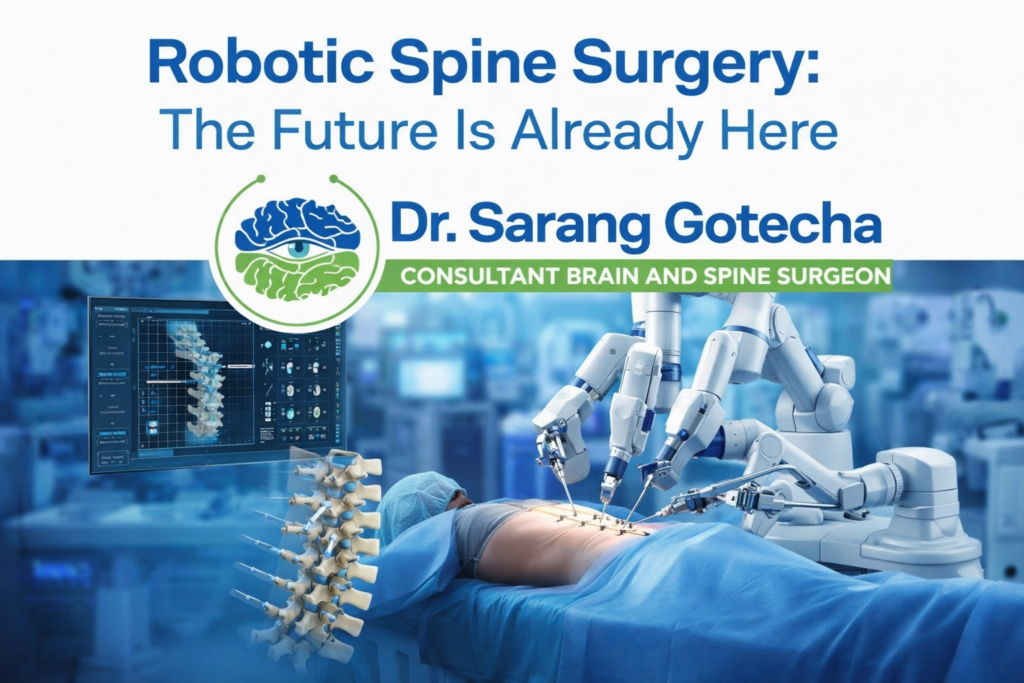
For decades, spinal surgery carried with it an image of lengthy hospital stays, significant blood loss, and months of painful rehabilitation. That image is rapidly becoming obsolete. Today, robotic-assisted spine surgery is rewriting every chapter of that story—delivering millimeter precision, faster recovery, and dramatically improved patient outcomes. As a trusted spine surgeon in PCMC, Dr. Sarang Gotecha is at the forefront of this surgical revolution, bringing world-class robotic spine care to the people of Pimpri-Chinchwad and Pune.
What Is Robotic Spine Surgery?
Robotic spine surgery is not science fiction—it is the current standard of care at leading neurosurgical centers worldwide. In this technique, a surgeon uses a robotic arm system (such as Mazor X, ROSA Spine, or Globus ExcelsiusGPS) guided by real-time 3D imaging and pre-operative CT data to plan and execute spinal procedures with sub-millimeter accuracy.
Crucially, the robot does not operate independently. The surgeon remains entirely in control, using the robotic system as a precision guidance tool. Think of it as the difference between driving a car manually and driving one with advanced GPS and lane assist—the driver’s judgment remains paramount, but technology eliminates the margin for error.
Procedures commonly performed with robotic assistance include pedicle screw placement, spinal fusion, disc replacement, decompression laminectomy, and correction of spinal deformity such as scoliosis.
Why Robotic Precision Matters in Spine Surgery
The spinal column is one of the most complex structures in the human body—housing the spinal cord, nerve roots, and critical blood vessels within a narrow bony corridor. Even a 1–2 mm deviation in screw placement during spinal fusion can mean the difference between a successful outcome and a nerve injury. This is precisely where robotic systems prove their worth.
Studies published in journals including Spine and The Journal of Neurosurgery have consistently demonstrated that robotic-guided pedicle screw placement achieves accuracy rates exceeding 97–99%, compared to 85–92% with conventional freehand techniques. For patients, this translates directly into:
- Significantly reduced risk of nerve or vascular injury
- Lower rates of surgical revision and re-operation
- Reduced intra-operative radiation exposure for both patient and surgical team
- Shorter anaesthesia and operating time
- Faster mobilisation and discharge from hospital
For the growing population of PCMC residents suffering from degenerative spine disease, disc herniations, spinal stenosis, and instability, access to a qualified spine surgeon in PCMC who employs robotic technology represents a transformative step forward in care quality.
Robotic Surgery vs. Traditional Open Spine Surgery: A Clear Comparison
To appreciate the magnitude of this advancement, it is helpful to contrast robotic and conventional approaches across key parameters:
- Incision size: Traditional open surgery requires a 10–15 cm midline incision with extensive muscle retraction. Robotic minimally invasive surgery (MISS) uses multiple small portals of 1–2 cm, causing far less soft-tissue trauma.
- Blood loss: Open procedures can involve 400–1,000 ml of blood loss. Robotic MISS averages under 100 ml, reducing the need for transfusions.
- Hospital stay: Patients undergoing robotic procedures are typically discharged within 1–2 days versus 5–7 days for open surgery.
- Return to activity: Most robotic spine patients resume light activities within 2–3 weeks and full activity within 6–8 weeks, compared to 3–6 months for traditional surgery.
- Screw placement accuracy: Robotic systems achieve 97–99% accuracy versus 85–92% with conventional technique—a critical differentiator in complex multi-level fusions.
Who Is an Ideal Candidate for Robotic Spine Surgery?
Not every spinal condition requires robotic intervention, and patient selection remains the cornerstone of surgical excellence. Robotic-assisted techniques are particularly advantageous for:
- Multi-level lumbar or cervical spinal fusion
- Severe spinal stenosis with neural compression
- Degenerative disc disease unresponsive to conservative management
- Spondylolisthesis (slippage of one vertebra over another)
- Revision spine surgery following a previous failed procedure
- Complex spinal deformity such as scoliosis or kyphosis
- Spinal tumour resection requiring precise pedicle instrumentation
- Obesity or altered anatomy where conventional landmarks are unreliable
Dr. Gotecha’s team offers comprehensive pre-surgical evaluation—including MRI, CT scan, and full neurological assessment—to determine whether minimally invasive spine surgery or robotic-guided intervention is the optimal approach for your specific condition.
The Role of a Skilled Spine Surgeon in PCMC
Technology is only as powerful as the surgeon who wields it. Robotic spine systems augment surgical skill—they do not replace it. A deep understanding of spinal anatomy, neurophysiology, and intra-operative decision-making remains non-negotiable.
Dr. Sarang Gotecha brings over 18 years of surgical experience, an MCh in neurosurgery, and international fellowship training in advanced spine and neuro surgeries. Serving patients across Baner, Wakad, Thergaon, and Pimpri-Chinchwad, he is committed to making tertiary-level spinal care available without patients needing to travel to Mumbai or Delhi.
His expertise spans the full spectrum of spinal conditions—from spinal trauma and fracture fixation to degenerative disorders and complex revision surgeries.
For patients across PCMC and surrounding areas, having a robotic-capable spine surgeon in PCMC means no compromise on cutting-edge care, no unnecessary travel, and no delay in treatment—all critical factors when neurological symptoms are present.
Post-Operative Recovery: What to Expect
One of the most frequently asked questions by patients is: ‘How long will recovery take?’ With robotic minimally invasive spine surgery, the answer is far more encouraging than it once was.
- Day 1–2: Patients typically stand, walk short distances, and begin light physiotherapy within 24 hours of surgery.
- Week 1–3: Most patients are discharged home with oral pain management and a structured physiotherapy program.
- Week 4–8: Progressive return to desk work, driving, and daily activities under physiotherapist guidance.
- Month 3–6: Full fusion consolidation on imaging; clearance for physically demanding activities.
Dr. Gotecha’s practice provides personalized post-operative care, regular follow-up consultations, and rehabilitation coordination to ensure each patient achieves the best possible outcome from their surgery.
Yes. Robotic spine surgery has an exceptional safety profile, with multiple large-scale studies demonstrating reduced complication rates compared to conventional open surgery. The technology provides real-time feedback and prevents the surgeon from inadvertently deviating from the pre-planned trajectory.
Advanced spine surgical care, including minimally invasive and technologically guided techniques, is available through Dr. Sarang Gotecha at his clinics in Baner, Wakad, and Thergaon. To learn more about the full range of spine surgery services offered, visit the services page.
Costs vary depending on the procedure, number of spinal levels, implants used, and hospital facility. Dr. Gotecha’s team provides transparent, itemized cost estimates following a consultation and review of imaging. Many procedures are covered under health insurance and cashless facility schemes.
Absolutely. Dr. Gotecha follows a conservative-first philosophy. Wherever medication, physiotherapy, nerve blocks, or rehabilitation can manage the condition adequately, surgery is deferred. Surgery is recommended only when conservative measures have been exhausted or when neurological compromise necessitates urgent intervention.
Conclusion: The Future of Spine Surgery Is Here—And It Is in PCMC
Robotic spine surgery represents the convergence of precision engineering, advanced imaging, and surgical expertise into a single transformative platform. For patients who have been told that spine surgery is risky, recovery is long, or outcomes are uncertain—robotic technology is fundamentally changing those narratives.
If you or a loved one is experiencing chronic back pain, leg weakness, numbness, or instability that has not responded to conservative care, the time to seek specialist evaluation is now. Early intervention with advanced techniques consistently delivers better long-term outcomes. Consult Dr. Sarang Gotecha—Spine Surgeon at PCMC—at his clinics in Baner, Wakad, Thergaon, or Manipal Hospital, Baner, to discuss whether robotic-assisted or minimally invasive spine surgery is right for you.

Dr. Sarang Gotecha
Dr. Sarang Gotecha is a leading brain & spine surgeon in Pune, offering advanced care for complex neurological and spinal conditions. With strong academic credentials (MBBS, MS, MCh Neurosurgery) and years of surgical experience, he is committed to delivering precise, safe, and patient-focused treatments.
- Expert in brain tumor, spine & neuroendoscopic surgeries
- Specialized in minimally invasive & skull base surgeries
- Follows an ethical and patient-centric approach
- Available at clinics in Baner, Wakad, and Thergaon (Pune)