
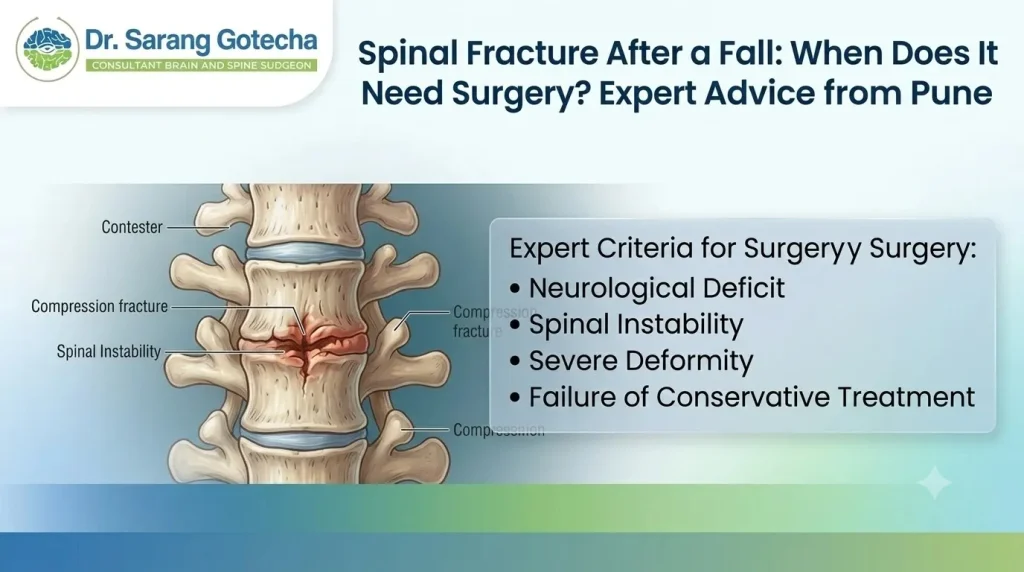
KEY TAKEAWAYS
- Not all spinal fractures need surgery the key determinants are fracture stability, neurological status and the degree of spinal canal compromise.
- The most important question after any fall involving spine pain is: are there neurological symptoms? Leg weakness, numbness or bladder changes change the urgency from days to hours.
- Stable compression fractures (wedge fractures) in neurologically intact patients are managed conservatively with a TLSO brace for 8 to 12 weeks.
- Burst fractures with retropulsed bone fragment compromising the spinal canal, or any fracture with neurological deficit, require urgent surgical evaluation.
- Fracture-dislocation injuries where one vertebra has shifted on another are unstable and require emergency surgical fixation regardless of neurological status.
- Spinal fracture surgery cost in Pune ranges from INR 2,50,000 to INR 5,50,000 for posterior fixation with pedicle screws and rods.
- Dr. Sarang Gotecha manages spinal trauma and fracture fixation for patients across Pune, PCMC, Baner and Wakad.
A fall down the stairs in PCMC. A road accident near Wakad. A heavy fall from a construction scaffold in Chinchwad. These are the common mechanisms behind spinal fractures presenting to Pune emergency departments every day. The spine protects the spinal cord and nerve roots when a vertebra breaks, whether the neurological structures inside are threatened is the question that determines everything about what happens next.
This guide explains spinal fracture classification, the neurological red flags that demand urgent surgery and how experienced neurosurgeons in Pune decide between operative and non-operative management for each fracture pattern.
QUICK FACTS
Most Common Spinal Fracture Level: T12-L1 (thoracolumbar junction) and L1-L2
Stable Compression Fracture Management: Conservative TLSO brace 8 to 12 weeks
Burst Fracture with Neurological Deficit: Urgent surgery within hours
Fracture-Dislocation: Emergency surgery regardless of neurology
Spinal Fracture Fixation Cost Pune 2026: INR 2,50,000 to INR 5,50,000
Neurological Recovery Post-Surgery: Best when surgery within 8 hours of deficit onset
Spinal Fracture Statistics in Pune and India 2025-2026
| Metric | Data Point | Source |
| Annual traumatic spinal fractures in India | ~50,000 to 80,000 (Industry estimate) | Industry estimate |
| Road accidents as cause of spinal fractures | ~40 to 50% | Industry estimate |
| Falls as cause | ~30 to 40% | Industry estimate |
| Proportion requiring surgical fixation | ~30 to 40% | Industry estimate |
| Neurological recovery surgery within 8 hours | Significantly better outcomes | Published literature |
| Spinal fracture fixation cost in Pune | 2,50,000 to 5,50,000 INR | Industry estimate |
| Conservative management success stable fractures | Over 80% satisfactory outcome at 1 year | Industry estimate |
Classifying Spinal Fractures: The Four Types That Matter
1. Compression Fracture (Wedge Fracture)
The anterior (front) column of the vertebra collapses under axial load the vertebra becomes wedge-shaped. The posterior ligamentous complex (the structural ligaments behind the spine) remains intact. These fractures are inherently stable the posterior structures prevent forward translation. Doctors typically treat compression fractures in neurologically intact patients conservatively with a TLSO brace for 8 to 12 weeks. They are particularly common in older adults with osteoporosis after minor falls.
2. Burst Fracture
Both the anterior and posterior vertebral walls fail under axial compression the vertebra literally bursts. Bone fragments are driven in all directions, and the displaced posterior wall fragment can move into the spinal canal (retropulsion), where it may compress the spinal cord or cauda equina. The key determinant of management is canal compromise: over 50% canal compromise or any neurological deficit = surgical evaluation. Experts can sometimes manage neurologically intact burst fractures conservatively when the spinal canal has less than 50% compromise and the posterior ligamentous complex remains intact.
3. Chance Fracture (Flexion-Distraction Injury)
Chance fractures occur when the spine is flexed and distracted simultaneously classically in lap-belt-only motor vehicle accidents where the torso flexes forward over the belt. The fracture goes through the vertebra horizontally, disrupting both bony and ligamentous structures. Chance fractures are associated with intraabdominal injuries (up to 50% have bowel injury in classic lap-belt mechanism). Bony chance fractures can sometimes heal with bracing; ligamentous chance fractures require surgical fixation.
4. Fracture-Dislocation
Fracture-dislocation combines a fracture with translation one vertebra has shifted forward, backward or sideways on the one below. These are the most unstable spinal injuries. All three structural columns of the spine are disrupted. They carry the highest risk of neurological injury and require emergency surgical fixation regardless of the patient’s neurological status even a neurologically intact patient with fracture-dislocation has an unstable spine that will injure the cord with any movement.
Neurological Red Flags After a Spinal Injury
| Red Flag | What It Means | Required Action |
| Weakness in legs after a fall | Cord or cauda equina compression | Emergency neurosurgical evaluation |
| Inability to urinate after spinal injury | Cauda equina syndrome or cord injury | Emergency surgery within hours |
| Numbness from a specific level downward | Spinal cord injury sensory level | Emergency neurosurgical evaluation |
| Pain that dramatically worsens with position change | Unstable fracture | Immobilise do not allow upright activity |
| Neurological deficit worsening over hours | Expanding haematoma or progressive instability | Emergency imaging and surgery |
| Intact neurology in a fall over 3 metres | High-energy mechanis unstable fracture likely | CT and MRI before mobilisation |
Conservative vs Surgical Management: The Decision Framework
The decision between conservative and surgical management of a spinal fracture is based on three factors: fracture stability (will the fracture displace further with normal activity?), neurological status (is the spinal cord or cauda equina compromised?) and patient factors (age, bone quality, comorbidities and ability to comply with brace management).
| Fracture Pattern | Neurological Status | Recommended Management |
| Compression fracture stable | Intact | Conservative TLSO brace 8 to 12 weeks |
| Burst fracture under 50% canal compromise | Intact | Expert assessment possibly conservative |
| Burst fracture over 50% canal compromise | Intact | Surgical fixation (decompression and stabilisation) |
| Burst fracture any | Neurological deficit | Emergency surgery |
| Chance fracture bony | Intact | Possible conservative (hyperextension brace) |
| Chance fracture ligamentous | Intact | Surgical fixation |
| Fracture-dislocation any | Intact or deficit | Emergency surgical fixation |
| Osteoporotic compression fracture | Intact | Vertebroplasty or kyphoplasty, or conservative |
Surgical Fixation of Spinal Fractures in Pune
The standard surgical approach for thoracolumbar fractures in Pune is posterior pedicle screw and rod fixation. Pedicle screws are placed above and below the fracture level typically 2 levels above and 2 below and connected with titanium rods that restore spinal alignment and stability. For fractures with significant canal compromise, anterior decompression (corpectomy removing the damaged vertebral body and replacing it with a cage) provides more complete neural decompression.
Minimally invasive percutaneous pedicle screw fixation is available for neurologically intact fractures using fluoroscopic guidance, screws are placed through small incisions without the open dissection of traditional posterior fixation. This approach reduces blood loss and hospital stay for suitable fracture patterns.
For osteoporotic vertebral compression fractures causing severe pain without neurological deficit, vertebroplasty (cement injection) or kyphoplasty (balloon inflation followed by cement) provides rapid pain relief and vertebral height restoration. These are performed as day procedures in Pune under local anaesthesia and fluoroscopic guidance, costing INR 60,000 to INR 1,50,000.
Spinal Trauma Management in Pune and PCMC
Dr. Sarang Gotecha manages spinal trauma and fracture fixation for patients across Pune, PCMC, Baner and Wakad. His practice covers the full spectrum from conservative management guidance for stable fractures through to emergency posterior fixation and anterior corpectomy for complex unstable fractures with neurological compromise.
For any fall with spine pain particularly if accompanied by any of the neurological red flags described in this guide urgent assessment at a hospital with CT, MRI and neurosurgical capability is essential. Do not allow a patient with possible unstable spinal fracture to sit or stand until imaging has confirmed stability. Book non-emergency consultations Today.
Frequently Asked Question
Q: When does a spinal fracture need surgery after a fall?
A: Doctors recommend surgery for spinal fractures that cause neurological deficits such as leg weakness, bladder changes, or numbness below the injury level. They also perform surgery for burst fractures with more than 50% spinal canal compromise, fracture-dislocation injuries (which are unstable by definition), ligamentous Chance fractures, and cases where conservative treatment fails. Doctors manage neurologically intact, stable compression fractures without surgery by using a TLSO brace.
Q: What are the warning signs of serious spinal injury after a fall?
A: Warning signs requiring emergency evaluation: any weakness in arms or legs after the fall, inability to urinate or loss of bladder control, numbness or tingling from a specific level downward, pain dramatically worsening with position changes and intact neurology after a high-energy fall (over 3 metres) — which carries high fracture instability risk regardless of initial symptom severity.
Q: What is the difference between a compression fracture and a burst fracture?
A: A compression fracture affects only the front column of the vertebra it is wedge-shaped and typically stable. A burst fracture affects both the front and back walls of the vertebra, which fails explosively under axial load. Burst fractures can drive bone fragments into the spinal canal, causing cord or nerve compression. Burst fractures carry a significantly higher risk of neurological injury and more frequently require surgical management.
Q: What is the cost of spinal fracture surgery in Pune in 2026?
A: Posterior pedicle screw and rod fixation for spinal fracture in Pune costs approximately INR 2,50,000 to INR 5,50,000 all-inclusive, depending on the number of levels fixed and whether anterior decompression is also needed. Percutaneous minimally invasive fixation is at the lower end of this range. Vertebroplasty or kyphoplasty for osteoporotic fractures costs INR 60,000 to INR 1,50,000.
Q: How long does recovery take after spinal fracture surgery?
A: After posterior pedicle screw fixation, hospital stay is 4 to 7 days. Physiotherapy starts within 1 to 2 days of surgery. Return to desk work is typically 6 to 8 weeks. Physical labour or heavy lifting is restricted for 3 to 4 months until fusion is confirmed on CT. Neurological recovery depends on the degree of cord or nerve compression before surgery intact patients recover fully; those with deficits show progressive improvement over 6 to 18 months.
Q: Is Dr. Sarang Gotecha available for spinal fracture emergencies in Pune?
A: Yes. Dr. Sarang Gotecha manages spinal trauma including emergency fracture fixation and decompression for patients across Pune and PCMC. For non-emergency spinal fracture consultations, book at drsaranggotecha.com. For acute neurological deterioration after spinal injury, go directly to the nearest emergency department with neurosurgical capability.
Not every spinal fracture after a fall needs surgery but every spinal fracture needs proper assessment. The key decision points are fracture stability, canal compromise and neurological status. Conservative management works for stable fractures in neurologically intact patients. Surgery is urgent for unstable fractures, canal-compromising burst fractures and any fracture associated with neurological deficit.
For spinal fracture assessment, management guidance and fracture fixation surgery across Pune, Baner, Wakad and PCMC, Dr. Sarang Gotecha.

Dr. Sarang Gotecha
Dr. Sarang Gotecha is a leading brain & spine surgeon in Pune, offering advanced care for complex neurological and spinal conditions. With strong academic credentials (MBBS, MS, MCh Neurosurgery) and years of surgical experience, he is committed to delivering precise, safe, and patient-focused treatments.
- Expert in brain tumor, spine & neuroendoscopic surgeries
- Specialized in minimally invasive & skull base surgeries
- Follows an ethical and patient-centric approach
- Available at clinics in Baner, Wakad, and Thergaon (Pune)