
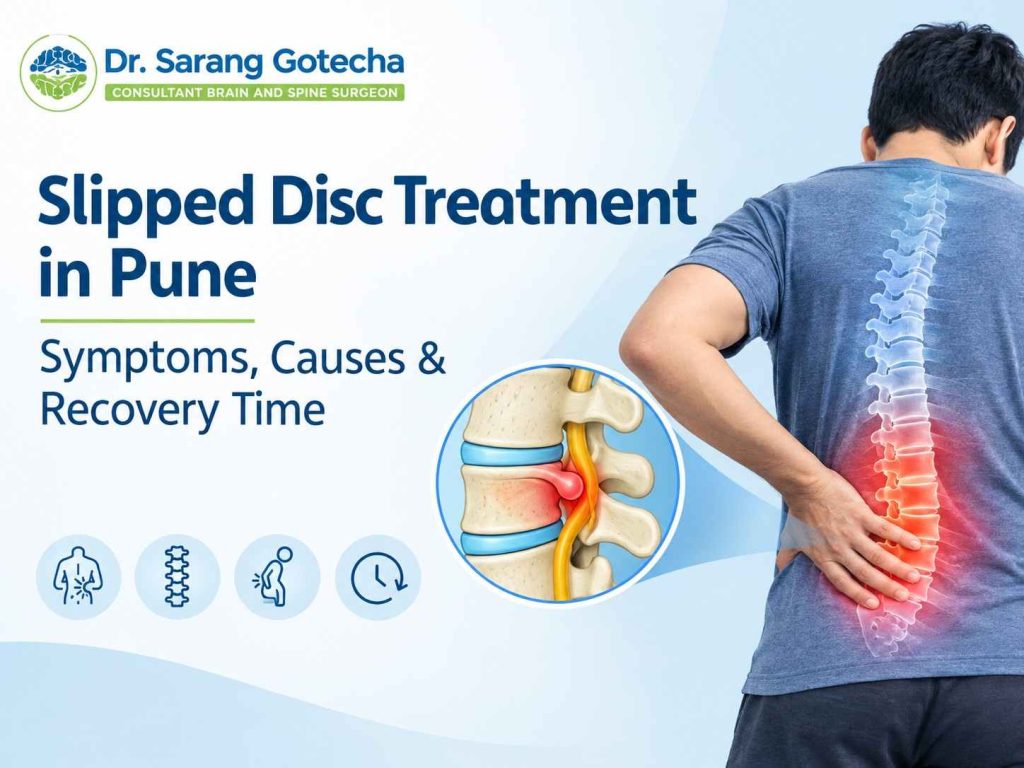
If you have been waking up with a sharp, shooting pain in your lower back or neck, or if you feel a numbing, tingling sensation that travels down your arm or leg, there is a real chance a slipped disc could be the culprit. Slipped disc treatment in Pune has become a lot more accessible and precise over the past few years, largely because of specialists like Dr. Sarang Gotecha — an MCh-qualified neurosurgeon who has dedicated a significant part of his practice to helping people recover from this very condition. Whether you live in Wakad, Baner, or anywhere in western Pune, understanding what a slipped disc is, what causes it, and how it is treated can save you a lot of confusion — and pain.
What Exactly Is a Slipped Disc?
The spine is made up of small bones called vertebrae, and between each pair of vertebrae sits a soft, rubbery cushion called an intervertebral disc. Think of it like a jelly doughnut — a tough outer ring (the annulus fibrosus) with a soft, gel-like centre (the nucleus pulposus). When the outer ring cracks or weakens, that soft inner material can push out or bulge through the gap. That is what people commonly call a slipped disc, though the medical term you are more likely to hear is a herniated or prolapsed disc.
This condition can happen anywhere along the spine — in the neck (cervical region), the middle back (thoracic), or the lower back (lumbar). The lumbar region is by far the most commonly affected, followed by the cervical spine. When the disc material presses against a nearby nerve, it triggers a chain of symptoms that can range from mild discomfort to genuinely debilitating pain.
It is worth clarifying one thing that often confuses patients: a slipped disc does not literally “slip out” of place. The disc itself stays anchored to the vertebrae; it is the inner material that protrudes. The terminology is a bit misleading, which is why so many people are surprised when they see their MRI scans for the first time.
Common Symptoms You Should Not Ignore
Symptoms depend heavily on where the disc herniation is located and whether it is pressing on a nerve. Here is what patients typically report:
Lumbar (Lower Back) Disc Herniation
- Lower back pain that may be dull and constant or sharp and stabbing
- Sciatica — a radiating pain that starts in the lower back and shoots down one leg, sometimes reaching the foot
- Numbness or tingling in the thigh, calf, or foot
- Muscle weakness in the leg — you may notice difficulty lifting your foot (foot drop)
- Pain that worsens when you sit for long periods, cough, or sneeze
Cervical (Neck) Disc Herniation
- Neck pain, often described as a deep ache
- Pain radiating into the shoulder, arm, or hand
- Numbness or weakness in the fingers
- Difficulty performing fine motor tasks — buttoning a shirt, for instance
When to seek immediate care: If you experience loss of bladder or bowel control, weakness in both legs, or sudden loss of sensation in the groin area — go to a hospital right away. These can be signs of a serious condition called cauda equina syndrome, which requires emergency attention.
Patients in Wakad and Baner who visit Dr. Sarang Gotecha’s clinics often describe living with these symptoms for weeks or months before seeking medical help, assuming the pain will resolve on its own. While mild cases sometimes do improve, ignoring progressive symptoms — especially weakness or numbness — is never a good idea.
What Causes a Slipped Disc?
The intervertebral discs are remarkably resilient structures, but they are not indestructible. Several factors can contribute to a disc herniation:
Age-Related Degeneration
As we age, the discs naturally lose water content and become less flexible. This makes them more prone to cracking under pressure. Most cases of disc herniation in Pune patients over 40 have a degenerative component, even if the final episode was triggered by a specific incident.
Poor Posture and Sedentary Lifestyle
This is an increasingly significant factor, particularly in IT professionals, corporate employees, and students who spend 8 to 10 hours a day seated at a desk or hunched over a screen. Poor posture places uneven load on the lumbar spine, accelerating disc wear. With Wakad and Baner housing a large population of working professionals, this is something Dr. Gotecha encounters regularly in his consultations.
Heavy Lifting with Incorrect Technique
Lifting heavy objects while bending at the waist instead of squatting creates a tremendous amount of stress on the lower lumbar discs. A single incident of this kind can be enough to push an already weakened disc over the edge.
Trauma or Injury
A fall, a road accident, or a sports injury can cause sudden disc herniation even in otherwise healthy discs. In these cases, the impact force is simply too great for the outer ring to withstand. Dr. Gotecha’s expertise in spinal trauma and fracture fixation makes him well-placed to manage both the disc injury and any associated spinal instability.
Genetic Factors
Research suggests that some people are genetically predisposed to disc degeneration. If a parent or sibling has had significant disc problems, your own risk is higher, regardless of lifestyle.
Obesity and Pregnancy
Excess body weight increases the compressive load on the lumbar spine. Pregnancy can have a similar effect, combined with ligament laxity caused by hormonal changes.
How Is a Slipped Disc Diagnosed?
Diagnosing a slipped disc requires more than just a description of symptoms. Dr. Sarang Gotecha begins every consultation with a thorough neurological examination assessing reflexes, muscle strength, and sensory function. This clinical assessment alone can often localise the level of the disc herniation.
Imaging studies are then used to confirm the diagnosis and plan treatment:
- MRI (Magnetic Resonance Imaging) — The gold standard. An MRI shows the soft tissues of the spine in detail, clearly revealing which disc has herniated, how much material has protruded, and whether a nerve is being compressed.
- CT Scan — Sometimes used alongside an MRI to assess bony structures.
- X-ray — Does not show the disc directly but can rule out fractures and assess alignment.
- EMG/Nerve Conduction Studies — Used in select cases to assess the degree of nerve damage.
Patients who come to Dr. Gotecha’s Baner or Wakad clinics often bring their own MRI reports. He takes the time to sit with patients and explain exactly what the scan shows a simple but meaningful step that helps patients feel informed about their condition rather than overwhelmed by it.
Slipped Disc Treatment in Pune: Your Options
The good news is that the majority of slipped disc cases studies suggest around 80 to 90 percent can be managed without surgery, at least in the initial stages. Treatment is always matched to the severity of the condition, the patient’s overall health, and how long symptoms have been present.
1. Conservative (Non-Surgical) Management
For most patients, the first line of treatment involves a structured combination of:
- Rest and activity modification — Not complete bed rest, but avoiding the movements that aggravate the disc. Short periods of rest are helpful; prolonged immobility is counterproductive.
- Physiotherapy — A guided physiotherapy programme builds core muscle strength, improves spinal flexibility, and corrects posture. This is often the most impactful long-term intervention.
- Pain medication — NSAIDs (non-steroidal anti-inflammatory drugs), muscle relaxants, and in some cases, nerve pain medications are prescribed to manage symptoms while the natural healing process occurs.
- Epidural steroid injections — For patients with significant nerve pain that has not responded to oral medications, targeted injections can reduce inflammation around the nerve root and provide meaningful relief.
Most patients who follow a dedicated conservative programme notice significant improvement within 6 to 12 weeks. The key word here is “dedicated” — physiotherapy works only if the exercises are done consistently.
A note on self-treatment: Many patients in Pune try to manage disc pain with over-the-counter painkillers and YouTube exercises for months before consulting a specialist. While mild pain can sometimes be self-managed, progressive neurological symptoms worsening weakness, spreading numbness — should always be evaluated by a qualified specialist without delay.
2. Minimally Invasive Spine Surgery
Surgery is recommended when conservative management has not delivered adequate relief after 6 to 8 weeks, or when there is significant neurological compromise — motor weakness, progressive numbness, or bowel/bladder involvement. For eligible patients, minimally invasive spine surgery (MISS) offers an excellent alternative to open surgery.
Dr. Sarang Gotecha completed a dedicated fellowship in Minimally Invasive Spine Surgery at St. Mary’s Hospital, Catholic University of Korea, Seoul one of the most respected training programmes for this subspecialty in Asia. In Pune, very few surgeons hold this specific training.
Minimally invasive procedures for slipped disc include:
- Microdiscectomy — A small incision, an operating microscope, and specialised tools are used to remove the herniated disc fragment compressing the nerve. It is highly effective for lumbar disc herniations causing sciatica.
- Endoscopic discectomy — An even less invasive approach using a small endoscope, resulting in minimal muscle damage and very short hospital stays.
- TLIF / PLIF (spinal fusion) — Recommended in cases where disc degeneration has caused spinal instability, these procedures involve removing the damaged disc and fusing the adjacent vertebrae.
The benefits of MISS over traditional open surgery are meaningful: smaller incisions, significantly less blood loss, shorter hospital stay (often 1 to 2 days), and faster return to normal activities. For patients in Wakad and Baner who need to get back to work or family life quickly, this matters a great deal.
You can learn more about the full range of spine surgery options available at Dr. Gotecha’s practice.
Key Facts About Minimally Invasive Spine Surgery
- Incision size: typically less than 2 cm vs. 5–8 cm for open surgery
- Hospital stay: 1–2 days in most cases
- Blood loss: significantly reduced compared to open procedures
- Return to desk work: often within 2–4 weeks post-surgery
- Success rate for microdiscectomy: above 85–90% for leg pain relief
Recovery Time: What to Realistically Expect
Recovery timelines vary depending on the severity of the herniation, the treatment chosen, and how well a patient follows their rehabilitation plan. Here is a broad overview:
Conservative Management Recovery
Most patients who undergo physiotherapy and medication notice a significant reduction in symptoms within 4 to 6 weeks. Full recovery meaning a return to pre-injury activity levels typically takes 2 to 3 months. Some patients may continue to experience occasional flare-ups, which can usually be managed with targeted physiotherapy and lifestyle modifications.
Post-Surgical Recovery (MISS)
- Week 1–2: Rest at home, gentle walking, wound care. Most patients are off strong pain medication within a week.
- Week 3–6: Physiotherapy begins. Core strengthening exercises, posture correction, and gradual increase in activity.
- 1–3 months: Return to office work and light activities. Driving is usually permitted by 4 to 6 weeks.
- 3–6 months: Full recovery for most patients, including return to physically demanding activities.
Open surgery generally requires a longer recovery typically 3 to 6 months before patients feel fully functional. This is one of the meaningful advantages of the minimally invasive approach that Dr. Gotecha routinely offers.
Preventing a Recurrence
Whether you recover through conservative care or surgery, the lifestyle changes you make afterwards are what determine whether the problem comes back. A few straightforward but important steps:
- Maintain a strong core — the muscles around the lumbar spine are its primary support system.
- Correct your posture at your desk. Invest in an ergonomic chair if you work long hours.
- Learn to lift correctly — bend at the knees, keep the object close to your body, never twist while lifting.
- Maintain a healthy weight to reduce compressive load on the lumbar discs.
- Stay active. A sedentary lifestyle is one of the biggest risk factors for disc degeneration.
Dr. Gotecha’s team will typically give patients a structured exercise and lifestyle guidance plan as part of discharge both from surgical and conservative care programmes.
Why Patients from Wakad and Baner Choose Dr. Sarang Gotecha
For residents of Wakad, Baner, Balewadi, Pashan, and surrounding areas, geography matters — and Dr. Gotecha has made a deliberate effort to be accessible across western Pune. His Wakad clinic at Sonigara Landmark near Chatrapati Chowk Road and his Baner clinic at Shivom Regency are both conveniently located for patients across the Pimpri-Chinchwad corridor.
Surgical procedures are performed at Manipal Hospital, Baner — one of Pune’s most comprehensively equipped neurosurgical facilities, with access to an operating microscope, neuronavigation system, and the full infrastructure that complex spine procedures require.
What patients consistently mention is that Dr. Gotecha does not rush through consultations. He explains the diagnosis, outlines all available options, and helps patients make informed decisions rather than pushing them toward surgery. For a condition like a slipped disc, where most cases can be managed conservatively, that measured approach matters enormously.
Conclusion: Slipped Disc Treatment Pune Make the Right Call
A slipped disc is one of those conditions that tends to escalate slowly and then suddenly. The tingling in your leg that you have been brushing off for three months can, if left unaddressed, turn into motor weakness that disrupts your ability to walk. Getting an accurate diagnosis early, and understanding whether conservative management or surgical intervention is the right path for your specific situation, is the single most important step you can take.
Effective slipped disc treatment in Pune is not just about taking painkillers and hoping things resolve. It involves a properly structured treatment plan whether that is a supervised physiotherapy programme, interventional pain management, or a minimally invasive surgical procedure carried out by a specialist who has the training, technology, and experience to do it well.
Dr. Sarang Gotecha
MBBS · MS (General Surgery)
MCh (Neurosurgery)
Fellowship – Minimally Invasive Spine Surgery
Catholic University of Korea, Seoul
WFNS Fellowship
National Neuroscience Institute, Singapore
12+ Years Experience · 6+ PubMed Publications
Dr. Sarang Gotecha is one of a small number of MCh-qualified neurosurgeons in Pune who holds dual international fellowships specifically in spine surgery. His minimally invasive approach means that patients who do require surgery face smaller incisions, shorter hospital stays, and significantly faster recovery compared to conventional open surgery. For patients who do not need surgery, his conservative management protocols built around evidence-based physiotherapy and targeted interventional care produce excellent outcomes without ever stepping into an operating theatre.
With clinics in Baner and Wakad, and surgical facilities at Manipal Hospital, Dr. Gotecha serves patients across western Pune with a standard of care that is genuinely hard to match locally. If back pain or neck pain is affecting your daily life, do not wait for it to worsen book a consultation and get a clear picture of what is actually going on.
Wakad Clinic: Sonigara Landmark, Near Chatrapati Chowk Rd, Wakad, Pune
Baner Clinic: Shivom Regency, Baner Road, Baner, Pune
Frequently Asked Questions
Can a slipped disc heal on its own without surgery?
Yes — in many cases, a slipped disc improves significantly with conservative management alone. Studies show that 80 to 90% of patients with lumbar disc herniation experience meaningful symptom relief within 6 to 12 weeks through physiotherapy, rest, and medication. However, if symptoms include progressive neurological weakness or bowel/bladder dysfunction, surgical evaluation is needed urgently. Dr. Sarang Gotecha always explores non-surgical options first before recommending any procedure.How long does it take to recover from slipped disc surgery in Pune?
How long does it take to recover from slipped disc surgery in Pune?
Recovery after minimally invasive surgery (such as microdiscectomy) is typically much faster than after traditional open surgery. Most patients are walking within 24 hours of the procedure, discharged within 1 to 2 days, and return to desk work within 2 to 4 weeks. Full physical recovery including return to sport or heavy activity usually takes 3 to 6 months. Open surgery recovery is longer, typically 3 to 6 months for desk work and up to a year for full activity.Is minimally invasive spine surgery safe? What are the risks?
Is minimally invasive spine surgery safe? What are the risks?
Minimally invasive spine surgery is well-established and carries a strong safety profile in experienced hands. The success rate for microdiscectomy in relieving leg pain (sciatica) is above 85 to 90%. Like all surgeries, it carries small risks including infection, nerve injury, or recurrence of disc herniation but these risks are generally lower than with open surgery due to reduced tissue disruption. Dr. Gotecha holds a dedicated international fellowship in MISS, which is precisely the kind of training that makes these procedures safer.I live in Wakad where should I consult Dr. Gotecha?
I live in Wakad where should I consult Dr. Gotecha?
Dr. Sarang Gotecha runs a dedicated consultation clinic in Wakad at Sonigara Landmark, 3rd Floor, Clinic No. 304, near Chatrapati Chowk Road, Wakad, Pune 411057. The clinic is open Monday to Saturday, 9 AM to 9 PM. You can book an appointment by calling +91 93222 88645. For surgical procedures, Dr. Gotecha operates at Manipal Hospital, Baner.What is the difference between a slipped disc and a bulging disc?
What is the difference between a slipped disc and a bulging disc?
A bulging disc involves the outer wall of the disc pushing outward uniformly, often without the inner material breaking through. A slipped (herniated) disc involves the inner gel-like material actually rupturing through a crack in the outer wall. Herniated discs typically cause more acute and intense nerve compression symptoms. However, both conditions are evaluated and treated through the same clinical process MRI, neurological examination, and a structured treatment plan based on severity.Can I continue working a desk job with a slipped disc?
Can I continue working a desk job with a slipped disc?
For many patients, yes with modifications. Ergonomic adjustments to your workstation, regular short breaks to stand and walk, and a disciplined physiotherapy programme can make it possible to continue working through conservative treatment. However, if your symptoms are severe enough to affect concentration or function, short-term medical leave may be recommended. Dr. Gotecha provides practical, patient-centred guidance on this, keeping realistic work and lifestyle factors in mind.Are there any external resources I can read to understand slipped disc better?
Are there any external resources I can read to understand slipped disc better?
Two trusted external resources we recommend: the NIH/NCBI overview of lumbar disc herniation provides a well-referenced clinical summary, and Spine-health.com’s guide to lumbar disc treatment is a readable, evidence-based patient resource. These are useful alongside not as a replacement for a proper consultation with a qualified spine specialist.

Dr. Sarang Gotecha
Dr. Sarang Gotecha is a leading brain & spine surgeon in Pune, offering advanced care for complex neurological and spinal conditions. With strong academic credentials (MBBS, MS, MCh Neurosurgery) and years of surgical experience, he is committed to delivering precise, safe, and patient-focused treatments.
- Expert in brain tumor, spine & neuroendoscopic surgeries
- Specialized in minimally invasive & skull base surgeries
- Follows an ethical and patient-centric approach
- Available at clinics in Baner, Wakad, and Thergaon (Pune)