
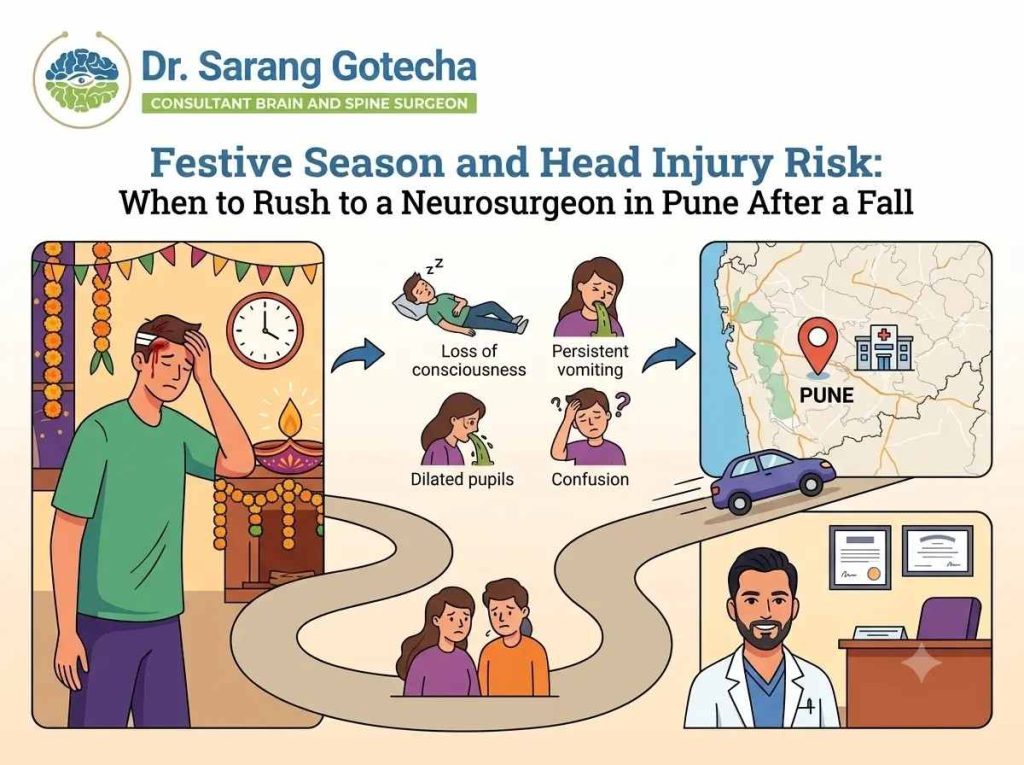
KEY TAKEAWAYS
- Head injury rates in Pune increase 25 to 35% during the festive season Ganesh Chaturthi, Navratri and Diwali due to crowding, late-night activity, fireworks and increased road use.
- Most head injuries after minor bumps are harmless but a small proportion cause intracranial haemorrhage that can be fatal if missed.
- The NICE head injury criteria provide a simple clinical checklist of symptoms that indicate CT brain is needed within 1 hour memorising this list can save a life.
- Adults over 65, patients on blood thinners (warfarin, aspirin, clopidogrel, newer anticoagulants) and children under 2 years require lower thresholds for CT scan after head injury.
- The ‘talk and die’ phenomenon a patient who seems fine immediately after a head injury but deteriorates hours later is caused by expanding epidural haematoma and is the most important reason not to dismiss a head injury that initially seems minor.
- Observation at home for 24 hours by a responsible adult using the head injury observation card instructions is appropriate for low-risk head injuries without NICE criteria features.
- Dr. Sarang Gotecha provides urgent head injury consultation for patients across Pune, PCMC, Baner and Wakad.
Pune’s festive season is among the most vibrant in India. Ganesh Chaturthi fills the streets with processions. Navratri brings late-night Garba celebrations. Diwali creates a citywide atmosphere of fireworks, gatherings and family feasts. In the middle of all this joy, head injuries happen from falls on crowded pavements, road accidents in heavy festive traffic, firework accidents and tumbles from rooftops or stages during celebrations.
Most of these head injuries are minor a bump, a sore head for a day, resolved by morning. But a small proportion cause intracranial bleeds that can be missed, expand over hours and become fatal by the time the family realises something is wrong. This guide gives Pune families the clinical criteria to distinguish between ‘observe at home’ and ‘go to emergency now’.
QUICK FACTS
Festive Season Head Injury Increase in Pune: 25 to 35% above baseline (Industry estimate)
NICE CT Criteria: 8 clinical features — see table below
CT Within 1 Hour Indication: GCS under 13 at any point, focal neurological deficit, open/depressed skull fracture
‘Talk and Die’ Mechanism: Expanding epidural haematoma — lucid interval then rapid deterioration
High-Risk Groups: Age over 65, blood thinners, alcohol, children under 2
Observation Period at Home: 24 hours by a responsible adult for low-risk injuries
Why Festive Season Raises Head Injury Risk in Pune and PCMC
Four festive season factors converge to raise head injury rates in Pune every October and November:
First, crowding. Ganesh visarjan processions draw hundreds of thousands onto streets not designed for foot traffic of that density. Falls on wet, muddy or uneven surfaces decorated but neglected pavements, broken kerbs, construction hoardings are predictably common. Second, night-time activity. Navratri Garba events run until 1 to 3 AM in Pune’s suburban venues. Fatigue-related falls and road accidents peak in the early morning hours after these events.
Third, fireworks. Diwali firework accidents cause burns, eye injuries and head injuries from premature detonation and from falls while lighting rockets on rooftops. Fourth, road accidents. Festive season increases two-wheeler and four-wheeler traffic by 30 to 40% in Pune’s PCMC corridor as families travel for celebrations. The combination of traffic volume, late-night driving and festive distractions elevates road accident rates.
The NICE Head Injury Criteria: Your Emergency Decision Tool
The NICE (UK National Institute for Health and Care Excellence) head injury guidelines provide clinically validated criteria for when CT brain imaging is needed after head injury. These criteria are used by emergency physicians worldwide and provide the best evidence-based guidance for post-injury evaluation. Memorise these or save this guide on your phone.
| NICE Criteria | CT Brain Within 1 Hour Required? | Urgency |
| GCS under 13 on initial assessment | Yes | Emergency — immediate CT |
| GCS under 15 at 2 hours post-injury | Yes | Emergency — within 1 hour |
| Suspected open or depressed skull fracture | Yes | Emergency — immediate CT |
| Any sign of basal skull fracture (Battle’s sign, raccoon eyes, CSF from nose/ear) | Yes | Emergency — immediate CT |
| Post-traumatic seizure (no epilepsy history) | Yes | Urgent — within 1 hour |
| Focal neurological deficit (limb weakness, speech change, vision change) | Yes | Emergency — immediate CT |
| More than one episode of vomiting | Yes | Urgent — within 1 hour |
| Loss of consciousness over 5 minutes | Yes | Urgent — within 1 hour |
| Amnesia for events over 30 minutes before injury | Yes | Urgent — within 1 hour |
| Age over 65 with any LOC or amnesia | Yes | Urgent — lower threshold |
| Dangerous mechanism of injury (RTA, fall over 1 metre) | Yes | Urgent — within 8 hours |
If ANY of the criteria in this table are present after a head injury in Pune, go to the emergency department at a hospital with 24-hour CT scanning and neurosurgical capability. Do not wait to see if it improves. Do not give pain relief and monitor at home. Go now.
The ‘Talk and Die’ Phenomenon: Why ‘Fine at First’ Is Not Reassurance
The most dangerous and most commonly mismanaged pattern in head injury is what neurosurgeons call ‘talk and die’. The patient is hit on the head often a temple blow causing a temporal skull fracture that tears the middle meningeal artery. They are conscious, oriented and coherent immediately after the injury. Family members are reassured. They are driven home. Two to four hours later, the expanding epidural haematoma reaches the critical volume where it herniates the temporal lobe and compresses the brainstem. The patient becomes confused, then unconscious, then dies.
This outcome is entirely preventable. An immediately post-injury CT brain showing the early haematoma leads to emergency craniotomy within the hour and the patient walks out of hospital neurologically intact 7 to 10 days later. The same patient who was ‘talking fine’ two hours ago and was taken home without CT imaging dies in a local clinic later that night.
The take-home message for every Pune family: ‘They seemed fine’ is not reassurance after a significant head injury. The NICE criteria must be applied regardless of how well the patient appears in the first 30 minutes. Temporal skull fractures do not look dramatic. The patient does not necessarily lose consciousness immediately. A significant mechanism a fall, a blow to the side of the head combined with any of the NICE criteria items is enough to mandate CT evaluation.
High-Risk Groups Requiring Lower Threshold in Pune
Adults Over 65 Years
Cerebral atrophy in older adults creates a larger subdural space bridging veins are under greater tension and rupture more easily. Subdural haematomas can develop from surprisingly minor falls in this age group. Any loss of consciousness or amnesia after head injury in an adult over 65, however briefly, requires CT brain. Blood thinners further increase bleeding risk see below.
Patients on Anticoagulants or Antiplatelets
Warfarin, clopidogrel, aspirin, rivaroxaban, apixaban, dabigatran any anticoagulant or antiplatelet medication dramatically increases the risk of intracranial haemorrhage after even minor head trauma. A patient on warfarin who falls and hits their head has perhaps 10 times the baseline risk of developing a clinically significant intracranial bleed. The threshold for CT imaging in anticoagulated patients after any head injury is essentially zero they require evaluation regardless of initial symptom severity.
Alcohol Intoxication
Alcohol is both a risk factor for head injury (impaired coordination, judgment) and a confounder of the clinical assessment. A patient who is drunk after a head injury cannot reliably report their symptoms, cannot accurately describe the mechanism and has altered GCS that may mask neurological deterioration. Do not dismiss confusion or reduced GCS in a drunk head injury patient as ‘just the alcohol’. Evaluate with CT.
What to Do When There Is No NICE Criteria Feature
When a head injury has no NICE criteria features a minor bump with brief pain, no loss of consciousness, no amnesia, no vomiting, no neurological symptoms, in a young adult without anticoagulants the appropriate management is observation at home for 24 hours.
The person observing at home a family member or responsible adult should watch for: increasing headache (especially one that is worsening over the first 4 to 6 hours), increasing confusion or disorientation, vomiting (any episode after the first few hours), seizure, weakness in an arm or leg and difficulty waking the patient when they sleep. If any of these develop during the 24-hour observation period, go to the emergency department with the CT criteria available.
For patients in Pune, Baner, Wakad, Thergaon and PCMC who need urgent head injury assessment or are uncertain whether CT is needed, Dr. Sarang Gotecha provides emergency neurosurgical consultation. Save drsaranggotecha.com before the festive season begins.
Frequently Asked Questions
Q: When should I go to hospital after a head injury during Diwali in Pune?
A: Go to hospital immediately if the injured person has: GCS below 15 at 2 hours post-injury, lost consciousness for more than 5 minutes, had a seizure, has weakness or speech change, has vomited more than once, is over 65 years, is on blood thinners, or has amnesia for more than 30 minutes before the injury. Even without these features, if the mechanism was serious a fall from height, road accident or direct blow to the temporal area CT evaluation is appropriate.
Q: What is the ‘talk and die’ phenomenon in head injury?
A: Talk and die describes the pattern where a patient who appears alert and coherent after a head injury subsequently deteriorates and dies from an expanding epidural haematoma caused by arterial bleeding from a middle meningeal artery tear after temporal skull fracture. The patient is conscious initially because the haematoma takes 1 to 4 hours to expand to a critical volume. Emergency CT and craniotomy within this window is curative. Not imaging a ‘talking’ patient after significant head trauma is the missed opportunity that kills these patients.
Q: What are the NICE head injury criteria and can I use them in Pune?
A: The NICE head injury guidelines provide clinically validated criteria for when CT brain imaging is needed after head injury. The key features requiring urgent CT are: GCS below 15 at 2 hours, any focal neurological deficit, post-traumatic seizure, suspected skull fracture, more than one episode of vomiting and age over 65 with any loss of consciousness. These criteria are evidence-based, internationally validated and apply equally to patients in Pune as anywhere else. Save this list on your phone before the festive season.
Q: Why do blood thinners make head injury more dangerous?
A: Anticoagulants and antiplatelets (warfarin, aspirin, clopidogrel, rivaroxaban, apixaban) impair the blood’s normal clotting ability. After head injury, arterial or venous bleeding within the skull that would normally clot and stop continues unabated allowing haematomas to expand to dangerous volumes from very small initial bleeds. A patient on warfarin can develop a life-threatening intracranial haemorrhage from a head injury that would cause nothing more than a bump in a non-anticoagulated person. Any head injury in an anticoagulated patient warrants emergency CT evaluation.
Q: Is it safe to let someone sleep after a head injury in Pune?
A: Contrary to popular belief, sleep after a minor head injury is generally safe you do not need to keep someone awake all night. However, someone must check on the sleeping person every 2 to 4 hours to confirm they can be roused and are responding normally. If the person cannot be woken, is confused when woken or has developed new neurological symptoms while sleeping, go to hospital immediately. For patients with any NICE criteria features, sleep should not occur until CT evaluation has been completed.
Q: Where should I go for emergency head injury evaluation in Pune and PCMC?
A: Go to the nearest hospital with 24-hour CT scanning and neurosurgical capability. In PCMC and western Pune, multiple hospitals in the Baner-Wakad corridor meet these requirements. Dr. Sarang Gotecha provides emergency neurosurgical consultation for head injury patients across Pune and PCMC. For urgent head injury queries during the festive season, contact information is available.
Pune’s festive season is worth celebrating and celebrating safely. Knowing the NICE criteria, understanding the talk-and-die phenomenon and recognising the high-risk groups (elderly, anticoagulated, alcohol-involved) gives families the tools to make the right call when a head injury happens.
Dr. Sarang Gotecha provides emergency neurosurgical consultation for head injury patients across Pune, Baner, Wakad and PCMC. Save now before you need it during the celebrations.
Medical Disclaimer
This article is for general informational purposes only and does not constitute medical advice. It is not a substitute for professional medical consultation, diagnosis or treatment. Always consult a qualified neurosurgeon for any medical concern. Individual outcomes, costs and recovery timelines vary. Dr. Sarang Gotecha and Edgelink Technology Pvt Ltd accept no liability for decisions made solely based on this content.

Dr. Sarang Gotecha
Dr. Sarang Gotecha is a leading brain & spine surgeon in Pune, offering advanced care for complex neurological and spinal conditions. With strong academic credentials (MBBS, MS, MCh Neurosurgery) and years of surgical experience, he is committed to delivering precise, safe, and patient-focused treatments.
- Expert in brain tumor, spine & neuroendoscopic surgeries
- Specialized in minimally invasive & skull base surgeries
- Follows an ethical and patient-centric approach
- Available at clinics in Baner, Wakad, and Thergaon (Pune)