
Hydrocephalus in adults is often missed because its early signs look like normal ageing. A person starts walking slowly, forgets recent conversations or rushes to the toilet more often, and the family puts it down to age. In many cases the real cause is a build-up of cerebrospinal fluid inside the brain, and this can be treated.
This guide explains what hydrocephalus is, what causes it, which symptoms to watch for, how doctors diagnose it and which treatment options exist. It is written for patients and families in Pune who want clear answers before they meet a neurosurgeon.
What Is Hydrocephalus?
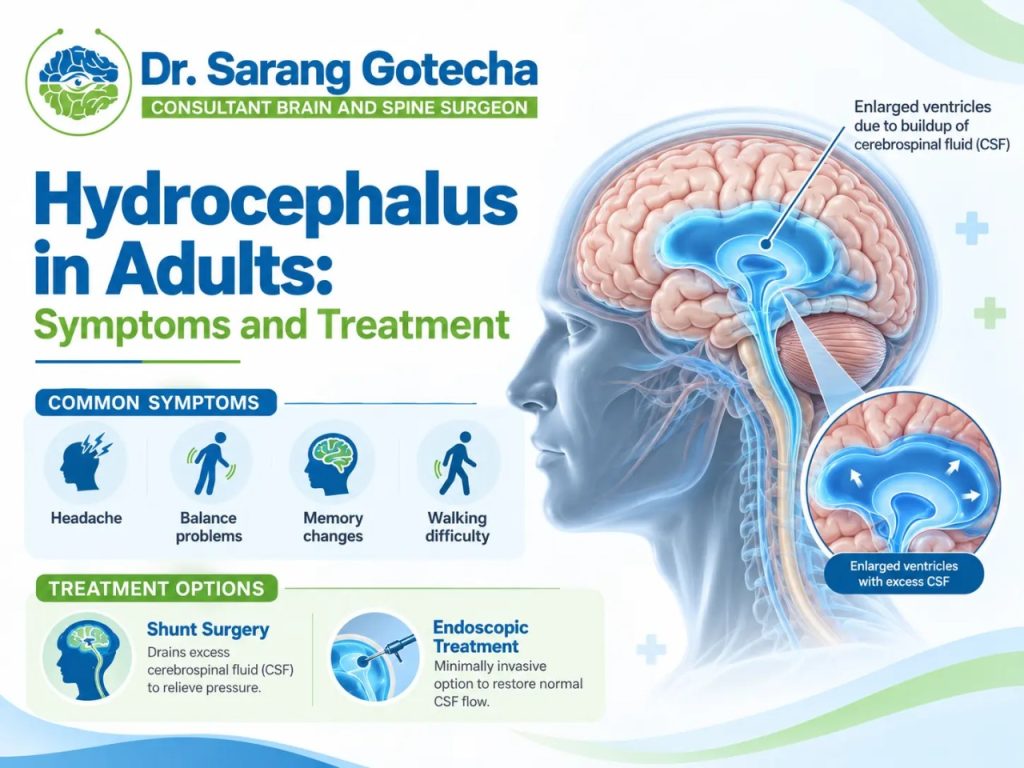
Hydrocephalus is a condition in which cerebrospinal fluid (CSF) collects in the ventricles of the brain faster than the body can drain it. CSF is the clear fluid that cushions the brain and spinal cord. The brain makes it all the time and absorbs it all the time. When the flow is blocked or absorption slows down, the ventricles swell and press on the surrounding brain tissue.
In simple terms, hydrocephalus is a fluid drainage problem inside the head. Many people call it “water on the brain”, although the fluid is CSF and not plain water.
Can Hydrocephalus Occur in Adults?
Yes. Many people link hydrocephalus only with babies, but hydrocephalus can occur in adults at any age. It can develop later in life after a brain injury, infection, bleeding or tumour, or it can appear slowly in older adults without any obvious trigger. Doctors divide adult cases into two broad types:
- Obstructive (non-communicating) hydrocephalus: A blockage stops CSF from moving between the ventricles. A tumour, a cyst or a narrowed aqueduct is a typical cause.
- Communicating hydrocephalus: CSF flows between the ventricles but the brain cannot absorb it properly, often after bleeding or infection.
Normal pressure hydrocephalus (NPH) is a slow form of communicating hydrocephalus seen mostly in older adults.
So, can hydrocephalus develop later in life? It can. A person who never had any problem as a child may develop symptoms in their 60s or 70s, and a head injury or infection can trigger the condition at any age.
What Causes Hydrocephalus in Adults?
The causes of hydrocephalus in adults fall into two groups: known triggers and cases with no clear cause. Common known causes include:
- Brain haemorrhage: Bleeding from a ruptured aneurysm or into the fluid spaces can block CSF absorption.
- Head injury: Trauma can cause bleeding or scarring that disturbs CSF flow.
- Meningitis and other brain infections: Infection leaves inflammation and scar tissue that stop CSF from draining.
- Brain tumours and cysts: A growth near the ventricles can block the fluid pathway.
- Earlier brain surgery or radiation: Scarring afterwards can interfere with CSF circulation.
- Idiopathic NPH: In many older adults doctors find no clear cause.
What Are the Early Symptoms of Hydrocephalus in Adults?
Hydrocephalus symptoms in adults depend on how fast the fluid builds up. A rapid build-up causes sudden and severe signs. A slow build-up causes gradual changes that are easy to miss. The common signs of hydrocephalus in adults include:
- Headache: Often worse in the morning or when lying down.
- Nausea and vomiting: Frequent, with no stomach problem to explain it.
- Blurred or double vision: Pressure affects the nerves that control the eyes.
- Drowsiness or confusion: The person seems less alert than usual.
- Walking difficulty: Slow, shuffling steps and frequent loss of balance.
- Memory and thinking problems: Poor attention, slow thinking and forgetfulness.
- Bladder control problems: A sudden urge to pass urine or leakage.
A sudden severe headache with repeated vomiting, extreme sleepiness or confusion needs emergency care at once.
Can Hydrocephalus Cause Memory Loss in Adults?
Yes. Hydrocephalus can cause memory loss in adults because the enlarged ventricles press on brain areas that handle attention, planning and memory. The person may forget recent events, think more slowly, lose interest in daily activities or struggle to follow a conversation.
These signs resemble dementia, so hydrocephalus is sometimes mistaken for Alzheimer’s disease. The difference matters. Memory loss caused by hydrocephalus may improve when doctors drain the excess fluid, while dementia from other causes does not respond to drainage.
Does Hydrocephalus Cause Balance and Walking Problems?
Yes, and walking trouble is often the first sign. Pressure on the brain pathways that control the legs produces a typical pattern: short shuffling steps, feet that seem stuck to the floor, a wide stance and difficulty turning. Doctors call this a magnetic gait. Falls become more frequent, which makes early diagnosis important for safety. Walking is also the symptom that often improves first after treatment.
What Are Normal Pressure Hydrocephalus Symptoms?
Normal pressure hydrocephalus symptoms follow a classic triad:
- Gait disturbance: A slow, wide-based, shuffling walk.
- Cognitive decline: Forgetfulness, slow thinking and reduced attention.
- Urinary urgency or incontinence: Frequent urges or accidents without warning.
Not every patient shows all three signs at the start. The name also confuses families. In NPH the pressure measured during a lumbar puncture may look normal, but the enlarged ventricles still harm brain function over time.
How Is Hydrocephalus Diagnosed in Adults?
Adult hydrocephalus diagnosis combines a clinical examination with imaging and, when needed, a CSF drainage test. A neurosurgeon usually follows these steps:
- Clinical history and examination: The doctor reviews symptoms, walking pattern, memory and bladder control.
- MRI or CT scan of the brain: Scans show enlarged ventricles and may reveal the cause, such as a tumour or an old bleed. MRI gives more detail.
- CSF tap test: The doctor removes a small amount of CSF through a lumbar puncture and compares walking and thinking before and after. Improvement suggests that surgery may help.
- Extended lumbar drainage: In unclear cases, CSF is drained over a few days in hospital.
- Gait and cognitive assessment: Simple tests record a baseline for comparison after treatment.
What Is the Treatment for Hydrocephalus in Adults?
Hydrocephalus treatment in adults is surgical in most cases. Medicines may ease symptoms for a short time in selected patients, but they do not correct the drainage problem. The two main hydrocephalus treatment options are:
- Ventriculoperitoneal (VP) shunt: A thin tube drains excess CSF from the ventricle to the abdomen, where the body absorbs it. A valve controls the flow. This is a widely used hydrocephalus surgery in adults.
- Endoscopic third ventriculostomy (ETV): The surgeon uses an endoscope to make a small opening in the floor of a ventricle so that CSF finds a new route. No implant stays in the body. ETV suits mainly obstructive hydrocephalus.
Doctors also treat the underlying cause, such as removing a tumour or cyst that blocks the pathway. The treatment of hydrocephalus depends on the type of hydrocephalus, the scan findings, age and general health.
Every option carries risks. A shunt can block, become infected or drain too much fluid, and some patients need a revision operation. ETV may not work for every patient and the opening can close over time. Your surgeon will explain these risks against the expected benefit before you decide.
How Is Normal Pressure Hydrocephalus Treated?
Surgeons treat normal pressure hydrocephalus mainly with a VP shunt, usually after a positive tap test or drainage trial. Most adults with NPH are older, so the surgeon weighs general health before advising surgery.
Results vary. Walking tends to improve first, bladder control next, and thinking changes least predictably. Early treatment gives better results because long-standing pressure can cause lasting damage.
Is Hydrocephalus Treatable in Older Adults?
Yes. Age alone does not rule out surgery. Many older adults with hydrocephalus can be treated after a careful check of the heart, lungs and other conditions. The neurosurgeon discusses benefits and risks, including anaesthesia risk, with the patient and family.
Treatment does not cure every symptom, particularly when the brain has been under pressure for years. It can, however, improve walking and daily function in many patients.
How Long Does It Take to Recover from Hydrocephalus Surgery?
Recovery varies from person to person. These are general guides, and your surgeon will give personal advice:
- Hospital stay: Usually a few days after shunt surgery or ETV, with monitoring and scans.
- Return to routine: Many people resume light activity within a few weeks once the wound heals.
- Symptom improvement: Walking may improve within days to weeks. Memory and bladder control may take longer and may improve only in part.
- Follow-up: Regular checks and scans confirm that the shunt or the new CSF route works. A programmable valve may need adjustment.
Report fever, a worsening headache, repeated vomiting, unusual sleepiness or redness along the shunt tract to your doctor without delay.
What Happens If Hydrocephalus Is Left Untreated?
Untreated hydrocephalus usually gets worse. Rising pressure and enlarged ventricles damage brain tissue. Walking, memory and bladder control decline, falls and injuries become more likely, and acute cases can become life-threatening. Delay also reduces the chance that symptoms will reverse after surgery. A change in walking or memory in an older person deserves a scan rather than a long wait.
Where Can You Get Hydrocephalus Treatment in Pune?
Families looking for hydrocephalus treatment in Pune should choose a hospital with neurosurgery, advanced imaging and neuro-intensive care. When selecting a neurosurgeon in Pune for hydrocephalus, ask about these points:
- Experience: How often the surgeon performs shunt and ETV procedures.
- Facilities: MRI, neuro-ICU and endoscopic equipment.
- Counselling: A clear explanation of benefits, risks and the follow-up plan.
- Follow-up access: Easy availability for shunt checks and valve adjustment.
Hydrocephalus surgery in Pune, including brain surgery for hydrocephalus in Pune, uses shunt and endoscopic techniques performed by trained neurosurgeons. If you are unsure whether symptoms are linked to hydrocephalus, a consultation with a neurosurgeon along with a brain MRI is a sensible first step.
Frequently Asked Questions About Hydrocephalus in Adults
Can hydrocephalus occur in adults?
Yes. It can occur at any age and may be caused by head injury, bleeding, infection, tumours or, in older adults, normal pressure hydrocephalus with no clear cause.
What are the early symptoms of hydrocephalus in adults?
Early signs include headaches, nausea, blurred vision, sleepiness, mild balance problems and slight memory or concentration changes.
How is hydrocephalus diagnosed in adults?
Diagnosis involves a neurological examination, CT or MRI imaging and, where needed, a lumbar puncture tap test or CSF flow studies.
Can hydrocephalus develop later in life?
Yes. It may develop after a head injury, stroke, infection or tumour, or gradually in older age as normal pressure hydrocephalus.
What is the treatment for hydrocephalus in adults?
Treatment is mainly surgical, most often a VP shunt or an endoscopic third ventriculostomy, along with treating any underlying cause.
Can hydrocephalus cause memory loss in adults?
Yes. Slowed thinking, poor attention and memory problems are common, and they may improve after timely treatment.
Does hydrocephalus cause balance and walking problems?
Yes. A shuffling, unsteady walk and frequent falls are among the most typical signs, particularly in normal pressure hydrocephalus.
How long does it take to recover from hydrocephalus surgery?
Hospital stay is usually short, light activity often resumes within weeks, while thinking and memory may take longer to improve.
Is hydrocephalus treatable in older adults?
Yes. Many older adults benefit from surgery when they are carefully assessed and treated early.
Consult a Neurosurgeon for Hydrocephalus
Dr. Sarang Gotecha is a neurosurgeon in Pune who practises at Manipal Hospital, Baner. He has over 12 years of experience and holds MBBS, MS and MCh (Neurosurgery) qualifications. If you or a family member has walking trouble, memory changes or bladder problems that seem to be getting worse, you can book a consultation at any of the locations below.
• Manipal Hospital, Baner: OPD No. 37, Manipal Hospital, Survey No. 111/11/1, Veerbhadra Nagar Rd, Baner-Mahalunge Rd, Baner, Pune, Maharashtra 411045. Get directions
• Wakad clinic: Clinic No. 304, 3rd Floor, Sonigara Landmark, near Chatrapati Chowk Road, Dynasty Society, Vishnu Dev Nagar, Wakad, Pimpri-Chinchwad, Maharashtra 411057. Get directions
• Healing Touch Clinic, Baner: Office Number 501, Shivom Regency, Main Baner Rd, above Jyoti Gas Appliances, Baner, Pune, Maharashtra 411069.
• Thergaon clinic: Greens, Pudumjee Paper Mill Colony, Thergaon, Pimpri-Chinchwad, Maharashtra 411033. Get directions
• BMH Hospital OPD, Baner: No. 2, PMC Garden, BMH Hospital OPD, Pancard Club Rd, Baner Gaon, Maharashtra 411069. Get directions
For appointments at any location, call +91 93222 88645.

Dr. Sarang Gotecha
Dr. Sarang Gotecha is a leading brain & spine surgeon in Pune, offering advanced care for complex neurological and spinal conditions. With strong academic credentials (MBBS, MS, MCh Neurosurgery) and years of surgical experience, he is committed to delivering precise, safe, and patient-focused treatments.
- Expert in brain tumor, spine & neuroendoscopic surgeries
- Specialized in minimally invasive & skull base surgeries
- Follows an ethical and patient-centric approach
- Available at clinics in Baner, Wakad, and Thergaon (Pune)