
Degenerative Disc Disease: Can Age-Related Spine Changes Cause Chronic Pain?
Quick answer Yes, it can, but not always. Degenerative disc disease is the gradual wear of the cushions between your spinal bones. It is a normal part of ageing, and many people with it feel nothing. In others, the changes irritate nerves and spinal joints and lead to chronic back or neck pain. Most people improve with non-surgical care. Surgery is kept for nerve damage or pain that does not settle. |
If your MRI report says “disc degeneration” or “desiccated discs”, the wording probably sounded worse than you expected. Many people leave the scan centre convinced their spine is falling apart. In most cases that is not true, but it is also not something to ignore if the pain keeps coming back.
This guide, reviewed by Dr. Sarang Gotecha, Spine Surgeon, explains what degenerative disc disease is, how ageing changes the spine, when it turns into chronic pain, how it is diagnosed, and which treatments are used. It also covers the benefits and limits of each option, when surgery is considered, and how to prepare for a consultation. It is written for patient education and does not replace an examination.
What Is Degenerative Disc Disease?
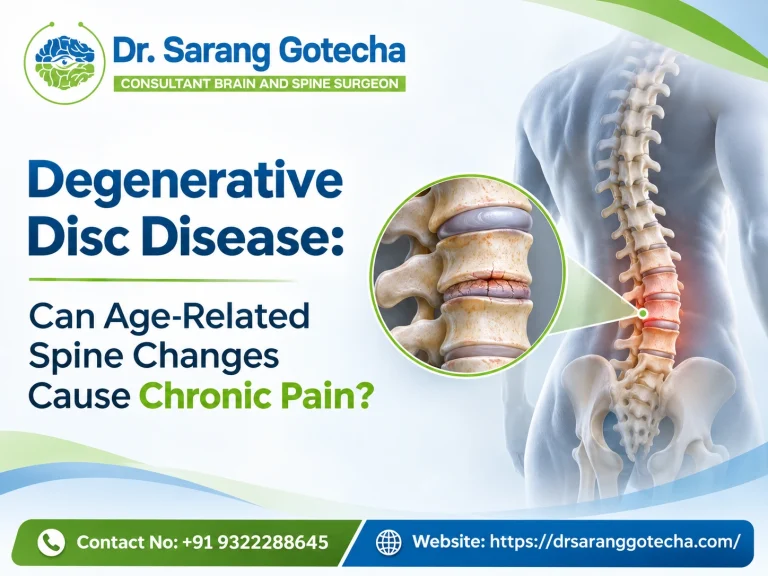
Degenerative disc disease (DDD) is the age-related wear of the intervertebral discs, the cushions that sit between the bones of your spine. Despite the name, it is not a disease in the usual sense. It describes changes that happen to discs over time, and it becomes a medical problem only when those changes cause pain or press on a nerve.
Each disc has a soft, gel-like centre (the nucleus pulposus) and a tougher outer ring (the annulus fibrosus). Together they absorb shock, let the spine bend, and keep enough space open for the nerves leaving the spinal canal. Intervertebral disc degeneration happens when this structure dries out, thins and develops small tears.
DDD can occur anywhere along the spine, but it most often affects the lower back and the neck, which are the most mobile regions. Doctors call these lumbar degenerative disc disease and cervical degenerative disc disease. Cleveland Clinic notes that most disc degeneration is found in the lowest part of the lumbar spine.
How Does Ageing Affect Spinal Discs?
Ageing changes spinal discs in three main ways. Discs lose water, lose height and lose flexibility.
• Water loss. A young disc is plump and well hydrated. With age the centre dries out and absorbs shock less well.
• Height loss. As the disc flattens, the gap between two vertebrae narrows. This can crowd the openings where nerves exit the spine.
• Small tears and bone spurs. The outer ring develops cracks, and the body may grow bony spurs (osteophytes) around the segment to steady it.
Discs also have a limited blood supply, so they repair themselves poorly. That is why wear that starts quietly in your 30s or 40s can add up over the years. This age-related spine degeneration is so common that most people over 60 show some disc changes on imaging, and many of them have no pain at all.
Can Degenerative Disc Disease Cause Chronic Back Pain?
Yes, it can, but the link is not automatic. The amount of wear on a scan does not match the amount of pain a person feels. One person with a badly worn disc on MRI may have no symptoms, while another with mild changes lives with daily pain.
Chronic back pain due to disc degeneration usually comes from one or more of these:
• The worn disc itself becomes a pain source (doctors call this discogenic pain).
• Extra load shifts to the small facet joints at the back of the spine, which become arthritic and inflamed.
• A bulging disc or bone spur presses on a nerve root, causing pain, tingling or weakness in the leg or arm.
• Nearby muscles tighten and tire while guarding the painful segment.
Pain that lasts beyond about three months is generally called chronic. Degenerative disc disease back pain often arrives in flares, with good weeks and bad weeks, rather than as a steady ache. Weak core muscles, long hours of sitting, smoking and stress tend to make those flares last longer.
How Does Disc Degeneration Affect the Rest of the Spine?
A disc does not wear in isolation. As it thins, the joints, ligaments and bones around it take on extra load and respond in their own way.
• Facet joint arthritis. The small joints at the back of each vertebra carry more weight and can become stiff and painful.
• Bone spurs. The body lays down extra bone to stabilise the segment. Cleveland Clinic describes a later stage in which the spine tries to steady itself, which can lead to narrowing of the spinal canal.
• Spinal stenosis. A narrowed canal or nerve opening can squeeze nerves, causing leg heaviness, tingling or pain when walking.
• Disc bulge or herniation. A weakened outer ring can let the inner gel push out and press on a nerve.
This is why two people with the same MRI finding can have very different symptoms. What matters most is whether a nerve is being irritated or compressed.
What Are the Early Signs of Degenerative Disc Disease?
Early degenerative disc disease symptoms are easy to dismiss as a stiff back. Watch for these patterns:
• A dull ache in the lower back that spreads into the buttocks or upper thighs.
• Pain that gets worse with sitting, bending, lifting or twisting.
• Pain that eases when you walk, change position or lie down.
• Morning stiffness that loosens as the day goes on.
• Sharp flare-ups that last a few days to a few weeks and then settle.
Lumbar Degenerative Disc Disease
In the lower back, symptoms include aching across the waist, pain that travels to the buttock or thigh, and stiffness after sitting. If a nerve is involved you may feel pain below the knee (sciatica), numbness in the foot, a weak ankle, or difficulty walking longer distances.
Cervical Degenerative Disc Disease
In the neck, symptoms include stiffness, pain spreading to the shoulder or arm, tingling in the fingers, and headaches that start at the base of the skull. If the spinal cord is being squeezed, you may notice clumsy hands (trouble with buttons or writing) or unsteady walking, which should be assessed promptly. Read more in our guides on cervical disc problems and when to consult a spine surgeon and the warning signs of neck pain.
What About Upper Back Pain?
Pain in the middle or upper back is less often caused by disc wear and has its own list of possible causes. Our guide to thoracic pain symptoms and upper back pain causes explains how doctors tell them apart.
What Causes Degenerative Disc Disease?
Age is the biggest factor, but not the only one. Degenerative disc disease causes include ageing, repeated mechanical stress, injury, genetics and lifestyle habits. Cleveland Clinic lists injuries, obesity, smoking and physically demanding work among the recognised risk factors.
Risk factor | How it affects the discs |
Ageing | Discs gradually lose water and height over decades. |
Smoking | Linked with faster disc degeneration, likely through reduced nutrient supply to the disc. |
Excess body weight | Adds constant load on the lumbar discs. |
Heavy work, repeated bending or twisting | Repeated stress creates tiny tears in the outer ring. |
Long hours of sitting and poor posture | Keeps pressure on the lower discs and weakens supporting muscles. |
Physical inactivity | A 14-year MRI follow-up study (Maurer et al., The Spine Journal, 2020) linked low physical activity with more spinal degeneration. |
Previous spine injury | A fall or accident can start disc wear earlier than expected. |
Family history | Some families show earlier or faster disc changes. |
Does Degenerative Disc Disease Get Worse With Age?
The disc changes usually progress slowly over the years, but pain does not always follow the same path. In many people symptoms level off, and some even improve as the affected segment stiffens and becomes more stable.
Degenerative disc disease in older adults often looks different from the picture in a 35-year-old. Older adults are more likely to have bone spurs, arthritic facet joints and a narrowed spinal canal (spinal stenosis) alongside thin discs. This can bring leg heaviness or pain while walking, and a need to sit down after a short distance.
What you do still matters at every age. Staying active, keeping your weight in a healthy range and not smoking all reduce the load on your discs. A sudden change, such as new leg weakness, balance problems or numbness, is not routine ageing and should be checked by a doctor.
What Is the Difference Between Degenerative Disc Disease and Slipped Disc?
The two terms are often mixed up, and they can occur together. In simple terms, the difference between degenerative disc disease and slipped disc comes down to how the problem develops and what it does to the nerve.
Feature | Degenerative disc disease | Slipped (herniated) disc |
What it is | Gradual wear and thinning of the disc | The inner gel pushes through a tear in the outer ring |
How it starts | Slowly, over years | Can be sudden after a lift or twist, or build on an already worn disc |
Typical pain | Aching back or neck pain, stiffness, flares | Sharp pain travelling down the leg or arm, tingling, numbness |
Nerve involvement | Sometimes | Common |
Relationship | Often the underlying cause | Often a complication of degeneration |
A herniated disc usually forms on a disc that has already started to degenerate, so a person can have both. The label matters less than whether a nerve is being compressed, because that is what shapes the treatment plan.
How Is Degenerative Disc Disease Diagnosed?
Diagnosis starts with listening. A spine specialist will ask where the pain is, what makes it better or worse, and whether you have any tingling, weakness, or bladder and bowel changes. After that, the usual steps are:
• Physical and neurological examination. Posture, spine movement, reflexes, muscle strength, sensation, and tests such as the straight leg raise.
• X-ray. Shows reduced disc space, bone spurs and spinal alignment.
• MRI scan. The most useful test for disc hydration, bulges, and pressure on nerves or the spinal cord.
• CT scan or nerve studies. Used in selected cases when the MRI is unclear or nerve function needs checking.
One important point: scans must be read together with symptoms. Many people have degenerative changes on MRI without any pain, so a good specialist treats the person and not just the report. A frightening-sounding report does not on its own mean you need surgery.
What Is the Best Treatment for Degenerative Disc Disease?
The best treatment for degenerative disc disease is a stepwise plan that starts without surgery and is matched to your symptoms. There is no single answer for everyone. Most people improve with conservative care, and Degenerative Disc Disease treatment usually moves through three steps.
Step 1: Non-surgical care
• Physiotherapy to strengthen the core and back or neck muscles, improve flexibility and correct posture.
• Medication such as pain relievers, anti-inflammatory medicines, muscle relaxants or nerve-pain medicines, taken only as prescribed.
• Heat or cold packs and short-term activity changes. Prolonged bed rest is not helpful.
• Lifestyle changes: weight management, quitting smoking, a better desk setup and regular breaks from sitting.
Step 2: Targeted procedures
For pain that does not respond to the first step, image-guided injections can help. An epidural steroid injection calms an irritated nerve root, and facet or medial branch blocks target joint pain. These are best seen as a window of relief that lets you complete rehabilitation, not as a permanent fix.
Step 3: Surgery
Surgery is reserved for specific situations, explained in the section on when Degenerative Disc Disease requires surgery below.
Can Degenerative Disc Disease Be Reversed?
A worn disc cannot be restored to its youthful state, but the pain can often be reversed and further wear can be slowed. To be direct: no exercise, supplement, device or injection has been proven to regrow a disc that has lost its height. Be careful with any clinic or product promising “disc regeneration”.
What can change is how you feel and function. Stronger muscles, a healthier weight, no smoking and regular movement reduce the strain on worn discs. Many people return to normal work and exercise even though their repeat MRI looks much the same.
Can Walking Help With Degenerative Disc Disease?
Yes. Walking is one of the safest and most useful activities for most people with degenerative disc disease. It keeps the spine moving, gently builds postural muscles and helps with weight control, without the impact of running.
• Start with 10 to 15 minutes on flat ground once or twice a day, then build up slowly.
• Wear cushioned, supportive footwear and walk tall instead of leaning forward.
• Add swimming, cycling, yoga or gentle stretching if you enjoy them.
• During a flare, avoid heavy lifting, deep forward bends and high-impact exercise until your doctor advises otherwise.
One caution. If walking brings on leg pain, heaviness or numbness that eases when you sit down, tell your doctor. It can point to a narrowed spinal canal, which needs its own assessment.
When Does Degenerative Disc Disease Require Surgery?
Most people with degenerative disc disease never need surgery. It is considered when a damaged disc is pressing on a nerve or the spinal cord and one or more of these apply:
• Weakness in a leg, foot, arm or hand is getting worse.
• Numbness is spreading or increasing.
• Severe arm or leg pain has not settled after a proper trial of non-surgical care, usually several weeks to a few months.
• Pain keeps you from working, sleeping or walking despite treatment.
• Scans show significant compression that matches your symptoms.
Seek urgent care the same day if you notice Loss of control over urine or stools, numbness in the groin or inner thigh area, sudden severe leg weakness, or (with neck problems) rapidly worsening hand clumsiness and balance trouble. These can signal serious nerve or spinal cord compression. |
Depending on your scans and examination, surgical options include removing the part of a disc that presses on a nerve (discectomy), widening the space around the nerve (decompression), spinal fusion to stabilise an unstable level, and in carefully selected patients, artificial disc replacement. Each has benefits and limits. Surgery relieves nerve compression or instability, but it does not make the rest of your spine younger, and recovery needs a structured rehabilitation plan. Your surgeon should explain these trade-offs before recommending anything.
Degenerative Disc Disease Treatment in Pune: Who Treats It and Where?
Degenerative disc disease treatment in Pune involves a team rather than a single doctor. Physiotherapists lead exercise-based rehabilitation, physicians and pain specialists manage medicines and injections, and a spine specialist in Pune, usually an orthopaedic spine surgeon or a neurosurgeon, assesses nerve compression and advises whether surgery is a reasonable option.
Chronic back pain treatment in Pune normally starts with a clinical assessment and a review of any scans you already have. Lumbar disc treatment in Pune follows the same stepwise order described above: non-surgical care first, with procedures or surgery considered only when symptoms and findings point that way. A spine surgeon in Pune is usually consulted when:
• pain travels down an arm or leg,
• there is numbness, tingling or weakness,
• symptoms have lasted more than six weeks despite treatment, or
• an MRI shows pressure on a nerve or the spinal cord.
Practice Information
Dr. Sarang Gotecha, Spine Surgeon in Pune, is a neurosurgeon (MBBS, MS, MCh Neurosurgery) whose practice includes complex spine surgeries among other neurosurgical conditions. He consults at the locations listed below. Residents of Pimpri-Chinchwad looking for spine treatment in PCMC will find the Thergaon clinic in the list, and the table also notes the Wakad and Baner locations for those searching for a spine surgeon in Wakad or a spine specialist in Baner.
Location | Area | Useful for |
Manipal Hospital, Baner (OPD 37) | Baner, Pune | Spine specialist in Baner |
Healing Touch Clinic | Baner, Pune | |
BMH Hospital OPD | Baner, Pune | |
Wakad clinic | Wakad, Pune | |
Thergaon clinic | Thergaon, PCMC |
Appointment days and timings can be confirmed with the clinic on +91 93222 88645.
Frequently Asked Questions About Degenerative Disc Disease
Is degenerative disc disease serious?
Usually not. It is a common, age-related change, and most people manage it without surgery. It becomes serious when it causes progressive weakness, loss of bladder or bowel control, or spinal cord compression, which need prompt medical attention.
Can degenerative disc disease cause sciatica?
Yes. When a degenerated disc or bone spur presses on a lower back nerve root, pain can travel from the buttock down the leg, often with tingling or numbness. This is known as sciatica.
Which doctor should I see for degenerative disc disease?
For mild pain, a physiotherapist or physician is a reasonable start. If you have nerve symptoms, long-lasting pain or MRI findings of nerve compression, an orthopaedic spine surgeon or a neurosurgeon who treats spine conditions can assess you.
Is bed rest good for disc pain?
No. A day or two of lighter activity is fine, but long bed rest weakens muscles and can prolong recovery. Gentle movement such as walking usually helps more.
Can young people get degenerative disc disease?
Yes, though it is less common. Disc wear can start in the 20s or 30s after an injury, heavy strain, long sedentary hours or because of family history. Many young people have changes on MRI without symptoms.
Does a degenerative disc on MRI mean I need surgery?
No. Scan findings alone do not decide treatment. The decision depends on your symptoms, examination, and whether a nerve is being compressed.
How long does a flare-up last?
It varies. Flares of degenerative disc pain can last from a few days to a few weeks. Mayo Clinic notes that most back pain improves within six to eight weeks. Pain that is not settling, or that comes with weakness or numbness, deserves an examination.
Is it safe to exercise with disc degeneration?
For most people, yes, and it is usually encouraged. Start gently, ideally with guidance from a physiotherapist. Stop and seek advice if an exercise causes sharp pain, new numbness or weakness.
Key Takeaways
• Degenerative disc disease is age-related disc wear. It is common, and many people have it without pain.
• It can cause chronic back or neck pain, usually in flares, but the amount of wear on a scan does not predict the amount of pain.
• Most people improve with physiotherapy, medicines, activity and lifestyle changes. Surgery is needed only in selected cases.
• A worn disc cannot be regrown, but pain and function can improve.
• Weakness, spreading numbness, loss of bladder or bowel control, or fever with back pain need prompt medical attention.
• Scan reports should be read with your symptoms and examination, and a second opinion before surgery is reasonable.

Dr. Sarang Gotecha
Dr. Sarang Gotecha is a leading brain & spine surgeon in Pune, offering advanced care for complex neurological and spinal conditions. With strong academic credentials (MBBS, MS, MCh Neurosurgery) and years of surgical experience, he is committed to delivering precise, safe, and patient-focused treatments.
- Expert in brain tumor, spine & neuroendoscopic surgeries
- Specialized in minimally invasive & skull base surgeries
- Follows an ethical and patient-centric approach
- Available at clinics in Baner, Wakad, and Thergaon (Pune)
- Dr. Sarang Gotecha
- Dr. Sarang Gotecha
- Dr. Sarang Gotecha
- Dr. Sarang Gotecha