
Table of contents
- What Are Brain Tumors in Children?
- At What Age Can Children Develop Brain Tumors?
- What Are the Early Symptoms of Brain Tumors in Children?
- When Should Parents Worry About Headaches in Children?
- Can Vomiting Be an Early Symptom of a Brain Tumor?
- What Are the Types of Brain Tumors in Children?
- Are All Childhood Brain Tumors Cancerous?
- What Causes Brain Tumors in Young Children?
- How Is a Brain Tumor Diagnosed in a Child?
- Which Doctor Treats Brain Tumors in Children?
- How Are Brain Tumors in Children Treated?
- How Is Brain Tumor Surgery Performed in Children?
- What Happens After a Child Is Diagnosed With a Brain Tumor?
- Where Can Parents Find Brain Tumor Treatment in Pune?
- Frequently Asked Questions About Brain Tumors in Children
Brain tumors in children form when abnormal cells grow inside the skull and press on healthy brain tissue. Parents usually notice brain tumor symptoms in children as headaches, repeated vomiting, unsteady walking or a change in behavior. These signs overlap with far more common childhood illnesses, which is why a pediatric brain tumor can go unrecognized for weeks.
This guide explains the early signs of brain tumor in children, the main types and causes, how doctors reach a diagnosis with an MRI and which treatment options exist. It also covers the specialists who treat the condition and what families in Pune can check when they look for care.
Key takeaway:
- Most children with headaches or vomiting do not have a tumor.
- A cluster of symptoms that lasts, worsens or wakes a child from sleep needs a doctor’s evaluation and usually an MRI.
What Are Brain Tumors in Children?
A brain tumor is a mass of abnormal cells that grows in or around the brain. A pediatric brain tumor differs from an adult tumor in type, location and behavior. Childhood tumors form more often in the posterior fossa, the lower back part of the skull that holds the cerebellum and the brainstem. Adult tumors form more often in the upper parts of the brain.
Doctors classify each tumor by its exact site, the tissue it comes from and whether it is cancerous. Childhood brain cancer is the everyday term for the malignant tumors in this group. Brain and spinal cord tumors rank as the second most common cancer in children after leukemia and make up roughly one in five childhood cancers (Industry estimate).
Key takeaway: Brain tumors in children usually grow in the lower brain, so symptoms often involve balance, vomiting and fluid pressure rather than thinking or memory alone.
At What Age Can Children Develop Brain Tumors?
Brain tumors in children can occur at any age, including in newborns. Each tumor type favors a different age group:
• Medulloblastoma: the most common cancerous brain tumor in children, and most cases appear before age 10.
• Brainstem glioma: occurs almost only in children, at an average age of about 6 years.
• Craniopharyngioma: rare before age 2 and most often diagnosed between ages 5 and 14.
What Are the Early Symptoms of Brain Tumors in Children?
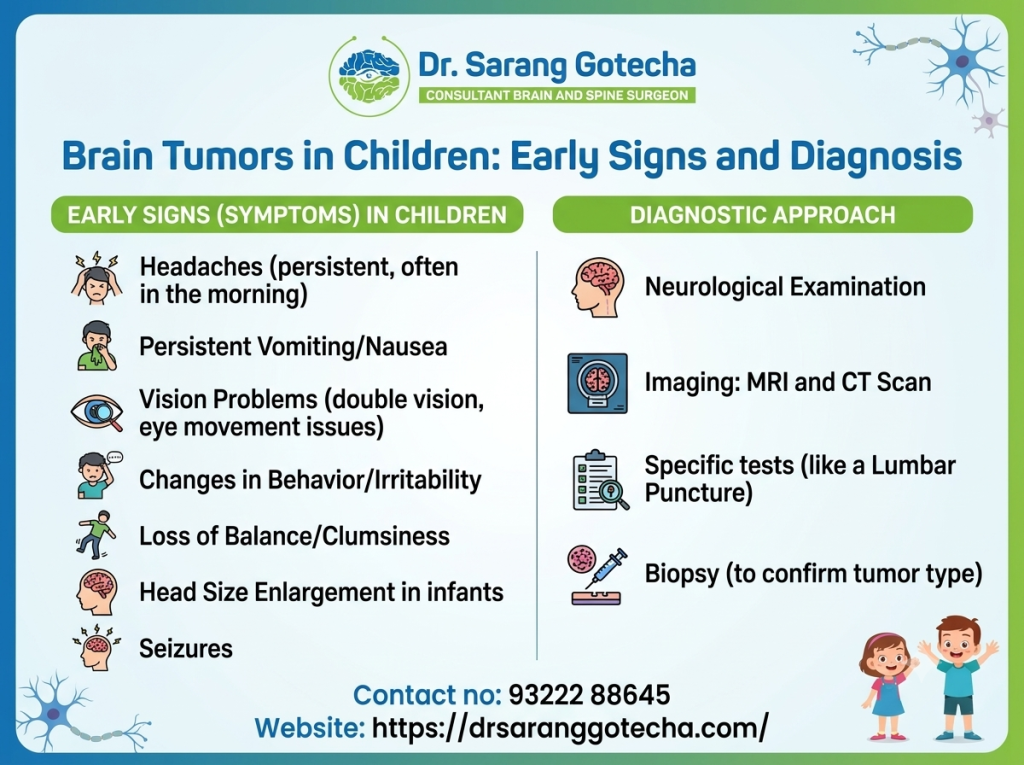
The early signs of brain tumor in children depend on the child’s age and on where the tumor sits. Symptoms may build slowly or appear suddenly, such as with a seizure. Childhood brain tumor symptoms mostly come from rising pressure inside the skull or from damage to the area that controls a specific function.
These brain tumor warning signs in kids deserve attention:
• Headache: often worse in the early morning or after lying down, and it tends to grow worse over weeks.
• Vomiting: repeated or forceful vomiting without a stomach infection to explain it.
• Balance and walking problems: stumbling, clumsiness, a new unsteady walk or a persistent head tilt.
• Vision changes: blurred or double vision, a squint, crossed eyes or unusual eye movements.
• Seizures: sometimes the first symptom, although most seizures in children do not come from a tumor.
• Behavior and learning changes: irritability, constant tiredness, falling school performance or a change in personality.
• Speech and strength changes: slurred speech, weakness or numbness in one arm or leg.
A systematic review of 74 papers covering 4,171 children found that headache (33%) and nausea with vomiting (32%) were the most frequent symptoms at diagnosis, followed by gait and coordination problems (27%). For tumors in the posterior fossa, vomiting (75%), headache (67%) and abnormal gait (60%) appeared more often.
Symptoms in infants and toddlers
Young children cannot describe a headache, so parents see other changes. These include irritability, poor feeding, trouble swallowing, weight loss, delayed milestones and loss of skills the child already had. The head may grow larger than expected, and the soft spots on the skull (fontanelles) may bulge.
Symptoms in school-aged children and teenagers
Older children can report headaches, double vision and nausea. Teachers and parents often notice poor concentration, fatigue, declining marks and mood changes before the child names any physical complaint.
How to Identify Brain Tumors in Children at Home?
Parents cannot diagnose a tumor at home, but they can record patterns that help the doctor. Useful steps include:
• Keep a symptom diary: note the time of each headache or vomiting episode and whether it follows waking or sleep.
• Record short videos: capture the child’s walking, eye movements and handwriting changes.
• Track behavior and school changes: write down new tiredness, mood shifts or drops in performance with dates.
• Bring the notes to the visit: a dated record helps the doctor decide how urgent the evaluation is.
Key takeaway: One symptom rarely points to brain tumors in children. Several symptoms together, especially headache with vomiting and a change in walking or vision, call for prompt medical review.
When Should Parents Worry About Headaches in Children?
Headache is a common complaint in children, and migraine, tension headache, eye strain and routine infections cause most of them. Only very rarely does a headache signal brain tumors in children. A headache becomes more concerning when it matches any of these patterns:
• Duration: it continues or returns often for longer than 4 weeks.
• Timing: it wakes the child from sleep or feels worst on waking.
• Companions: it comes with vomiting, confusion, drowsiness or a change in behavior.
• Neurological signs: it appears together with clumsy walking, double vision, a head tilt or weakness.
• Trend: it grows steadily stronger or more frequent over time.
Are Frequent Headaches a Sign of Brain Tumors in Children?
Frequent headaches alone seldom point to a brain tumor. Headache becomes a warning sign when it is new, progressive and paired with vomiting, balance trouble or vision change. A doctor can sort migraine and tension headache from a pressure-related headache through history and examination.
Can Vomiting Be an Early Symptom of a Brain Tumor?
Yes. Vomiting is one of the most common early symptoms of brain tumors in children, particularly with tumors in the posterior fossa. Rising pressure irritates the vomiting center of the brain, so a child may vomit repeatedly, often in the morning, with no fever or diarrhea. Vomiting may ease the headache for a short time, but it does not remove the cause.
Vomiting from a stomach infection usually settles within days. Vomiting that keeps returning for weeks, or that comes with headache, drowsiness or walking problems, needs a doctor’s review.
What Are the Types of Brain Tumors in Children?
The types of brain tumors in children differ from adult types. Doctors name a tumor after the cell it comes from. The main types are:
• Pilocytic astrocytoma: a slow-growing, low-grade glioma that often forms in the cerebellum.
• Medulloblastoma: a fast-growing cancerous tumor of the cerebellum and the most common childhood brain cancer.
• Ependymoma: a tumor of the cells that line the fluid spaces of the brain and spinal canal, which can be benign or malignant.
• Brainstem glioma: a tumor in the brainstem that surgeons often cannot remove because of its deep location.
• Craniopharyngioma: a usually low-grade tumor near the pituitary gland that can affect vision, growth and hormones. Surgeons sometimes use transnasal endoscopic surgery to reach it.
• High-grade glioma and germ cell tumors: less common types that need specialized, multi-step treatment.
Are All Childhood Brain Tumors Cancerous?
No. Brain tumors in children can be benign (non-cancerous) or malignant (cancerous). Pathologists assign a grade from 1 to 4. Low-grade tumors grow slowly, while high-grade tumors grow fast and can spread. Pilocytic astrocytoma is grade 1 and medulloblastoma is grade 4 by definition.
A benign tumor can still cause serious problems. The skull has a fixed space, so a growing mass raises pressure and can block the flow of cerebrospinal fluid, a condition called hydrocephalus. Doctors therefore treat benign tumors that cause symptoms.
What Causes Brain Tumors in Young Children?
The causes of brain tumors in children remain unknown in most cases. Most brain tumors in children arise without any known risk factor, and nothing a parent did or did not do causes them. Researchers have identified these contributors:
• Gene changes: mutations acquired early in life, sometimes before birth, change how brain cells grow.
• Inherited syndromes: neurofibromatosis type 1 is the most common syndrome linked to childhood brain tumors. Neurofibromatosis type 2, tuberous sclerosis, Li-Fraumeni syndrome and von Hippel-Lindau disease also raise the risk. Together these syndromes account for fewer than 5% of cases.(ACCO).
• Radiation to the head: the only well-established environmental risk factor, most often from earlier radiotherapy for another cancer.
Studies have found no link between childhood brain tumors and cell phone use, power lines or specific foods. Lifestyle factors that matter for adult cancers play no major known role in childhood tumors.
Key takeaway: Parents did not cause a childhood brain tumor, and no known step prevents one.
How Is a Brain Tumor Diagnosed in a Child?
Brain tumor diagnosis in children moves through three stages: a clinical examination, imaging and tissue confirmation. The doctor first listens to the symptom history and examines the child. Imaging then shows whether a mass exists and where. A pathologist confirms the tumor type from a tissue sample, which completes the childhood brain tumor diagnosis.
What Tests Are Required to Diagnose a Brain Tumor?
• Neurological examination: checks eye movements, vision, balance, reflexes and strength. In infants it includes head size and the fontanelle. An eye examination looks for swelling of the optic nerve.
• MRI of the brain: the main test for brain tumor detection in children, usually with contrast dye.
• MRI of the spine: added for tumors that can spread along the spinal fluid, such as medulloblastoma.
• CT scan: used in emergencies because it is fast, although MRI shows far more detail.
• Biopsy or surgical sample: a pathologist studies the tissue, including gene tests, to confirm the type and grade.
• Blood and spinal fluid tests: used for selected tumors, such as germ cell tumors, to look for tumor markers.
Can an MRI Detect Brain Tumors in Children?
Yes. A brain tumor MRI scan in children is the standard test for detection. MRI uses magnets and radio waves instead of X-rays. It shows tumor size, position and the relationship to nearby structures, and it images the brainstem and posterior fossa in more detail than CT. An MRI shows that a mass exists and suggests its type, while a tissue sample confirms it.
Is a Brain MRI Safe for Children?
Yes. MRI involves no radiation. Children under about 6 or 7 years, or those who cannot lie still, often need sedation or short general anesthesia, and a pediatric anesthesiologist monitors them throughout. Gadolinium contrast is given in a weight-based dose. A study of 125 children aged 2 years and under found a macrocyclic contrast agent safe and well tolerated at the standard dose. Doctors use contrast only when the scan question needs it.
Key takeaway: An MRI is the first and most useful test when a doctor suspects brain tumors in children. It carries no radiation, and sedation makes it possible for young children.
Which Doctor Treats Brain Tumors in Children?
Care for brain tumors in children is a team effort. A brain surgeon is the everyday term for a neurosurgeon, and the neurosurgeon leads the surgical part of care. The core team includes:
• Neurosurgeon or pediatric neurosurgeon: evaluates the tumor, plans and performs surgery, and treats hydrocephalus.
• Pediatric oncologist: directs chemotherapy and overall cancer care.
• Radiation oncologist: plans radiotherapy, including proton therapy where it is available.
• Neuroradiologist and neuropathologist: read the scans and the tissue.
• Anesthesiologist, endocrinologist, physiotherapist and psychologist: support surgery, hormone health, recovery and emotional well-being.
Parents who are unsure whether to start with a neurologist or a neurosurgeon can read a guide on neurologist versus neurosurgeon roles.
How to choose a specialist in Pune
Families in Pune often search for a brain tumor specialist in Pune, a pediatric neurosurgeon in Pune, a neurosurgeon in Pune or a brain surgeon in Pune. Families in the western part of the city may also look for a neurosurgeon in Baner. Parents who type brain surgeon near me during an emergency can look past distance and check these points:
• Pediatric support: the hospital offers pediatric anesthesia and pediatric intensive care alongside neurosurgery.
• Diagnostic facilities: MRI with sedation, neuropathology and pediatric oncology are available on the campus or through a working partnership.
• Team discussion: a multidisciplinary tumor board reviews each case before treatment starts.
• Clear communication: the surgeon explains the goal, the risks and the alternatives, and accepts a request for a second opinion.
Dr. Sarang Gotecha, Neurosurgeon in Pune
Dr. Sarang Gotecha is a neurosurgeon in Pune. He holds MBBS, MS and MCh (Neurosurgery) qualifications and practices at Manipal Hospital, Baner. He evaluates and operates on brain and spine conditions, including brain tumors, as part of a multidisciplinary team that works with pediatric oncology, neuroradiology and anesthesia colleagues.
How Are Brain Tumors in Children Treated?
Brain tumor treatment in children depends on the tumor type, grade and location, the child’s age and whether the tumor has spread. The main pediatric brain tumor treatment options are:
• Surgery: needed for most primary brain tumors. The surgeon removes as much tumor as is safe. Some tumors come out completely. When removal is not possible, surgery still relieves pressure and gives a tissue sample.
• Chemotherapy: medicines that kill or slow tumor cells. Doctors use them after surgery for several tumor types and in very young children to delay radiation.
• Radiation therapy: high-energy beams aimed at the tumor. Doctors avoid it where possible in children under 3 because the developing brain is sensitive. Proton therapy delivers the dose more precisely and spares healthy tissue, but only a limited number of centers offer it.
• Targeted therapy and observation: tumors with specific gene changes may respond to targeted drugs, and some small stable tumors are watched with repeat MRI scans.
• Hydrocephalus treatment: a shunt or an endoscopic procedure drains the extra fluid and lowers pressure.
For a brainstem glioma, surgery may not be possible because of the deep location. Radiation, and sometimes targeted chemotherapy, then forms the main treatment.
How Is Brain Tumor Surgery Performed in Children?
Brain surgery in children takes place under general anesthesia in an operating theatre equipped for young patients. The usual sequence is:
• Planning: MRI-based navigation maps the tumor and nearby structures that control movement, speech and vision.
• Positioning and monitoring: the child’s head rests in a fixed support while the anesthesiologist tracks blood pressure, temperature and blood loss, since small children have less blood volume.
• Craniotomy: the surgeon lifts a small piece of skull bone to reach the tumor and replaces it at the end.
• Tumor removal: using an operating microscope and, where suitable, image guidance and nerve monitoring, the surgeon removes the tumor while protecting healthy tissue. Endoscopic techniques suit some tumors in fluid spaces or near the pituitary gland.
• Closure and recovery: the child moves to a monitored unit for close observation, and the tissue goes to the pathologist.
The surgeon balances how much tumor to remove against the risk to function. A complete removal is the goal only when it is safe.
What Happens After a Child Is Diagnosed With a Brain Tumor?
A diagnosis starts a planned sequence of care rather than a single decision. Families can expect these stages:
• Treatment planning: the team reviews scans and pathology and explains the plan, the expected benefits and the risks.
• Hospital care: medicines reduce brain swelling and control seizures, and surgery follows when it is advised.
• Further treatment: the tissue report decides whether chemotherapy or radiation is needed.
• Rehabilitation and school support: physiotherapy, speech therapy and learning support help the child regain skills, and parents should arrange support at home and at school.
• Follow-up scans: regular MRI checks look for regrowth and late effects.
• Emotional support: counseling and parent support groups help the child and the family cope with treatment.
Key takeaway: Outcomes vary widely by tumor type and grade, so the treating team can give the most reliable outlook for an individual child.
Where Can Parents Find Brain Tumor Treatment in Pune?
Brain tumor treatment in Pune is available at multispecialty hospitals that combine neurosurgery, pediatric oncology, neuroradiology and radiation oncology. Child brain tumor treatment in Pune follows the same team-based model described above for brain tumors in children. Brain tumor surgery in Pune takes place in operating theatres with microscopes, navigation and nerve monitoring where the hospital has installed them.
A pediatrician can arrange an urgent MRI and refer the child to a neurosurgeon. Parents who suspect a tumor should not wait for symptoms to settle on their own, because earlier imaging gives the team more time to plan.
Frequently Asked Questions About Brain Tumors in Children
What are the first signs of a brain tumor in a child?
The first signs are usually persistent headaches that are worse in the morning, repeated vomiting, unsteady walking, vision changes and a shift in behavior or school performance. Infants may show irritability, poor feeding and a growing head.
What are the first warning signs of childhood brain cancer?
The warning signs of childhood brain cancer match those of other brain tumors. Medulloblastoma, a cancerous tumor of the cerebellum, often starts with morning vomiting and unsteadiness. A seizure can also be the first sign. Any combination of these symptoms calls for an MRI.
How do doctors check for brain tumors in children?
Doctors begin with a symptom history and a neurological examination of eye movements, vision, balance, reflexes and strength. If the findings raise concern, the child has an MRI of the brain and sometimes of the spine. A tissue sample confirms the type.
Do brain tumors in children run in families?
Rarely. Inherited syndromes such as neurofibromatosis type 1 explain fewer than 5% of childhood brain tumors. Most tumors arise from random gene changes. A doctor can arrange genetic counseling when a syndrome is suspected.
Can children recover from brain tumors?
Many children do well, and the outlook for brain tumors in children depends on the tumor type and grade. A 2026 systematic review of proton therapy reported overall survival above 95% up to 10 years for low-grade glioma and craniopharyngioma. High-grade tumors need more intensive treatment, and the team explains the individual outlook.
Can a brain tumor in a child be prevented?
No known measure prevents a childhood brain tumor. Most children have no risk factor, and parents should not blame themselves.

Dr. Sarang Gotecha
Dr. Sarang Gotecha is a leading brain & spine surgeon in Pune, offering advanced care for complex neurological and spinal conditions. With strong academic credentials (MBBS, MS, MCh Neurosurgery) and years of surgical experience, he is committed to delivering precise, safe, and patient-focused treatments.
- Expert in brain tumor, spine & neuroendoscopic surgeries
- Specialized in minimally invasive & skull base surgeries
- Follows an ethical and patient-centric approach
- Available at clinics in Baner, Wakad, and Thergaon (Pune)