
Table of contents
A brain tumor does not always announce itself with drama. In many cases, the early signs are quiet—a headache that won’t go away, a vision that feels slightly off, a word that keeps slipping the mind. These are easy to dismiss as stress or aging. That dismissal can cost precious time.
Understanding the warning signs is not about causing alarm. It is about giving you the knowledge to act promptly when something does not feel right. Early detection dramatically improves outcomes for most brain tumours, whether benign or malignant.
symptoms that warrant a neurological evaluation
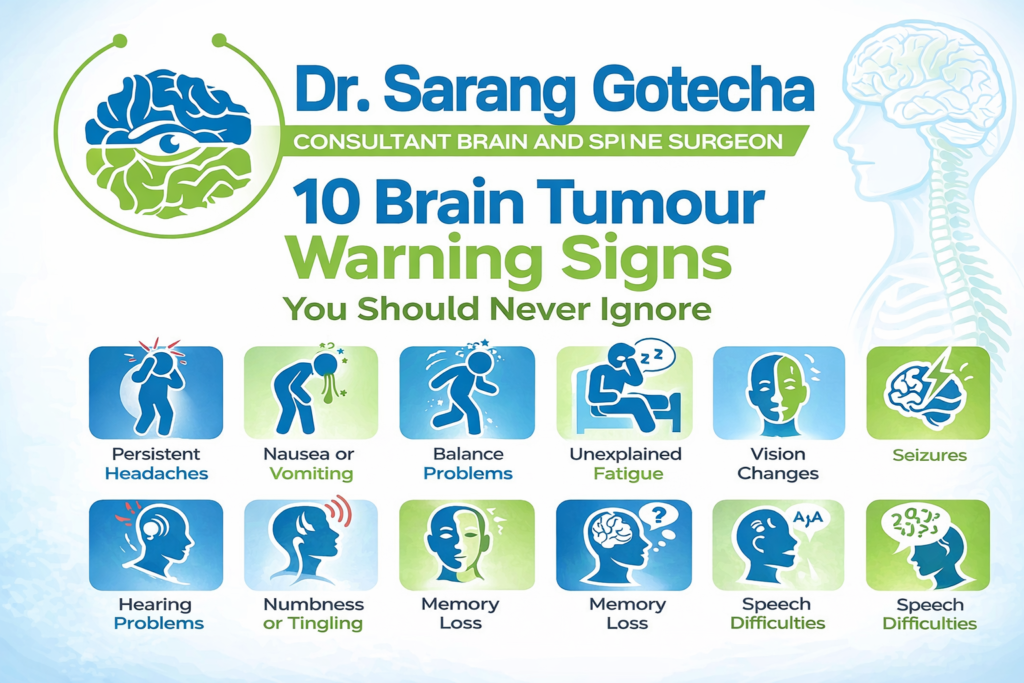
01. Persistent or worsening headaches
Headaches that are new in character, progressively worse in the morning, or wake you from sleep deserve medical attention. A brain tumor increases intracranial pressure—morning headaches that ease as the day progresses are a classic pattern.
02. Unexplained seizures
A first-time seizure in an adult with no prior epilepsy history is a neurological emergency. Tumors in certain brain regions lower the seizure threshold and may present as convulsions, unusual sensations, or brief blank spells. A prompt evaluation by a qualified neurosurgeon is essential.
03. Progressive vision changes
Blurred or double vision, loss of peripheral vision, or worsening visual field defects can indicate pressure on the optic pathways. Tumors near the pituitary gland—managed via transnasal endoscopic surgery—classically cause a tunnel vision pattern.
04. Weakness or numbness on one side
Gradual weakness in an arm, leg, or one side of the face may indicate a tumor pressing on motor pathways. Do not attribute progressive limb weakness to age or posture without an MRI reviewed by an experienced neurosurgeon in Pune.
05. Speech and language difficulties
Struggling to find words, speaking in broken sentences, or having difficulty understanding spoken language can point to a tumor affecting the dominant hemisphere’s language centers. These deficits often develop slowly and may relate to a tumor requiring brain tumor surgery.
06. Cognitive and memory changes
Uncharacteristic forgetfulness, confusion, or personality changes noticed by family—these are often the earliest signs of a frontal lobe tumor. They are frequently misattributed to burnout and diagnosed late. Early imaging saves lives. Learn more about neurosurgical services available in Pune.
07. Nausea and vomiting without cause
Morning nausea and vomiting accompanied by a headache—without any gastrointestinal illness—can signal raised intracranial pressure from a growing brain tumor rather than a digestive problem.
08. Balance and coordination problems
Unsteady walking, difficulty with fine motor tasks, or persistent dizziness not explained by inner ear conditions may point to a cerebellar tumor. Even small tumors here cause significant symptoms and may require neuroendoscopic surgery for safe access.
09. Hearing loss or tinnitus in one ear
Unilateral hearing loss or progressive ringing in one ear warrants brain imaging. Acoustic neuromas—benign tumors on the hearing nerve—are treatable conditions often managed with skull base surgery when diagnosed early.
10. Hormonal and endocrine disruptions
Unexplained weight gain, menstrual irregularities, or excessive thirst can be caused by pituitary tumors. These are highly treatable when diagnosed early using transnasal endoscopic approaches—a scarless, minimally invasive technique.
When should you seek urgent evaluation?
- A seizure occurring for the first time in adulthood
- Sudden or rapidly worsening neurological deficit—weakness, vision loss, speech failure
- A new, severe headache described as “the worst of my life”
- Any symptom that progresses continuously over days to weeks
- Two or more of the listed symptoms occurring together, even if mild individually
What happens when you seek evaluation?
The diagnostic pathway typically begins with a detailed neurological history and examination, followed by contrast-enhanced MRI of the brain. If a lesion is identified, further imaging such as MR spectroscopy, perfusion MRI, or PET-CT may be ordered before surgical planning begins.
Not every brain tumor requires immediate surgery. Meningiomas, certain low-grade gliomas, and small acoustic neuromas may be managed with observation or radiosurgery. Others benefit from neuroendoscopic procedures that minimize recovery time, while complex cases near the skull base require a specialist trained in skull base surgery. For tumors with associated brain injury or bleeding, emergency intervention may be required.
Internal resources to explore
→Brain tumour surgery (benign & malignant): drsaranggotecha.com/brain-tumor
→Neuroendoscopic surgery for hydrocephalus & cysts: drsaranggotecha.com/neuroendoscopic
→Transnasal endoscopic pituitary surgery: drsaranggotecha.com/transnasal-endoscopic
→Skull base & acoustic neuroma surgery: drsaranggotecha.com/skull-base
→Cerebrovascular surgery (aneurysms, AVMs): drsaranggotecha.com/cerebrovascular
→All neurosurgical services: services: drsaranggotecha.com/servi
About Dr. Sarang Gotecha
Dr. Sarang Gotecha is a leading neurosurgeon in Pune practicing at Manipal Hospital, Baner. With 12+ years of experience and qualifications spanning MBBS, MS, and MCh in neurosurgery, he specializes in brain tumor surgery, minimally invasive spine surgery, neuroendoscopic procedures, and skull base surgery. His dual international fellowship background—Korea and Singapore—positions him uniquely in a city of 7 million where fewer than 15 MCh-qualified neurosurgeons are in active practice. He sees patients at clinics across Baner, Wakad, and Thergaon, ensuring that geography is never a barrier to expert neurological care. To book a consultation or explore the full range of neurosurgical services, visit drsaranggotecha.com.
Common early signs include frequent headaches, blurred vision, memory problems, and unexplained seizures. If these symptoms persist or get worse, see a doctor as soon as possible.
Yes. Most brain tumors are highly treatable when caught early. Early diagnosis gives the best chance of successful treatment and faster recovery.
Doctors usually start with a neurological check-up followed by an MRI scan of the brain. Further tests may be done based on the results to plan the right treatment.

Dr. Sarang Gotecha
Dr. Sarang Gotecha is a leading brain & spine surgeon in Pune, offering advanced care for complex neurological and spinal conditions. With strong academic credentials (MBBS, MS, MCh Neurosurgery) and years of surgical experience, he is committed to delivering precise, safe, and patient-focused treatments.
- Expert in brain tumor, spine & neuroendoscopic surgeries
- Specialized in minimally invasive & skull base surgeries
- Follows an ethical and patient-centric approach
- Available at clinics in Baner, Wakad, and Thergaon (Pune)