
Table of contents
India records over 28,000 new brain tumor cases annually, yet fewer than 500 fellowship-trained neurosurgeons practice at tertiary hospitals across the country. Pune, a city of 7 million, has fewer than 15 practicing MCh-qualified neurosurgeons—making access to genuinely advanced spine and brain care one of the most critical healthcare gaps in western Maharashtra.
These figures matter because spine surgery sits at an intersection of high stakes and rapid innovation. Every year, thousands of patients in Pimpri-Chinchwad and across the Pune Metropolitan Region are told they need spinal intervention—a disc removal, a decompression, or a stabilization procedure. What many do not know is that the safety, precision, and recovery experience of that procedure depends enormously on both the surgeon’s training and the monitoring systems in place during the operation.
This blog explores how technology and intraoperative monitoring have transformed modern spine surgery, what patients in PCMC should look for when choosing a spine surgeon in PCMC, and why advanced fellowship training directly translates to better surgical outcomes.
Why Spine Surgery Safety Demands More Than Skill Alone
Spine surgery has historically carried risks that concerned both patients and surgeons—damage to nerve roots, unintended spinal cord injury, and implant misplacement. Historically, surgeons relied entirely on anatomical landmarks and tactile feedback. While experienced hands reduced risk significantly, they could not eliminate it entirely.
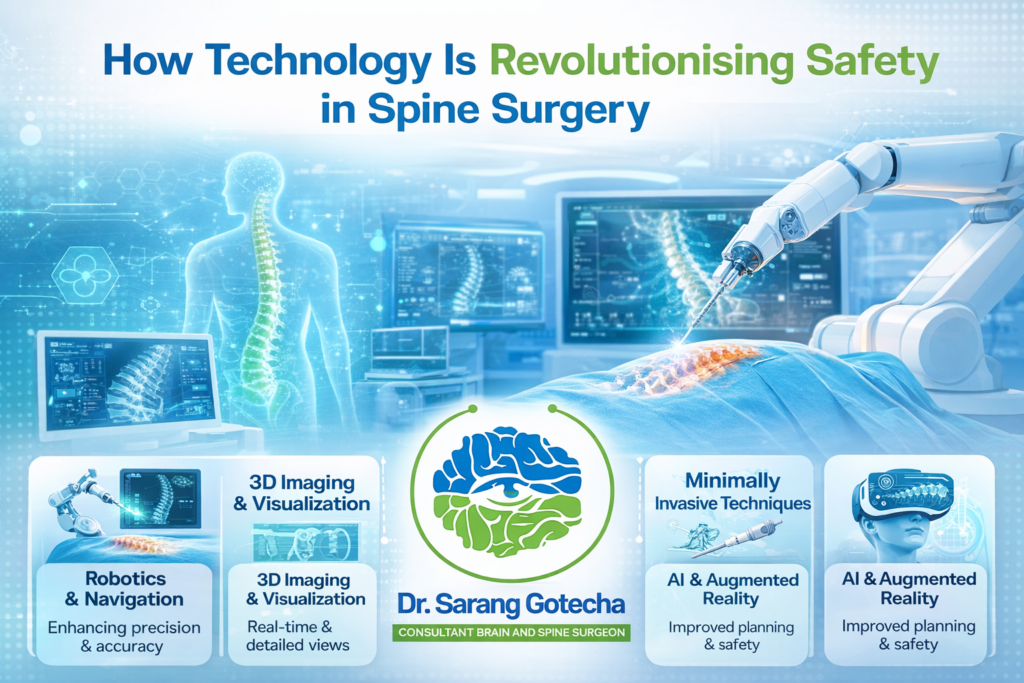
Over the past decade, a combination of real-time monitoring, imaging-guided navigation, and robotic assistance has fundamentally changed the risk equation. Today, a well-equipped spinal procedure is not just “careful”—it is actively verified at every step.
Key Safety Technologies Now Used in Advanced Spine Surgery
- Intraoperative Neuromonitoring (IONM) — continuous real-time tracking of nerve and spinal cord function during surgery, alerting the surgeon instantly to any signal change before injury can occur
- Spinal Navigation Systems—GPS-like 3D imaging that maps the patient’s exact spinal anatomy intraoperatively, enabling surgeons to place screws and implants with sub-millimetre accuracy
- Fluoroscopic C-arm Guidance—live X-ray imaging during the procedure that confirms position and alignment in real time, reducing the chance of revision surgery
- Operating Microscope & Endoscope — high-magnification visualisation that allows surgeons to protect nerves, blood vessels, and dural tissue while working through smaller incisions
- Minimally Invasive Tubular Retractors—replace wide muscle dissection with targeted access, dramatically cutting blood loss, post-operative pain, and hospital stay duration
- Robotic-Assisted Spine Surgery—Robotic arms guided by pre-operative CT planning deliver screw trajectories with accuracy rates above 98%, even in complex deformity and revision cases
Robotic Spine Surgery
For patients in PCMC wondering whether robotic spine surgery is a distant concept or a present reality—it is already here. Robotic platforms used in spine procedures are not autonomous systems; they are precision tools that extend the surgeon’s capabilities beyond what manual technique alone can achieve.
The workflow involves a pre-operative CT scan being uploaded into the robotic system. The surgeon plans every screw trajectory digitally before the patient reaches the operating theater. During surgery, the robotic arm holds the drill guide with micron-level stability, eliminating the tremor and fatigue that affect even experienced hands in long procedures.
What Robotic Spine Surgery Means for Patients
Reduced radiation exposure during surgery. Significantly lower rates of screw malposition. Shorter anesthesia time. Less blood loss. Faster discharge from hospital. And critically, lower rates of reoperation. For patients with complex scoliosis, multilevel fusion, or previous failed spine surgery, robotic assistance has changed what is technically achievable in a single procedure.
When evaluating a minimally invasive spine surgeon in PCMC, ask whether their hospital has a neuronavigation system and robotic capability. These are not luxury features — they are safety infrastructure.
Understanding Movement Changes After Spine Surgery: A Simple Guide to Recovery
One of the most common concerns patients share after spine surgery is “Why does my back feel different when I move?” This is both expected and, in most cases, a sign that the surgery has worked correctly.
When a disc herniation compresses a nerve, the body compensates with altered posture and movement patterns — sometimes for months or years. After surgical decompression, the nerve begins to heal, but the muscular habits developed around pain do not disappear overnight. Recovery is genuinely a process of re-education.
What Patients Typically Experience — and Why It Happens
- Initial stiffness (weeks 1–3) — normal inflammation and protective muscle guarding; movement should be gentle and guided by a physiotherapist familiar with post-surgical protocols
- Altered gait or posture (weeks 3–8) — the nervous system is recalibrating; walking exercises, core activation, and gradual return to daily activity support this relearning process
- Reduced flexibility at the fused level—in fusion procedures, the operated segment no longer moves; adjacent segments compensate and adapt over several months, which is expected and by design
- New sensations in legs or feet—tingling or altered feeling during nerve recovery is typically a sign of healing, not worsening; persistent or new neurological symptoms should always be reported
- Full functional recovery (3–12 months)—the timeline varies by procedure type, patient age, and pre-surgical nerve damage; consistency with rehabilitation is the single biggest predictor of long-term outcome
Seeking a doctor in Baner for spine care? Here Is What You Need to Know
Dr. Sarang Gotecha at Manipal Hospital, Baner, brings fellowship-level minimally invasive spine expertise directly to the PCMC and Baner community. Whether you are experiencing chronic back pain or sciatica or have been referred for spine surgery, a specialist consultation ensures you receive an accurate diagnosis and a treatment plan aligned with current evidence. Book Your Consultation Today—call +91 93222 88645 or visit the clinic in Baner.
Why the Surgeon’s Training Is the Most Critical Safety Variable
Technology is only as effective as the surgeon using it. A neuronavigation system in the hands of a surgeon who trained in open technique without minimally invasive fellowship experience will not achieve the same outcomes as one who has spent years practicing under international mentorship.
This is why Dr. Gotecha’s dual international fellowship—at St. Mary’s Hospital, Catholic University of Korea (Seoul), in minimally invasive spine surgery; and at the National Neuroscience Institute, Singapore, under the World Federation of Neurosurgical Societies (WFNS)—is not merely a credential. It represents approximately two to three years of hands-on operative training beyond the standard MCh curriculum under surgeons who helped write the protocols now used across Asia’s leading neurosurgical centers.
For a patient in Baner, Wakad, or Thergaon deciding where to seek spine care, that distinction matters in a very practical way: it affects whether your procedure uses the current generation of technique, whether recovery complications are recognized early, and whether the surgical plan was built around your anatomy rather than a template.
About Dr. Sarang Gotecha—Neurosurgeon in PCMC
Dr. Sarang Gotecha is a leading neurosurgeon in Pune practicing at Manipal Hospital, Baner. With 12+ years of experience and qualifications spanning MBBS, MS, and MCh in neurosurgery, he holds dual international fellowships—a Fellowship in Minimally Invasive Spine Surgery from St. Mary’s Hospital, Catholic University of Korea (Seoul), and a WFNS Fellowship from the National Neuroscience Institute, Singapore—credentials held by fewer than 15 MCh-qualified neurosurgeons practicing in Pune today. His clinical focus includes brain tumor surgery, minimally invasive spine surgery, neuroendoscopic procedures, and skull base surgery, serving patients across Baner, Wakad, and Thergaon. In a city of 7 million where fewer than 15 fellowship-trained neurosurgeons practice, Dr. Gotecha’s international training means patients in PCMC access the same standard of spinal and neurological care available at the world’s leading centers—without leaving Pune.
Yes. With robotic assistance, neuromonitoring, and navigation systems, modern spine surgery is significantly safer and more precise than ever before.
Yes. Dr. Sarang Gotecha offers advanced minimally invasive spine procedures for patients across PCMC and Pune.
Most patients resume light activity within 2–4 weeks and achieve full recovery within 3–12 months depending on the procedure.

Dr. Sarang Gotecha
Dr. Sarang Gotecha is a leading brain & spine surgeon in Pune, offering advanced care for complex neurological and spinal conditions. With strong academic credentials (MBBS, MS, MCh Neurosurgery) and years of surgical experience, he is committed to delivering precise, safe, and patient-focused treatments.
- Expert in brain tumor, spine & neuroendoscopic surgeries
- Specialized in minimally invasive & skull base surgeries
- Follows an ethical and patient-centric approach
- Available at clinics in Baner, Wakad, and Thergaon (Pune)