
KEY TAKEAWAYS
- Glioblastoma (GBM) is the most aggressive primary brain tumor — WHO Grade 4 — and the most common malignant brain tumor in adults, accounting for approximately 15% of all brain tumors.
- The standard treatment — the Stupp protocol — is surgery (maximal safe resection) followed by concurrent radiation and temozolomide chemotherapy, then 6 months of adjuvant temozolomide.
- Maximal safe resection improves survival and quality of life compared to biopsy alone — complete resection of enhancing tumor is the surgical goal.
- Median survival with the Stupp protocol is 14 to 16 months — MGMT methylation (a genetic marker) identifies the 40 to 50% of GBM patients who benefit significantly more from temozolomide, with median survival extending to 21 to 23 months.
- Awake craniotomy for eloquent area GBMs maximises resection extent while protecting speech and motor function — it is the standard of care for tumors within 1 cm of critical cortex.
- Glioblastoma surgery cost in Pune is INR 4,00,000 to INR 9,00,000 — the complete treatment including radiation and chemotherapy represents a significantly larger total cost.
- Families facing GBM deserve honest, compassionate communication about prognosis, treatment goals and quality of life — not evasiveness or false optimism.
Glioblastoma is a diagnosis that changes everything. It is the most aggressive brain tumor. Its treatment is demanding. Its prognosis, despite modern therapy, remains the most sobering in oncological medicine. And yet — treatment meaningfully extends survival, preserves function and maintains quality of life for months that matter enormously to patients and families.
This guide is written with the commitment to honesty that families facing GBM deserve. It covers what the disease is, what treatment looks like at every stage, what realistic outcomes look like in Pune’s oncological neurosurgery setting and what questions to ask at every step. It does not offer false hope. It offers real information — because real information is what allows families to make good decisions and spend their time well.
QUICK FACTS
GBM Proportion of Brain Tumors: ~15% of all primary brain tumors; ~45% of malignant
Median Survival — Stupp Protocol: 14 to 16 months overall; 21 to 23 months for MGMT methylated
MGMT Methylation Rate: ~40 to 50% of GBM patients
2-Year Survival Rate: ~27% overall; ~46% for MGMT methylated
GBM Surgery Cost Pune 2026: INR 4,00,000 to INR 9,00,000
Total Treatment Cost (Surgery + RT + Chemo): INR 8,00,000 to INR 20,00,000+ (full Stupp protocol)
Glioblastoma Statistics in India 2025-2026
| Metric | Data Point | Source |
| GBM proportion of primary brain tumors | ~15% | Published literature |
| Annual GBM diagnoses in India | ~15,000 to 25,000 (Industry estimate) | Industry estimate |
| Median survival — Stupp protocol | 14 to 16 months | Stupp et al., NEJM 2005 |
| MGMT methylation — median survival | 21 to 23 months | Published literature |
| 2-year survival — all GBM | ~27% | Published literature |
| 5-year survival — all GBM | ~5 to 10% | Published literature |
| Maximal resection benefit vs biopsy | Median +3 to 4 months additional survival | Published literature |
What Is Glioblastoma?
Glioblastoma (GBM, WHO Grade 4 glioma) is a malignant tumor of glial cells — the supportive cells of the brain. Unlike meningiomas which sit on the brain surface, GBMs grow within the brain tissue itself — their cells infiltrate along white matter tracts, across the corpus callosum and throughout the brain parenchyma. Complete resection is not possible because tumor cells extend beyond the visible enhancing lesion on MRI into apparently normal-looking brain.
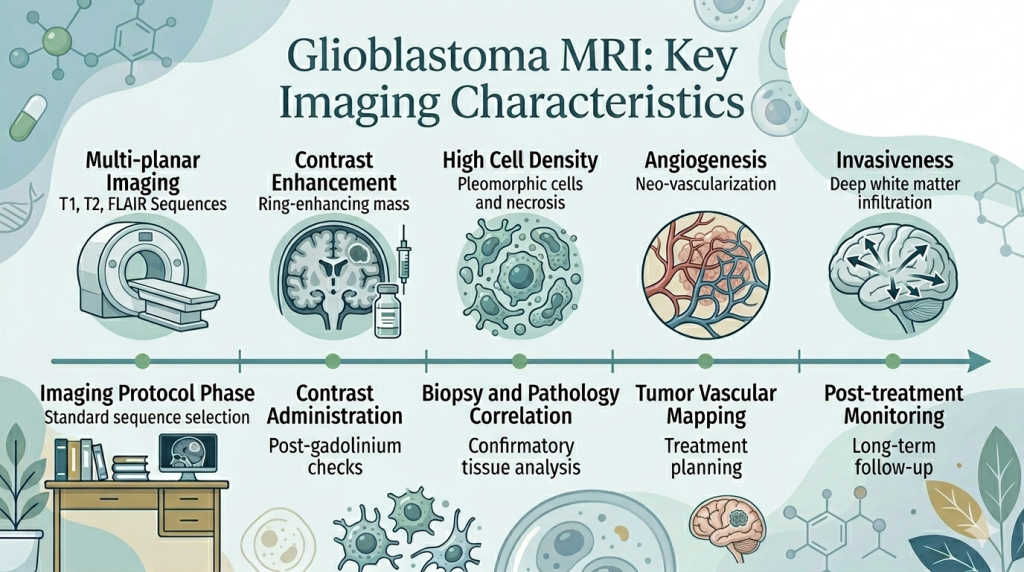
GBMs are characterised on MRI by ring-enhancing lesions with central necrosis — the classic ‘ring sign’. They tend to grow rapidly, often becoming symptomatic within weeks. They arise de novo (primary GBM, most common) or from malignant transformation of a lower-grade glioma (secondary GBM). Genetic markers — particularly MGMT promoter methylation and IDH mutation status — stratify prognosis and predict response to chemotherapy.
IDH mutation status is particularly important: IDH-mutant gliomas (more common in younger adults and secondary GBMs) have significantly better prognosis than IDH-wildtype gliomas. The 2021 WHO Classification now classifies IDH-wildtype Grade 4 gliomas as GBM regardless of histological appearance — reinforcing that molecular markers define the diagnosis as much as the microscope.
The Stupp Protocol: The Standard of Care for GBM in Pune
Step 1: Maximal Safe Surgical Resection
Surgery is the first and most impactful step in GBM management. The goal is maximal safe resection — removing as much of the contrast-enhancing tumor as possible without causing unacceptable neurological deficit. Every 10% increase in extent of resection is associated with approximately 2 to 4 weeks of additional median survival in published studies. Gross total resection (complete removal of enhancing tumor on post-operative MRI) is associated with the best survival outcomes.
‘Safe’ is the operative word. A surgeon who achieves 100% resection but causes permanent aphasia or hemiplegia has not served the patient’s quality of life. For tumors in or near eloquent cortex, awake craniotomy with real-time speech and motor mapping allows the surgeon to approach the eloquent cortex boundary precisely — maximising resection while preserving function.
5-ALA fluorescence-guided surgery (patients take a pink drink 3 to 5 hours before surgery that makes GBM cells fluoresce under blue-violet light) significantly improves extent of resection compared to standard white-light surgery — 65% versus 36% complete resection rates in the landmark Stummer trial.
Step 2: Concurrent Radiation and Temozolomide (Weeks 1 to 6)
Within 4 to 6 weeks of surgery, the Stupp protocol begins: 60 Gy of focal radiotherapy delivered over 30 fractions (6 weeks) combined with daily oral temozolomide chemotherapy at 75 mg/m2. The radiation targets the post-operative cavity and a 2 to 3 cm margin. The concurrent temozolomide acts as a radiation sensitiser, enhancing the DNA-damaging effect of radiation on residual GBM cells. This concurrent phase is delivered at a radiation oncology centre — ideally one in close communication with the operating neurosurgeon.
Step 3: Adjuvant Temozolomide (Months 1 to 6 Post-Radiation)
After concurrent chemoradiation, patients receive 6 cycles of adjuvant temozolomide at 150 to 200 mg/m2 for 5 days every 28 days. This phase is managed by the oncologist. Blood counts are monitored monthly — temozolomide causes myelosuppression in approximately 7% of patients. MGMT methylation status, determined from the surgical specimen, predicts response to temozolomide — methylated patients have a significantly greater benefit from chemotherapy than unmethylated patients.
MGMT Methylation: The Most Important Genetic Marker in GBM
MGMT (O6-methylguanine-DNA methyltransferase) is a DNA repair enzyme. When the MGMT gene is methylated (silenced), GBM cells cannot repair the DNA damage caused by temozolomide — making them significantly more vulnerable to the drug. MGMT methylation is found in 40 to 50% of GBMs and is the strongest predictor of both temozolomide response and overall prognosis.
| MGMT Status | Median Survival (Stupp Protocol) | 2-Year Survival | Benefit from Temozolomide |
| Methylated (~40 to 50%) | 21 to 23 months | 46% | Significant — first-line TMZ recommended |
| Unmethylated (~50 to 60%) | 12 to 14 months | 14% | Limited — RT alone may be equivalent |
| Unknown (no testing) | Population average | Population average | Cannot be personalised |
Every GBM patient in Pune should have MGMT methylation testing as part of the histopathological workup of the surgical specimen. This test guides temozolomide decisions, clinical trial eligibility and prognostic counselling. It should be requested by the treating neurosurgeon as a routine part of the pathology request.
Glioblastoma Surgery in Pune: Costs and What Insurance Covers
| Treatment Component | Cost Range (INR) | Notes |
| GBM craniotomy (standard) | 4,00,000 to 7,00,000 | Neuronavigation + IONM standard |
| GBM craniotomy (awake) | 5,00,000 to 9,00,000 | Neurophysiology + speech therapy |
| 5-ALA fluorescence surgery add-on | 30,000 to 60,000 | 5-ALA drug + blue-light filter |
| Concurrent RT + TMZ (6 weeks) | 3,00,000 to 6,00,000 | Radiation oncology centre |
| Adjuvant TMZ (6 cycles) | 60,000 to 1,50,000 | Temozolomide drug cost |
| Total Stupp protocol (estimated) | 8,00,000 to 20,00,000+ | Surgery + RT + chemo combined |
| Ayushman Bharat coverage | Up to 1,50,000 per procedure | Empanelled hospitals — GBM craniotomy |
What Families Need to Know: Honest Conversations About GBM
Families of GBM patients are often caught between the need for hope and the need for honesty. The neurosurgeon and oncologist have a responsibility to provide both — hope grounded in what treatment can realistically achieve, and honesty about the fact that GBM is not currently curable with standard therapy.
Treatment goals in GBM are: extending survival, preserving neurological function and quality of life for as long as possible, and managing symptoms effectively. For MGMT-methylated patients who respond well to temozolomide, survival of 2 to 3 years is achievable with the Stupp protocol and close oncological management. Recurrence is the rule — most GBMs recur within 6 to 9 months of completing the Stupp protocol. At recurrence, treatment options include repeat surgery, bevacizumab, second-line chemotherapy and clinical trials.
The Indian family facing a GBM diagnosis often carries the additional weight of financial planning alongside grief. The total treatment cost of INR 8,00,000 to INR 20,00,000 is not trivial. Insurance coverage for surgery and radiation exists but chemotherapy drug costs vary by policy. Early financial counselling — engaging the hospital social worker or insurance team at diagnosis rather than during the chemotherapy phase — reduces the financial crisis that often compounds the medical one.
Dr. Sarang Gotecha provides compassionate, honest GBM consultations for patients and families from Pune, Baner, Wakad, Thergaon and PCMC. He works closely with radiation and medical oncology partners to ensure seamless Stupp protocol delivery from surgery through the complete treatment course.
Book your the first Consultation at drsaranggotecha health care
Frequently Asked Questions
Q: What is the prognosis for glioblastoma treated in Pune in 2026?
With the Stupp protocol — surgery, concurrent radiation and temozolomide, then 6 months of adjuvant temozolomide — median overall survival is 14 to 16 months for all GBM patients. MGMT-methylated patients have significantly better outcomes with median survival of 21 to 23 months and 2-year survival of 46%. While GBM remains a serious diagnosis, treatment meaningfully extends survival and preserves quality of life. Individual outcomes vary with age, performance status, extent of resection and molecular markers.
Q: What is maximal safe resection for glioblastoma?
Maximal safe resection means removing as much of the contrast-enhancing tumor as possible on MRI without causing unacceptable permanent neurological deficit. It is the surgical goal for GBM. Complete resection of the enhancing component is associated with the longest survival benefit. For eloquent area tumors, awake craniotomy allows the surgeon to approach the critical cortex boundary while preserving speech and motor function — the word ‘safe’ is as important as ‘maximal’.
Q: What is the Stupp protocol for glioblastoma?
The Stupp protocol is the standard of care for GBM: surgical maximal safe resection followed by 6 weeks of concurrent radiotherapy (60 Gy) and daily temozolomide chemotherapy, then 6 cycles of adjuvant temozolomide. Published by Roger Stupp in the New England Journal of Medicine in 2005, it improved median survival from 12 months (radiation alone) to 14.6 months and remains the global standard 20 years later.
Q: What is MGMT methylation and why does it matter in glioblastoma?
MGMT methylation silences a DNA repair enzyme in GBM cells, making them unable to repair the DNA damage caused by temozolomide. MGMT-methylated GBMs (40 to 50% of cases) respond significantly better to temozolomide with median survival of 21 to 23 months versus 12 to 14 months for unmethylated tumors. MGMT testing should be routine on every GBM surgical specimen in Pune to personalise chemotherapy decisions.
Q: What is the cost of glioblastoma treatment in Pune in 2026?
GBM craniotomy in Pune costs INR 4,00,000 to INR 9,00,000. The complete Stupp protocol — surgery, 6-week concurrent RT and temozolomide, plus 6 cycles of adjuvant temozolomide — costs approximately INR 8,00,000 to INR 20,00,000 total. Health insurance covers surgery and often radiation. Temozolomide drug costs vary by policy — check your policy’s outpatient oncology drug coverage before starting treatment.
Q: Can glioblastoma be cured with surgery alone in Pune?
No. Glioblastoma cannot be cured with surgery alone because GBM cells infiltrate well beyond the visible tumor margin into apparently normal brain tissue. Surgery removes the visible enhancing tumor and provides histopathological diagnosis, but adjuvant radiation and chemotherapy are essential to target the infiltrating cells that surgery cannot remove. The Stupp protocol — combining all three modalities — provides the best available outcomes.
Glioblastoma treatment in Pune in 2026 follows internationally recognised protocols with surgery, radiation and temozolomide chemotherapy. Outcomes depend on molecular markers, extent of resection and performance status. Treatment meaningfully extends survival and protects quality of life. Families deserve honest conversations about both the possibilities and the limitations of current therapy.
For GBM consultation, surgical planning and coordination with oncology partners in Pune and PCMC, Dr. Sarang Gotecha is available at drsaranggotecha.com. His practice is built on honest, evidence-based communication alongside technical surgical excellence.

Dr. Sarang Gotecha
Dr. Sarang Gotecha is a leading brain & spine surgeon in Pune, offering advanced care for complex neurological and spinal conditions. With strong academic credentials (MBBS, MS, MCh Neurosurgery) and years of surgical experience, he is committed to delivering precise, safe, and patient-focused treatments.
- Expert in brain tumor, spine & neuroendoscopic surgeries
- Specialized in minimally invasive & skull base surgeries
- Follows an ethical and patient-centric approach
- Available at clinics in Baner, Wakad, and Thergaon (Pune)