
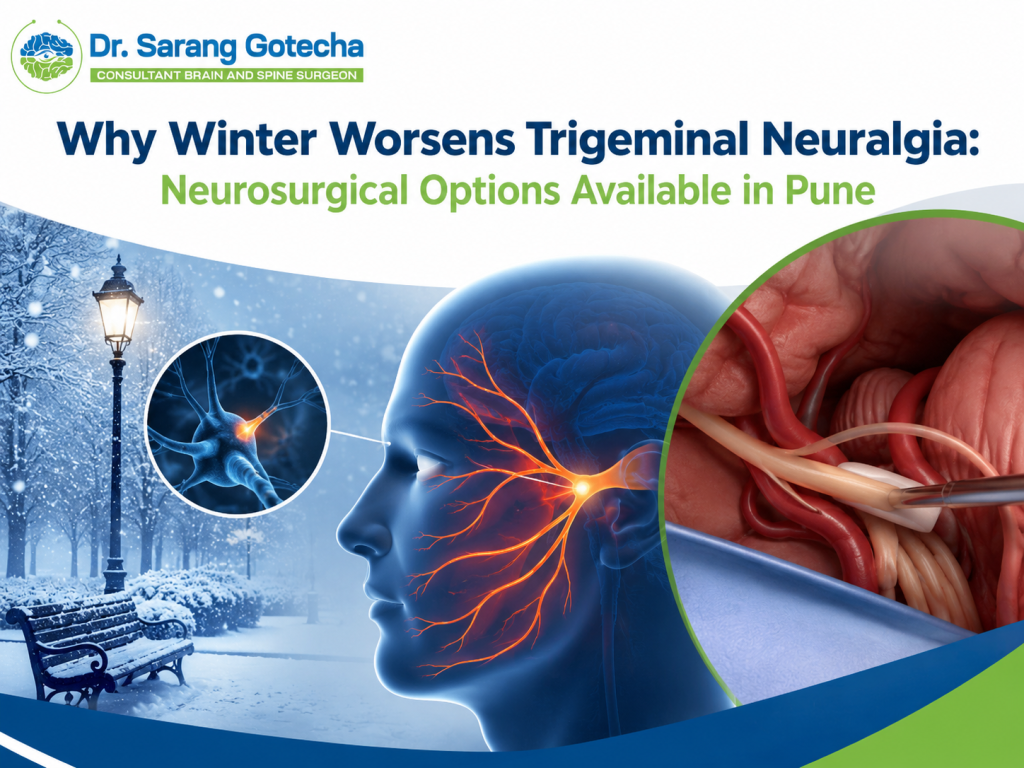
KEY TAKEAWAYS
- Trigeminal neuralgia (TN) is the most painful condition known to medicine — sudden electric-shock or stabbing facial pain lasting fractions of a second to 2 minutes, triggered by everyday activities like eating, talking, brushing teeth or cold air.
- Cold winter air is one of the most reliably documented TN triggers — November and December consistently bring the highest TN consultation rates to Pune neurosurgery OPDs.
- Classical TN is caused by vascular compression of the trigeminal nerve root at its entry into the brainstem — most commonly by the superior cerebellar artery.
- Three neurosurgical treatments are available in Pune: MVD (microvascular decompression) — the most durable cure with 70 to 80% pain-free at 10 years; Gamma Knife radiosurgery — non-invasive but delayed response; and percutaneous procedures — needle-based, immediate but less durable.
- MVD is the only treatment that addresses the underlying cause of TN — the vascular compression — rather than damaging the nerve to stop pain transmission.
- MVD surgery cost in Pune ranges from INR 3,50,000 to INR 6,00,000; Gamma Knife radiosurgery costs INR 2,50,000 to INR 4,00,000.
- Dr. Sarang Gotecha performs MVD and percutaneous procedures for trigeminal neuralgia patients across Pune, Baner, Wakad, Thergaon and PCMC.
Trigeminal neuralgia has been called the suicide disease. This name is not hyperbole. It describes a condition in which lightning-bolt facial pain can strike unpredictably dozens or hundreds of times per day — triggered by a breath of cold air, a sip of water, a word spoken or a tooth brushed. Patients stop eating, stop talking and withdraw from every activity that might trigger the next attack. The psychological devastation compounds the physical.
In Pune, November and December bring colder air off the Sahyadri ranges — and with it, a predictable increase in TN consultations. This guide explains why cold triggers TN, what the condition is, and what neurosurgical treatments are available locally for Pune and PCMC patients.
QUICK FACTS
Peak TN Consultation Season in Pune: November to January — cold air trigger season
Most Common Cause: Superior cerebellar artery compression of trigeminal root
MVD 10-Year Pain-Free Rate: 70 to 80%
Gamma Knife Response Rate: 85 to 90% initial; 50 to 60% at 5 years
MVD Surgery Cost Pune 2026: INR 3,50,000 to INR 6,00,000
Gamma Knife Cost Pune: INR 2,50,000 to INR 4,00,000
Trigeminal Neuralgia Statistics in India 2025-2026
| Metric | Data Point | Source |
| TN prevalence | ~4 to 5 per 100,000 population | Published literature |
| Annual TN cases in India | ~60,000 to 80,000 (Industry estimate) | Industry estimate |
| Female to male ratio | ~1.5 to 2:1 | Published literature |
| Peak age of onset | 50 to 70 years | Published literature |
| MVD 10-year pain-free rate | 70 to 80% | Published literature |
| Gamma Knife initial response | 85 to 90% | Published literature |
| MVD surgery cost in Pune | 3,50,000 to 6,00,000 INR | Industry estimate |
What Is Trigeminal Neuralgia and Why Is It So Painful?
The trigeminal nerve (cranial nerve V) is the main sensory nerve of the face, transmitting touch, temperature and pain signals from the forehead, cheeks, jaw and teeth to the brain. It has three divisions: V1 (ophthalmic forehead and eye), V2 (maxillary cheek, upper lip, nose) and V3 (mandibular jaw, lower lip, chin, tongue). TN typically affects V2 and V3 — the cheek and jaw distribution.
In classical TN, a blood vessel most commonly the superior cerebellar artery, sometimes the anterior inferior cerebellar artery or a venous structure presses against the trigeminal nerve root at the point where it enters the brainstem (the root entry zone). This chronic pulsatile compression strips the myelin sheath from the nerve fibres over time a process called demyelination. Demyelinated fibres misfire generating massive, synchronised pain discharges in response to trivial tactile stimuli that would not normally be painful.
This is why the pain of TN is so unique: it is not inflammatory, not ischaemic, not from tissue damage. It is ectopic electrical discharge from a misfiring demyelinated nerve which is why it feels like an electric shock, why it lasts for the duration of the discharge (fractions of a second to 2 minutes) and why it is triggered by sensory inputs as gentle as a breath of cold air on the cheek.
Why Cold Winter Air Worsens Trigeminal Neuralgia
The trigeminal nerve is the primary thermoreceptor for the face — it carries temperature signals from the skin, mucous membranes and teeth to the brain. Cold air activates cold-sensitive channels (TRPM8 receptors) in the trigeminal branches with every breath a normal sensory signal in a healthy nerve.
In a demyelinated TN nerve, this cold activation generates not just a normal temperature signal but a full ectopic pain discharge the same mechanism that touch triggers. The cooling effect of cold air on the intraoral mucosa when breathing through the mouth, on the skin of the cheek and around the nose is a constant, unavoidable trigger during Pune’s winter months.
Patients describe November and December as their worst months. In summer, they can manage with careful eating and speaking. In winter, simply walking from the house to an auto-rickshaw can trigger 10 to 15 attacks from the cold air. Wrapping a scarf tightly around the face, breathing through a mask and avoiding outdoor exposure are the improvised adaptations TN patients in Pune develop for winter none of which constitute adequate long-term management.
Medical Management: The First-Line Treatment
Medical management remains the appropriate first step for most newly diagnosed TN patients. Carbamazepine (Tegretol) is the first-line drug it is the only medication with Level A evidence for TN and works by stabilising the sodium channels responsible for ectopic nerve firing. Starting doses of 200 to 400 mg daily, titrated to pain control, achieve meaningful relief in 70 to 80% of newly diagnosed patients.
The problem is durability. Carbamazepine loses efficacy in 30 to 50% of patients over time as tolerance develops. Side effects dizziness, double vision, hyponatraemia, bone marrow effects limit dose escalation in older adults. Oxcarbazepine, pregabalin, baclofen and lamotrigine are second-line options. For patients whose pain is not controlled with two adequate medication trials, neurosurgical evaluation is appropriate.
The question of when to refer for surgery should be asked earlier rather than later. A 70-year-old patient who has been on carbamazepine for 3 years with declining efficacy, increasing doses and significant dizziness side effects is a better surgical candidate than one who has been managing for 15 years on maximum doses with severely impaired quality of life. Earlier surgical intervention, when patients are fitter, provides better outcomes.
Neurosurgical Treatment Options for TN in Pune
Option 1: Microvascular Decompression (MVD) — The Definitive Treatment
MVD is the only surgical treatment that addresses the underlying cause of classical TN the vascular compression of the trigeminal nerve root. Through a small retrosigmoid craniotomy behind the ear, the neurosurgeon uses a microscope to identify the compressing vessel and place a small Teflon pledget between the vessel and the nerve, permanently separating them and allowing the demyelinated nerve to recover.
MVD has the best long-term outcomes of all TN treatments: 90% of patients achieve immediate pain relief after MVD. At 10 years, 70 to 80% remain pain-free without medication. It preserves facial sensation fully — unlike ablative procedures that work by damaging the nerve. It is the appropriate treatment for fit patients under 75 years with classical TN and MRI-confirmed vascular compression.
The trade-off is surgical risk. MVD requires general anaesthesia and a posterior fossa craniotomy the same territory as acoustic neuroma surgery. Risks include facial numbness (1 to 2%), hearing loss (under 1%), cerebellar injury (under 1%) and very rarely meningitis or posterior fossa haematoma (under 0.5%). In experienced hands these risks are low and are outweighed by the 70 to 80% long-term pain-free rate.
Option 2: Gamma Knife Radiosurgery
Gamma Knife delivers a precisely focused dose of radiation to the trigeminal nerve root near the brainstem causing progressive demyelination that reduces ectopic discharge. It is performed as a day procedure, requires no general anaesthesia and leaves no surgical wound. Pain relief develops over 1 to 3 months (unlike MVD where relief is often immediate).
Gamma Knife achieves initial pain relief in 85 to 90% of patients. However, the relief is less durable than MVD approximately 50 to 60% remain pain-free at 5 years. Facial numbness develops in 10 to 25% of patients over 2 years after Gamma Knife as the radiation effect progresses. It is best suited for patients over 70 years, those unfit for open surgery, patients who have previously had MVD and those who prefer a non-invasive approach despite lower long-term durability.
Option 3: Percutaneous Procedures
Percutaneous procedures are needle-based approaches performed through the cheek under fluoroscopic guidance. A needle passes through the foramen ovale (a natural opening at the skull base) into the trigeminal ganglion. Three techniques are used: glycerol rhizolysis (injection of glycerol to damage the ganglion), balloon microcompression (inflating a balloon to compress the ganglion) and radiofrequency thermocoagulation (heating the ganglion to destroy pain fibres).
Percutaneous procedures provide immediate pain relief in 85 to 95% of patients. They are performed under brief general anaesthesia as day procedures no craniotomy, no hospital stay. The trade-offs: higher rates of facial numbness (20 to 50% depending on technique and dose), lower durability than MVD (50 to 60% pain-free at 5 years) and no addressing of the underlying compression. They are best suited for elderly or medically frail patients who cannot tolerate MVD or Gamma Knife.
Comparing the Three Neurosurgical Options in Pune
| Factor | MVD | Gamma Knife | Percutaneous Procedure |
| Mechanism | Removes vascular compression | Radiation damages nerve | Needle ablates ganglion |
| Anaesthesia | General — craniotomy | None — day procedure | Brief general — day procedure |
| Hospital stay | 3 to 5 days | Day procedure | Day procedure |
| Time to pain relief | Immediate (most patients) | 1 to 3 months | Immediate |
| Initial success rate | 90% | 85 to 90% | 85 to 95% |
| 5-year pain free rate | 75 to 80% | 50 to 60% | 50 to 60% |
| 10-year pain free rate | 70 to 80% | 40 to 50% | 40 to 50% |
| Facial numbness risk | Under 5% | 10 to 25% | 20 to 50% |
| Cost in Pune (INR) | 3,50,000 to 6,00,000 | 2,50,000 to 4,00,000 | 1,20,000 to 2,50,000 |
| Best for | Under 75, fit, classical TN | Over 70, unfit, no anaesthesia | Elderly, medically frail, recurrence |
TN in Pune and PCMC: Getting the Right Assessment
A 62-year-old woman from Wakad presented with 18 months of right-sided facial electric-shock pain triggered by eating, speaking and cold air. Winter had made her attacks so frequent she had lost 6 kg from avoiding eating. Carbamazepine had helped for 8 months but was causing severe dizziness at therapeutic doses. MRI showed right-sided superior cerebellar artery compression of the trigeminal root. MVD was performed. She reported immediate pain relief on waking from anaesthesia. At her 6-month review she was eating normally, had regained her weight and was no longer on carbamazepine. Winter had passed without a single attack.
Dr. Sarang Gotecha performs MVD for TN as part of his skull base neurosurgery practice in Pune. For patients in Baner, Wakad, Thergaon and PCMC with trigeminal neuralgia, a consultation that includes MRI review and a clear comparison of all three surgical options is available at drsaranggotecha.com.
Frequently Asked Questions
Q: Why does cold air trigger trigeminal neuralgia attacks?
A: The trigeminal nerve carries temperature signals from the face and mouth. Cold air activates cold-sensitive receptors (TRPM8) in the trigeminal branches with every breath. In a normal nerve, this generates only a temperature signal. In TN, where the nerve root is demyelinated by vascular compression, the same cold stimulus generates a massive ectopic pain discharge the electric-shock attack. This is why winter in Pune, with cold air coming off the Sahyadri hills, consistently worsens TN and drives the seasonal peak in surgical consultations.
Q: What is MVD surgery for trigeminal neuralgia and how effective is it?
A: Microvascular decompression (MVD) is the definitive neurosurgical treatment for classical trigeminal neuralgia. Through a small retrosigmoid craniotomy, the compressing blood vessel is separated from the trigeminal nerve root with a Teflon pledget. MVD achieves immediate pain relief in 90% of patients, with 70 to 80% remaining pain-free at 10 years without medication. It is the most durable of all TN treatments and the only one that addresses the underlying cause.
Q: What is the cost of trigeminal neuralgia surgery in Pune in 2026?
A: MVD surgery for trigeminal neuralgia costs approximately INR 3,50,000 to INR 6,00,000 all-inclusive at mid-tier Pune hospitals in 2026, covering surgeon, anaesthesia, retrosigmoid craniotomy and 3 to 5 days hospital stay. Gamma Knife radiosurgery costs INR 2,50,000 to INR 4,00,000 as a day procedure. Percutaneous procedures (glycerol rhizolysis, balloon microcompression, radiofrequency) cost INR 1,20,000 to INR 2,50,000 as day procedures.
Q: Is Gamma Knife or MVD better for trigeminal neuralgia?
A: For patients under 70 years who are fit for general anaesthesia and have MRI-confirmed vascular compression, MVD provides significantly better long-term pain-free rates (70 to 80% at 10 years vs 40 to 50% for Gamma Knife) with lower facial numbness risk. For patients over 70 or those who cannot tolerate craniotomy, Gamma Knife is an excellent non-invasive option with good initial response rates. The right choice depends on patient age, fitness, MRI findings and preference.
Q: Can trigeminal neuralgia be treated without surgery in Pune?
A: Yes. Medical management with carbamazepine is the appropriate first-line treatment for newly diagnosed TN, achieving meaningful relief in 70 to 80% of patients. Surgery is recommended when medications fail (30 to 50% of patients over time), when side effects limit adequate dosing, or when the patient’s quality of life is severely impaired despite medical management. The decision to proceed to surgery should be made collaboratively between the patient and neurosurgeon after medication has been adequately tried.
Q: Is trigeminal neuralgia surgery available in Pune and PCMC?
A: Yes. MVD and percutaneous procedures for trigeminal neuralgia are performed by Dr. Sarang Gotecha at hospitals in the Baner-Wakad corridor. Patients from Pune, Baner, Wakad, Thergaon and PCMC can access neurosurgical TN treatment locally without travelling to Mumbai. Gamma Knife radiosurgery may require referral to a centre with a Gamma Knife unit. Book a consultation to review your imaging and discuss all three treatment options.
Trigeminal neuralgia in Pune’s winter months is a predictable, seasonal crisis for thousands of patients. Cold air is a documented trigger and the November to January period is consistently the worst time of year for TN sufferers. Neurosurgical treatment MVD for fit patients, Gamma Knife for older or medically frail patients, percutaneous procedures for those who cannot tolerate other approaches provides meaningful and durable pain relief.
For TN consultation, MRI review and surgical planning in Pune and PCMC, Dr. Sarang Gotecha is available at drsaranggotecha.com.
Medical Disclaimer
This article is for general informational purposes only and does not constitute medical advice. It is not a substitute for professional medical consultation, diagnosis or treatment. Always consult a qualified neurosurgeon for any medical concern. Individual outcomes, costs and recovery timelines vary. Dr. Sarang Gotecha and Edgelink Technology Pvt Ltd accept no liability for decisions made solely based on this content.

Dr. Sarang Gotecha
Dr. Sarang Gotecha is a leading brain & spine surgeon in Pune, offering advanced care for complex neurological and spinal conditions. With strong academic credentials (MBBS, MS, MCh Neurosurgery) and years of surgical experience, he is committed to delivering precise, safe, and patient-focused treatments.
- Expert in brain tumor, spine & neuroendoscopic surgeries
- Specialized in minimally invasive & skull base surgeries
- Follows an ethical and patient-centric approach
- Available at clinics in Baner, Wakad, and Thergaon (Pune)