
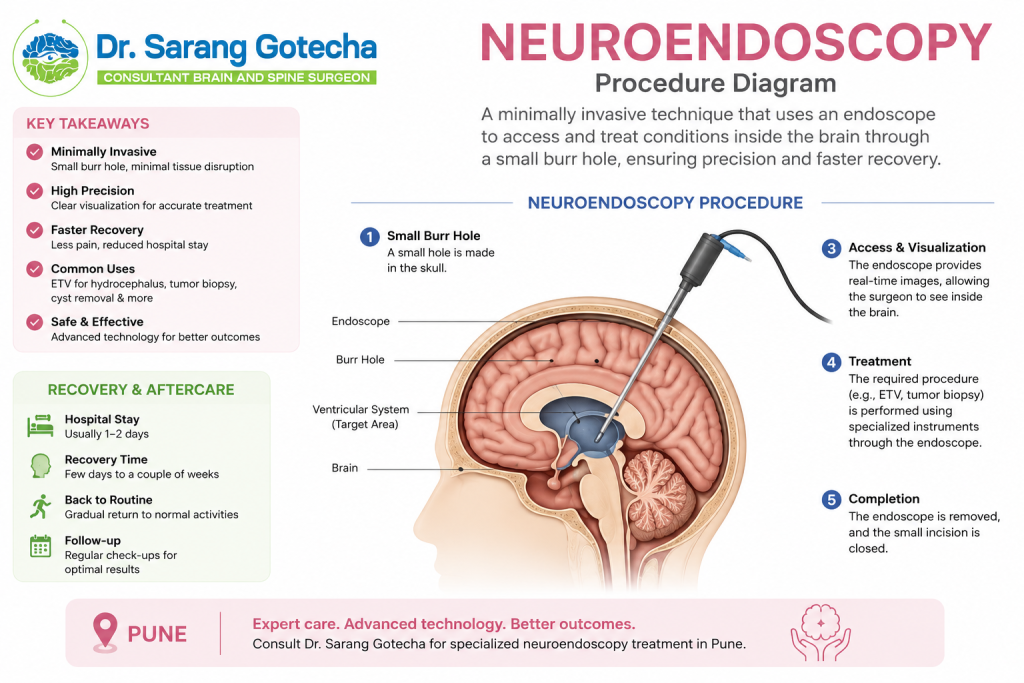
KEY TAKEAWAYS
- Neuroendoscopic surgery uses a narrow endoscope through a small burr hole in the skull to treat brain and ventricular conditions — no large craniotomy required.
- The most common neuroendoscopic procedure is ETV (endoscopic third ventriculostomy) for obstructive hydrocephalus — it costs INR 1,80,000 to INR 3,50,000 in Pune.
- Neuroendoscopic surgery is significantly less expensive than open craniotomy for the same conditions due to shorter OT time and hospital stay.
- Most private health insurance policies in India cover neuroendoscopic procedures when pre-authorisation is obtained before admission.
- Ayushman Bharat PM-JAY covers ETV and neuroendoscopic procedures at empanelled hospitals in Pune for eligible beneficiaries.
- Dr. Sarang Gotecha is experienced in a full range of neuroendoscopic procedures including ETV, endoscopic tumor biopsy and aqueductoplasty.
- Patients from Pune, Baner, Wakad, Thergaon and PCMC can access neuroendoscopic surgery locally without travelling to Mumbai.
Neuroendoscopic surgery represents one of the most significant advances in neurosurgery over the past two decades. Where a large craniotomy was once required to access ventricular structures or deep brain lesions, a narrow endoscope passed through a 1 to 1.5 cm burr hole now achieves the same surgical goal with a fraction of the tissue disruption.
For patients in Pune who are told they need neuroendoscopic surgery, the immediate questions are practical: how much does it cost, what does insurance cover and how is the cashless process managed? This guide answers all three directly.
QUICK FACTS
ETV for Hydrocephalus (Pune 2026): INR 1,80,000 to INR 3,50,000
Endoscopic Tumor Biopsy: INR 1,50,000 to INR 2,80,000
Endoscopic Colloid Cyst Removal: INR 2,50,000 to INR 4,50,000
VP Shunt Insertion (comparison): INR 1,50,000 to INR 3,00,000 + shunt hardware
Hospital Stay Post-Neuroendoscopy: 2 to 4 days
Insurance Coverage: Yes — most policies with pre-authorisation
Neuroendoscopic Surgery Cost Statistics in Pune 2025-2026
| Procedure | Cost Range (INR) | Hospital Stay | Source |
| ETV (Endoscopic Third Ventriculostomy) | 1,80,000 to 3,50,000 | 2 to 4 days | Industry estimate |
| Endoscopic tumor biopsy | 1,50,000 to 2,80,000 | 2 to 3 days | Industry estimate |
| Endoscopic colloid cyst removal | 2,50,000 to 4,50,000 | 3 to 5 days | Industry estimate |
| Endoscopic aqueductoplasty | 2,00,000 to 3,50,000 | 2 to 4 days | Industry estimate |
| VP shunt insertion (comparison) | 1,50,000 to 3,00,000 + shunt | 2 to 4 days | Industry estimate |
| Transnasal pituitary endoscopy | 3,50,000 to 6,00,000 | 3 to 5 days | Industry estimate |
What Is Neuroendoscopic Surgery?
Neuroendoscopic surgery uses a rigid or flexible endoscope — a narrow tube with a camera, light source and working channel — inserted through a small burr hole in the skull. The endoscope provides a high-definition, wide-angle view of the brain’s ventricular system and deep structures that would otherwise require large craniotomies with significant brain retraction.
The working channel allows surgical instruments — scissors, biopsy forceps, coagulation electrodes — to be passed alongside the camera. This enables the surgeon to perform operative procedures — ventriculostomy, cyst removal, biopsy, aqueductoplasty — under direct visual guidance through the same tiny access port.
The result is surgery with a burr hole, not a craniotomy. Hospital stay of 2 to 4 days rather than 5 to 8 days. Blood loss of under 50 ml rather than 200 to 500 ml. Faster recovery and a substantially lower risk of surface-level surgical complications.
Common Neuroendoscopic Procedures in Pune
ETV — Endoscopic Third Ventriculostomy for Hydrocephalus
ETV is the most commonly performed neuroendoscopic procedure. It treats obstructive hydrocephalus — enlargement of the brain’s fluid-filled ventricles caused by a blockage in the CSF circulation pathway — by creating a new opening in the floor of the third ventricle, allowing CSF to bypass the obstruction and reach the normal absorption surfaces.
ETV has the significant advantage over VP shunt of not requiring a permanent implant — there is no hardware to malfunction, become infected or require revision over decades of the patient’s life. In well-selected patients (aqueduct stenosis, tectal plate tumors, other obstructive pathologies), ETV has a long-term success rate of 60 to 80%. Cost in Pune: INR 1,80,000 to INR 3,50,000.
Endoscopic Tumor Biopsy
Deep-seated brain tumors that would carry high risk for open surgical resection can be biopsied under endoscopic guidance. The endoscope provides direct visual confirmation of the biopsy site and allows simultaneous treatment of associated hydrocephalus (ETV) during the same procedure. This combined approach — ETV plus tumor biopsy — is particularly valuable for pineal region tumors and third ventricular masses.
Endoscopic Colloid Cyst Removal
Colloid cysts are benign cysts located in the third ventricle that can cause intermittent or acute hydrocephalus with potentially life-threatening headaches. Endoscopic removal through a single frontal burr hole achieves complete or near-complete removal in over 80% of cases, with a recurrence rate significantly lower than simple aspiration and comparable to open microsurgical removal — but with a dramatically shorter recovery.
ETV vs VP Shunt: A Direct Comparison
| Factor | ETV | VP Shunt |
| Implant required | No | Yes — permanent hardware |
| Hardware malfunction risk | None | 5 to 10% per year (shunt failure) |
| Infection risk | Under 1% | 3 to 5% |
| Revision rate (10 years) | Lower — no hardware | 25 to 40% need at least one revision |
| Procedure duration | 45 to 90 minutes | 60 to 90 minutes |
| Hospital stay | 2 to 4 days | 2 to 4 days |
| Cost in Pune (INR) | 1,80,000 to 3,50,000 | 1,50,000 to 3,00,000 + shunt hardware |
| Long-term success rate | 60 to 80% (obstructive causes) | 85 to 90% initially, declines with revisions |
| Best suited for | Obstructive hydrocephalus | Communicating hydrocephalus, ETV failures |
Health Insurance Coverage for Neuroendoscopic Surgery in Pune
Neuroendoscopic procedures — ETV, endoscopic biopsy, colloid cyst removal — are covered under most comprehensive private health insurance policies in India. The procedure coding used in hospital billing must accurately reflect the endoscopic approach to ensure correct claim processing. Pre-authorisation is required before admission.
The pre-authorisation documentation for neuroendoscopic surgery typically requires: MRI brain (confirming the indication — hydrocephalus, tumor, cyst), the surgeon’s operative plan specifying the endoscopic approach, and the hospital’s pre-auth form submitted to the TPA 7 to 10 working days before surgery. Policies with sub-limits on ‘neurosurgery’ or ‘brain surgery’ should be checked — neuroendoscopic procedures fall within these categories.
Ayushman Bharat PM-JAY covers ETV at empanelled hospitals in Pune for eligible beneficiaries. VP shunt insertion is also covered, making both treatment options accessible to PM-JAY eligible patients who need hydrocephalus treatment. CGHS beneficiaries can access neuroendoscopic procedures at CGHS-empanelled neurosurgical centres in Pune at government-fixed rates.
Neuroendoscopic Surgery in Pune and PCMC: Local Access
Neuroendoscopic surgery requires dedicated endoscopy equipment, a 0-degree and 30-degree neuroendoscope system, a high-definition camera and monitor tower and a neurosurgeon with specific endoscopic training. Dr. Sarang Gotecha has trained in neuroendoscopic techniques and performs ETV, endoscopic biopsy and other ventricular procedures at hospitals in the Baner-Wakad corridor with appropriate equipment.
Patients from Wakad, Thergaon, Chinchwad and PCMC no longer need to travel to tertiary Mumbai centres for straightforward neuroendoscopic procedures. For a consultation, MRI review and assessment of whether ETV or VP shunt is the right approach for your hydrocephalus, book at drsaranggotecha.com.
Frequently Asked Questions
Q: What is neuroendoscopic surgery and how is it different from open brain surgery?
A: Neuroendoscopic surgery uses a narrow endoscope passed through a small burr hole in the skull to perform surgical procedures within the brain’s ventricular system. There is no large craniotomy, no significant brain retraction and no large scalp incision. Hospital stay is 2 to 4 days versus 5 to 8 days for open procedures. It is specifically suitable for conditions involving the ventricular system — hydrocephalus, colloid cysts, pineal region tumors — where the endoscope’s access to deep structures is superior to open approaches.
Q: What is the cost of neuroendoscopic surgery in Pune in 2026?
Neuroendoscopic surgery cost in Pune in 2026 ranges from INR 1,50,000 to INR 2,80,000 for endoscopic tumor biopsy, INR 1,80,000 to INR 3,50,000 for ETV and INR 2,50,000 to INR 4,50,000 for endoscopic colloid cyst removal. Costs include surgeon, anaesthesia, endoscopy equipment, 2 to 4 day hospital stay and post-operative monitoring. Always request an itemised written quote.
Q: Is neuroendoscopic surgery covered under health insurance in India?
Yes. ETV, endoscopic biopsy and other neuroendoscopic procedures are covered under most comprehensive private health insurance policies in India. Pre-authorisation is required before admission. Provide your brain MRI, the surgeon’s operative plan specifying the endoscopic approach and the hospital’s pre-auth form to your TPA 7 to 10 working days before surgery. Ayushman Bharat PM-JAY and CGHS also cover ETV at empanelled hospitals.
Q: Is ETV better than a VP shunt for hydrocephalus?
For obstructive hydrocephalus (blockage in the CSF pathway — aqueduct stenosis, tectal plate tumors, posterior fossa tumors), ETV is preferred because it avoids permanent implant hardware and its associated risks of malfunction and infection over the patient’s lifetime. For communicating hydrocephalus (impaired CSF absorption), ETV is less effective and VP shunt is more appropriate. The choice is determined by the specific cause of hydrocephalus on MRI.
Q: How long is recovery after neuroendoscopic surgery in Pune?
Most patients are discharged 2 to 4 days after neuroendoscopic surgery. Return to desk work is typically 2 to 3 weeks. The burr hole heals quickly and there is no large scalp or skull wound to manage. Headaches from the procedure typically resolve within 1 to 2 weeks. Follow-up MRI at 4 to 6 weeks confirms ventricle size reduction (for ETV) or complete cyst removal (for colloid cysts).
Q: Is Dr. Sarang Gotecha experienced in neuroendoscopic surgery in Pune?
Yes. Dr. Sarang Gotecha performs neuroendoscopic procedures including ETV, endoscopic tumor biopsy and ventricular procedures at hospitals in the Baner-Wakad corridor. His training at National Neuroscience Institute Singapore encompasses advanced neuroendoscopic techniques. Patients from Pune, Baner, Wakad, Thergaon and PCMC can access his neuroendoscopic expertise locally. Book at drsaranggotecha.com.
Neuroendoscopic surgery in Pune in 2026 offers patients with hydrocephalus, colloid cysts and deep brain lesions a minimally invasive alternative to open craniotomy. ETV for obstructive hydrocephalus eliminates the lifelong burden of shunt hardware. Endoscopic biopsy and cyst removal achieve their surgical goals through a burr hole rather than a craniotomy.
All major procedures are covered under health insurance with correct pre-authorisation. For a neuroendoscopy assessment and personalised cost estimate
Book a consultation with Dr. Sarang Gotecha at drsaranggotecha

Dr. Sarang Gotecha
Dr. Sarang Gotecha is a leading brain & spine surgeon in Pune, offering advanced care for complex neurological and spinal conditions. With strong academic credentials (MBBS, MS, MCh Neurosurgery) and years of surgical experience, he is committed to delivering precise, safe, and patient-focused treatments.
- Expert in brain tumor, spine & neuroendoscopic surgeries
- Specialized in minimally invasive & skull base surgeries
- Follows an ethical and patient-centric approach
- Available at clinics in Baner, Wakad, and Thergaon (Pune)