
KEY TAKEAWAYS
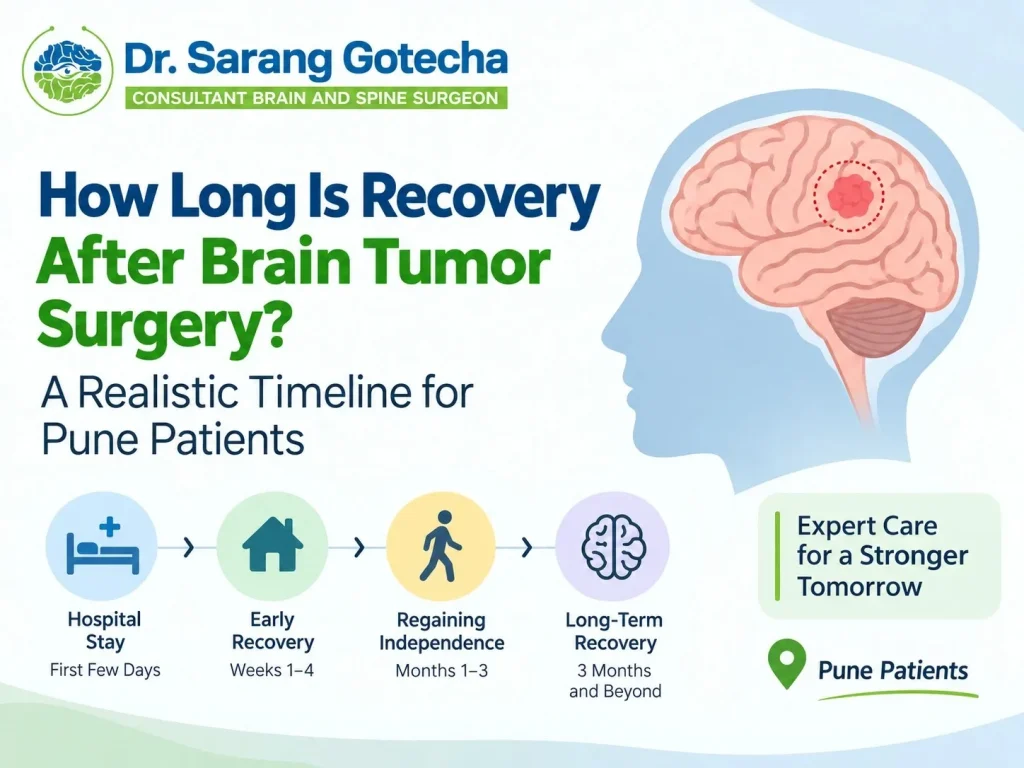
- Brain tumor surgery recovery time Pune realistic is not linear the first 2 weeks are dominated by fatigue, the next 4 weeks by physical rebuilding and months 2 to 6 by cognitive reintegration.
- Brain fatigue overwhelming tiredness disproportionate to activity is the most common and most under-acknowledged symptom of brain tumor recovery, affecting over 80% of patients.
- Most patients return to desk or IT work 6 to 10 weeks after craniotomy earlier for superficial tumors, later for eloquent area or deep tumors with post-operative neurological changes.
- Driving is typically cleared 3 months after brain tumor surgery in India earlier clearance requires a seizure-free period and surgeon sign-off.
- Neurological recovery after brain tumor surgery resolution of weakness, speech changes or visual deficits continues for up to 12 months as brain plasticity compensates for resected tissue.
- The first post-operative MRI at 6 to 8 weeks is the most important milestone it confirms resection completeness and establishes the baseline for surveillance.
- Dr. Sarang Gotecha provides structured post-operative care plans and recovery guidance for all brain tumor patients from Pune, Baner, Wakad and PCMC.
‘How long will it take to get back to normal?’ is the question every brain tumor patient asks before surgery. It deserves a direct, honest answer not a vague ‘it depends’ that leaves families guessing.
Recovery after brain tumor surgery follows a predictable pattern in most cases. The specific timeline is influenced by tumor location, size, whether eloquent areas were involved, the patient’s age and fitness and whether adjuvant treatment (radiation, chemotherapy) follows. This guide provides the week-by-week roadmap that Dr. Sarang Gotecha’s patients in Pune receive before their surgery.
QUICK FACTS
Return to Desk Work: 6 to 10 weeks (most patients)
Driving Clearance: 3 months post-surgery (seizure-free + surgeon sign-off)
First Post-Op MRI: 6 to 8 weeks
Neurological Recovery Window: Up to 12 months for deficits
Brain Fatigue Duration: 2 to 4 months (most patients); longer for GBM
Full Physical Activity: 3 to 4 months
Brain Tumor Surgery Recovery: What Affects the Timeline
| Factor | Faster Recovery | Slower Recovery |
| Tumor location | Superficial, non-eloquent | Deep, eloquent (motor/language) |
| Tumor size | Under 3 cm | Over 5 cm |
| Surgical approach | Mini craniotomy | Complex skull base |
| Post-op neurological deficit | None | Weakness, aphasia, visual field loss |
| Patient age | Under 50 years | Over 65 years |
| Adjuvant treatment | None required | Radiation + chemotherapy (GBM) |
| Pre-op fitness | Physically active, no comorbidities | Sedentary, diabetic, hypertensive |
| Tumor type | Benign (meningioma) | Malignant (GBM, Grade 3) |
Week-by-Week Recovery Roadmap After Brain Tumor Surgery in Pune
Days 1 to 3: The Acute Phase
Day 1 begins with the physiotherapist visiting the bedside. Patients are sat up, helped to the edge of the bed and encouraged to take supervised steps within the room. This early mobilisation is not optional it prevents deep vein thrombosis, reduces post-operative pneumonia risk and begins the neurological recovery process. Pain from the craniotomy wound is managed with oral analgesics. Most patients have a headache but are surprised by how manageable it is.
Brain imaging typically a CT or MRI is performed within 24 hours of surgery to confirm the operative result and rule out early complications such as post-operative haematoma. Neurological observations checking pupils, limb movements, speech, orientation are performed every 1 to 2 hours for the first 24 hours.
Week 1: Home Arrival and Rest
Most craniotomy patients are discharged on Day 5 to 7. The week at home is dominated by one overriding instruction: rest more than you think you need to. Brain surgery places enormous metabolic demand on the healing brain. The body prioritises this healing by generating profound fatigue a fatigue unlike any normal tiredness that does not fully resolve with sleep.
Activities during Week 1: gentle walks around the home or garden, increasing distance each day. Showering (not bathing) is permitted from Day 7 to 10 once the wound has healed. No driving, no lifting over 1 to 2 kg, no screen time beyond 30 to 60 minutes at a stretch. Family support for all daily tasks is essential during this week.
Weeks 2 to 4: Building Gradually
By Week 2, most patients feel meaningfully better than Week 1. The surgical headache has reduced. Appetite is returning. Short outdoor walks of 15 to 20 minutes are appropriate. Screen time can increase to 1 to 2 hours with breaks.
Steroid medications (dexamethasone prescribed for post-operative brain oedema) are typically tapered and stopped during this period some patients notice an energy dip when steroids are reduced, which is temporary. Anti-epileptic medications, if prescribed, continue as directed.
The wound scar is healing and sutures or staples are removed at the 10 to 14 day wound check. Hair begins to regrow over the shaved area. Most patients feel well enough to handle short social visits by Week 3.
Weeks 4 to 8: The Functional Rebuilding Phase
This is where most patients make their most visible progress. Physiotherapy, if prescribed, is now active core strengthening, balance exercises, stair climbing, progressive aerobic activity. Cognitive exercises reading, writing, mental arithmetic, crosswords are appropriate and beneficial during this phase.
Return to part-time desk work typically begins at 4 to 6 weeks for patients with no post-operative neurological deficits and straightforward tumors. Return to full-time desk work is usually 6 to 8 weeks. IT professionals from Pune’s tech corridors in Hinjewadi and Balewadi often request work-from-home clearance at 4 to 5 weeks this is reasonable for most standard craniotomy patients.
Weeks 8 to 12: The MRI Milestone and Beyond
The 6 to 8 week post-operative MRI is the most important milestone in recovery. It confirms whether gross total resection was achieved, identifies any residual tumor and establishes the imaging baseline for surveillance. This MRI result determines whether adjuvant treatment (radiation for GBM, surveillance MRI schedule for benign tumors) is required.
Driving is typically cleared at the 3-month mark in India for patients who: have had no seizures before or after surgery, are not taking medication with sedating effects and have received explicit surgeon clearance. The Motor Vehicle Act does not specify a mandatory post-craniotomy waiting period, but most neurosurgeons advise 3 months as standard.
Brain Fatigue: The Most Under-Acknowledged Recovery Challenge
Brain fatigue also called post-craniotomy fatigue syndrome is the overwhelming tiredness experienced after brain surgery that is disproportionate to physical activity. Among craniotomy patients, this symptom affects more than 80% during the first two months and may continue in 30–40% of patients for up to six months. Although it can occur alongside depression, it is not the same condition. Instead, the symptom is a physiological response to the brain’s increased demands during the healing process.
Managing brain fatigue: plan the day in advance with one primary activity and multiple rest periods. Even a 30-minute outing to a market or a family visit may require 2 to 3 hours of rest afterward. Work reintegration should begin with 2 to 3 hours of cognitively light activity, increasing gradually over 4 to 6 weeks rather than returning to full-time immediately. Families who understand brain fatigue provide better support explaining that the patient ‘looks fine’ but is genuinely exhausted prevents the social pressure to perform beyond capacity.
Cognitive Recovery After Brain Tumor Surgery
Cognitive changes after brain tumor surgery memory difficulties, word-finding problems, concentration impairment, slower information processing are common, particularly after resection near eloquent cortex. Most improve significantly over 3 to 6 months as brain plasticity allows adjacent regions to partially compensate.
A formal neuropsychological assessment at 3 months post-surgery identifies specific cognitive domains affected and guides targeted rehabilitation. Cognitive rehabilitation programmes available through neuropsychologists in Pune use structured exercises to retrain attention, memory and executive function. For patients returning to cognitively demanding IT roles in PCMC’s tech sector, this structured rehabilitation accelerates the return to full working capacity.
Surveillance After Brain Tumor Surgery in Pune
| Tumor Type | Post-Op MRI Schedule | Adjuvant Treatment |
| Benign meningioma (Grade 1, GTR) | 6 weeks, 1 year, then every 2 years | None required |
| Meningioma (Grade 2 or subtotal) | 6 weeks, 6 months, annual | Gamma Knife / radiotherapy for residual |
| GBM (Grade 4) | 6 to 8 weeks, then every 2 to 3 months | Stupp protocol — concurrent RT + TMZ |
| Grade 2 glioma | 6 weeks, 6 months, annual | Observation or radiotherapy per MDT |
| Single brain metastasis | 6 weeks, 3 months, 6 months, annual | Whole brain RT or Gamma Knife per oncology |
| Acoustic neuroma (GTR) | 6 weeks, 1 year, then every 2 to 3 years | None if GTR; Gamma Knife if residual |
Frequently Asked Questions
Q: How long does it take to recover from brain tumor surgery in Pune?
A: Most patients return to desk or IT work 6 to 10 weeks after craniotomy for brain tumor. Driving is cleared at 3 months. Full physical activity resumes at 3 to 4 months. Neurological deficits (weakness, speech changes) continue improving for up to 12 months. Recovery is faster for superficial benign tumors (meningioma) and slower for eloquent area or malignant tumors (GBM) requiring post-operative radiation and chemotherapy.
Q: What is brain fatigue after brain tumor surgery?
A: Brain fatigue is overwhelming tiredness disproportionate to physical activity present in over 80% of craniotomy patients in the first 2 months. It is a physiological consequence of the brain’s healing demands and is not depression. It is managed by planned rest periods, gradual activity increase and a reintegration-focused return to work. Most patients find brain fatigue resolves significantly by Month 3, with full resolution by Month 4 to 6 for benign tumor surgery.
Q: When can I drive after brain tumor surgery in Pune?
A: Driving is typically cleared 3 months after brain tumor surgery in India for patients who have had no seizures, are not on sedating medications and have received explicit neurosurgeon clearance. The 3-month interval is the standard advised by most Indian neurosurgeons. Patients who had seizures before surgery require a longer seizure-free period typically 6 to 12 months before driving clearance. Always confirm with your neurosurgeon before getting behind the wheel.
Q: When can I return to work at an IT company after brain surgery in Pune?
A: Most IT and desk-based workers can return to part-time work-from-home roles at 4 to 6 weeks after craniotomy if there are no significant post-operative neurological deficits. Full-time return is typically 6 to 8 weeks. Cognitively demanding roles involving complex coding, data analysis or management may require additional recovery time of 8 to 12 weeks. A gradual transition starting with 2 to 3 hours daily and increasing is significantly better than an immediate full-time return.
Q: What is the first post-operative MRI after brain tumor surgery and when is it done?
A: The first post-operative MRI is performed 6 to 8 weeks after brain tumor surgery. It uses gadolinium contrast and should ideally be a 3T MRI with the same sequences as the pre-operative scan. This MRI: confirms extent of tumor resection (gross total vs near-total vs subtotal), identifies any early recurrence or residual enhancement and establishes the imaging baseline for all subsequent surveillance scans. The result of this MRI determines whether adjuvant treatment is required.
Q: How long does cognitive recovery take after brain tumor surgery?
A: Cognitive changes memory difficulties, word-finding, concentration impairment are common after brain tumor surgery and improve over 3 to 6 months in most patients. Neuropsychological assessment at 3 months identifies specific affected domains. Structured cognitive rehabilitation through a neuropsychologist accelerates recovery, particularly for patients returning to cognitively demanding work. In some patients with significant pre-operative cognitive impairment from tumor mass effect, cognitive function actually improves after surgery as the pressure on brain tissue is relieved.
Brain tumor surgery recovery time Pune realistic follows a predictable pattern rest-dominated in the first 2 weeks, gradual rebuilding through weeks 4 to 8, cognitive reintegration over months 2 to 6. Brain fatigue is the most common and most misunderstood challenge. Neurological deficits improve over 12 months. Work return is realistic at 6 to 10 weeks for desk roles.
Dr. Sarang Gotecha provides structured post-operative recovery plans, rehabilitation guidance and follow-up protocols for all brain tumor patients from Pune, Baner, Wakad and PCMC. Book your consultation today.
Medical Disclaimer
This article is for general informational purposes only and does not constitute medical advice. It is not a substitute for professional medical consultation, diagnosis or treatment. Always consult a qualified neurosurgeon for any medical concern. Individual outcomes, costs and recovery timelines vary. Dr. Sarang Gotecha and Edgelink Technology Pvt Ltd accept no liability for decisions made solely based on this content.

Dr. Sarang Gotecha
Dr. Sarang Gotecha is a leading brain & spine surgeon in Pune, offering advanced care for complex neurological and spinal conditions. With strong academic credentials (MBBS, MS, MCh Neurosurgery) and years of surgical experience, he is committed to delivering precise, safe, and patient-focused treatments.
- Expert in brain tumor, spine & neuroendoscopic surgeries
- Specialized in minimally invasive & skull base surgeries
- Follows an ethical and patient-centric approach
- Available at clinics in Baner, Wakad, and Thergaon (Pune)