
KEY TAKEAWAYS
- A new-onset seizure in an adult with no prior history of epilepsy is a brain tumor until proven otherwise — it requires immediate MRI.
- The classic brain tumor headache is worst in the morning, improves within an hour of waking and is associated with nausea or vomiting — this pattern is highly distinct from tension or migraine headaches.
- Progressive weakness on one side of the body, developing over days to weeks, is one of the most consistent and underreported early signs of a brain tumor.
- Personality changes, increased irritability and impaired judgement — particularly in adults over 40 — can be the first presenting feature of a frontal lobe tumor.
- Most brain tumors in Pune are diagnosed after symptoms have been present for 3 to 9 months — earlier detection significantly improves surgical and survival outcomes.
- A normal CT scan does not exclude a brain tumor — MRI with gadolinium contrast is the required investigation for neurological symptoms.
- Dr. Sarang Gotecha offers urgent brain tumor assessment for patients from Pune, Baner, Wakad, Thergaon and PCMC.
Brain tumors don’t always announce themselves with dramatic collapses or sudden neurological events. More often, their early signs are subtle, gradual and easily attributed to stress, poor sleep or simply getting older. This is why the average time between first symptom and brain tumor diagnosis in India is 3 to 9 months — and why early recognition matters enormously.
This guide was written based on what neurosurgeons in Pune actually see in their OPDs: the symptoms that brought patients through the door and the warning signs they had been experiencing for months without acting on. Reading this list carefully could make the difference between removing a small, well-demarcated tumor and managing one that has grown into eloquent brain territory.
Brain Tumor Symptom Statistics in India 2025-2026
| Symptom | Frequency in Brain Tumor Patients | Notes | Source |
| Headache | 50 to 60% | Often progressive, morning-dominant | Published literature |
| Seizures | 20 to 40% | New-onset in adults — major red flag | Published literature |
| Cognitive or personality change | 30 to 40% | Common with frontal lobe tumors | Published literature |
| Motor weakness | 30 to 40% | Progressive, one side | Published literature |
| Visual disturbances | 20 to 30% | Blurring, field defects, double vision | Published literature |
| Speech problems | 10 to 20% | Word-finding, fluency issues | Published literature |
| Average delay to diagnosis in India | 3 to 9 months | Industry estimate | Industry estimate |
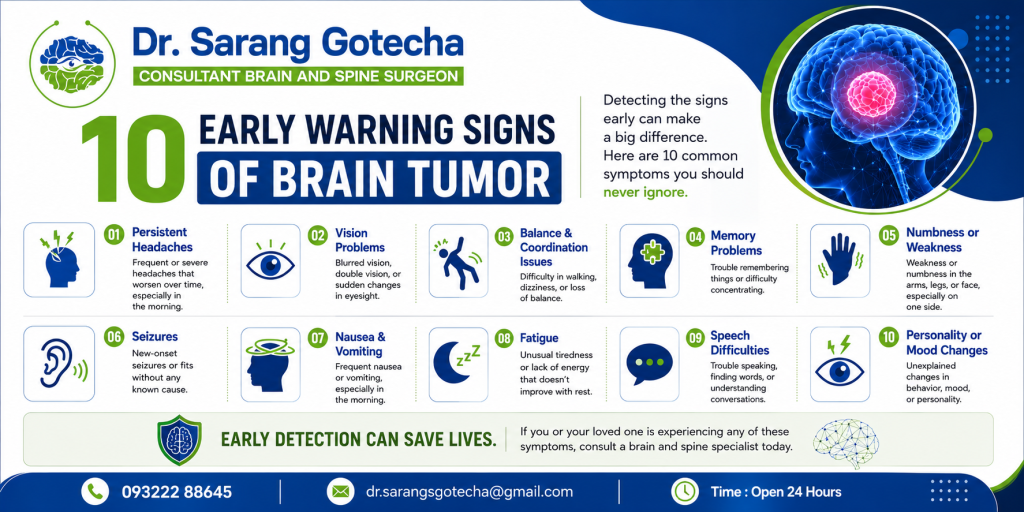
10 Early Warning Signs of a Brain Tumor — Explained by a Pune Neurosurgeon
1. Morning Headaches That Improve After Getting Up
Tension headaches and migraines are typically worse with activity and better with rest. Brain tumor headaches often follow the opposite pattern. Lying flat at night increases intracranial pressure — the tumor and any surrounding brain swelling produce more pressure in the horizontal position. Morning headache that eases 30 to 60 minutes after getting up and moving is a classic pattern of raised intracranial pressure. It is worth noting if this pattern repeats over 2 to 4 weeks.
Is every morning headache a brain tumor? Absolutely not. Most morning headaches are dehydration, sleep apnea or tension-related. But a new morning headache pattern — particularly in someone without a prior headache history, especially over 40 years old — warrants clinical assessment.
2. New-Onset Seizure in an Adult
A first-ever seizure in an adult who has never had epilepsy is a neurological emergency. It is a brain tumor until proven otherwise, and it requires an urgent MRI with contrast within 24 to 48 hours of the event. Seizures from brain tumors occur because the tumor irritates the surrounding cortex, generating abnormal electrical activity. They can be generalised (full body convulsion) or focal (twitching in one hand, a brief blank stare, a déjà vu episode).
In Pune, patients who have a first seizure are frequently started on anti-epileptic medication at the emergency department and discharged without brain imaging. This is a missed opportunity. Any adult with a first seizure needs an MRI — not just an EEG and medication.
3. Progressive Weakness on One Side
Weakness developing in one arm or one leg, gradually worsening over weeks, is one of the most consistent structural neurological signs. When a tumor grows in the motor cortex or the white matter pathways beneath it, it compresses or disrupts the motor signals travelling from brain to limb. The weakness is often noticed first as dropping objects, tripping on one foot or difficulty with fine tasks like typing or buttoning.
4. Speech or Language Difficulties
Tumors in or near the language areas of the brain — Broca’s area (speech production) or Wernicke’s area (speech comprehension) in the dominant hemisphere — present with speech changes. Patients notice difficulty finding words mid-sentence, substituting wrong words, or struggling to understand what others are saying. These symptoms are frequently attributed to stress or fatigue before a neurological cause is considered.
5. Persistent Vision Changes
Visual symptoms from brain tumors depend on where the visual pathway is affected. A tumor pressing on the optic chiasm (often a pituitary tumor) causes bitemporal visual field loss — the outer peripheral vision in both eyes. Tumors affecting the occipital lobe cause hemianopia (loss of half the visual field). Raised intracranial pressure causes papilloedema (swelling of the optic disc), detected on fundoscopy. Persistent double vision (diplopia) suggests cranial nerve involvement.
6. Personality Changes and Cognitive Decline
Frontal lobe tumors are notoriously insidious in their presentation. The frontal lobe governs executive function, personality, impulse control and social behaviour. A person with a growing frontal tumor may become increasingly irritable, make uncharacteristically poor decisions, show reduced empathy or become inappropriately jovial (disinhibition). Family members often notice these changes before the patient does.
In Pune’s middle-aged and older adult population, these symptoms are regularly attributed to work stress, marital discord or early-onset dementia. A new onset of personality change in an adult without a clear psychiatric or psychosocial explanation warrants neurological evaluation.
7. Unexplained Nausea and Vomiting
Vomiting caused by raised intracranial pressure — not from gastric disease — is characteristically projectile, occurs without preceding nausea in some cases and is often worst in the morning. It is one of the classic features of brain tumor-related intracranial hypertension, particularly in children and young adults with rapidly growing tumors. This symptom combined with morning headache is a high-yield combination for urgent brain imaging.
8. Balance Problems and Coordination Difficulties
Tumors in the cerebellum (posterior fossa) cause distinctive coordination problems: difficulty walking in a straight line, stumbling to one side, inability to perform fine coordinated movements and a broad-based unsteady gait. Cerebellar symptoms are different from leg weakness — the strength in the limbs is preserved but the coordination between them is impaired.
9. Hearing Loss or Ringing in One Ear
Acoustic neuroma (vestibular schwannoma) is a benign tumor of the hearing nerve that presents with unilateral progressive sensorineural hearing loss, tinnitus (ringing in one ear) and sometimes vertigo. These symptoms develop so slowly that most patients attribute them to ear wax or ageing and do not seek imaging for 1 to 3 years after onset. Unilateral hearing loss with tinnitus in an adult under 60 years warrants an MRI of the posterior fossa.
10. Unexplained Memory Problems in a Previously Sharp Adult
Memory disturbance — difficulty recalling recent events, getting lost in familiar places, forgetting appointments — can be the presenting feature of tumors in the temporal lobe or limbic system. In adults under 60, this presentation should not be automatically attributed to early Alzheimer’s disease without first obtaining brain imaging. A temporal lobe tumor or a slowly growing meningioma compressing the memory circuits can mimic early dementia precisely.
Red-Flag Timelines: When to Act Immediately
| Symptom | Timeline to Action | Why |
| First adult seizure | Within 24 to 48 hours — urgent MRI | Brain tumor until proven otherwise |
| Sudden severe ‘thunderclap’ headache | Emergency — same hour | Possible subarachnoid haemorrhage |
| Progressive arm or leg weakness over days | Within 48 to 72 hours — urgent MRI | Rapidly growing or oedematous tumor |
| New double vision with headache | Within 48 hours | Raised intracranial pressure, cranial nerve involvement |
| Personality change plus headache, 2+ weeks | Within 1 to 2 weeks — MRI | Frontal or temporal lobe tumor |
| Morning headache pattern, 3+ weeks | Within 2 weeks | Raised intracranial pressure pattern |
| Unilateral hearing loss under 60 years | Within 4 weeks | Acoustic neuroma or other CPA tumor |
Why a CT Scan Is Not Enough
CT scans of the brain are excellent for detecting bleeding, fractures and large masses. They are the right first step in an emergency department. But CT misses up to 20 to 30% of brain tumors — particularly small tumors, tumors in the posterior fossa (where bone artefact degrades image quality) and low-grade gliomas that don’t appear clearly on non-contrast CT.
If you have been told ‘your CT is normal’ but your symptoms persist, you need an MRI with gadolinium contrast. This is the imaging standard for brain tumor diagnosis. A normal CT does not exclude a brain tumor. This is one of the most important messages in this guide.
Brain Tumor Assessment in Pune and PCMC
If you or a family member has experienced any of the 10 warning signs described in this guide — particularly morning headaches, a first adult seizure, progressive limb weakness or personality change — the appropriate next step is a consultation with a neurosurgeon, not a watch-and-wait approach.
Dr. Sarang Gotecha offers brain tumor assessment for patients from Pune, Baner, Wakad, Thergaon and PCMC. A consultation includes a full neurological examination, MRI review and a transparent discussion of findings and recommendations. Early consultation, when tumors are still small and surgically accessible, produces the best possible outcomes. Book at drsaranggotecha.com.
Frequently Asked Questions
Q: What are the most common early signs of a brain tumor in adults?
The most common early signs of a brain tumor in adults are: new-onset headaches that are worst in the morning, a first-ever adult seizure, progressive weakness on one side of the body, personality or cognitive changes, visual disturbances and speech difficulties. No single symptom confirms a brain tumor — the pattern, progression over time and results of MRI brain imaging determine the diagnosis.
Q: Can headache alone be a sign of a brain tumor?
Most headaches are not brain tumors. However, a headache that is new in onset for someone who doesn’t normally have headaches, worst in the morning, associated with nausea or vomiting, or progressively worsening over 2 to 4 weeks warrants neurological evaluation. A headache that wakes you from sleep at night is a particular red flag. Reassurance without brain imaging is not appropriate for this headache pattern.
Q: What investigation is needed to diagnose a brain tumor?
MRI of the brain with gadolinium contrast is the gold-standard investigation for brain tumor diagnosis. It identifies the tumor’s location, size, relationship to critical structures and imaging characteristics that help determine tumor type. CT is useful in emergencies but misses 20 to 30% of brain tumors. A normal CT does not rule out a brain tumor if neurological symptoms are present.
Q: Is a new seizure in an adult always caused by a brain tumor?
No — but a new seizure in an adult who has never had epilepsy requires urgent MRI to exclude a structural cause. 15 to 25% of new adult seizures are associated with a structural brain abnormality including tumors, vascular malformations or previous injuries. Anti-epileptic medication controls seizures but does not address the underlying cause. Always obtain MRI after a first adult seizure.
Q: How quickly should I see a neurosurgeon if I have brain tumor symptoms?
A: For sudden severe headache, first adult seizure or rapidly progressive weakness — seek evaluation the same day or within 24 to 48 hours. For progressive symptoms developing over weeks (morning headaches, personality change, progressive limb weakness) — consult a neurosurgeon within 1 to 2 weeks. The earlier a brain tumor is detected, the smaller it typically is and the better the surgical outcome.
Q: Where can I get a brain tumor evaluation in Pune or PCMC?
A: Dr. Sarang Gotecha offers brain tumor assessment and MRI review for patients from across Pune, Baner, Wakad, Thergaon and PCMC. He conducts a full neurological examination, reviews imaging and provides a clear, honest assessment of whether a brain tumor is present and what the appropriate next steps are. Appointments are available at drsaranggotecha.com.
Brain tumors are most treatable when detected early. The 10 warning signs in this guide are the symptoms that experienced neurosurgeons in Pune use to decide when urgent imaging is warranted. Morning headaches, first adult seizures, progressive weakness and personality changes are not symptoms to dismiss or delay acting on.
If you recognise any of these patterns in yourself or a family member, book a consultation with Dr. Sarang Gotecha at drsaranggotecha.com. Early assessment is always better than late diagnosis.

Dr. Sarang Gotecha
Dr. Sarang Gotecha is a leading brain & spine surgeon in Pune, offering advanced care for complex neurological and spinal conditions. With strong academic credentials (MBBS, MS, MCh Neurosurgery) and years of surgical experience, he is committed to delivering precise, safe, and patient-focused treatments.
- Expert in brain tumor, spine & neuroendoscopic surgeries
- Specialized in minimally invasive & skull base surgeries
- Follows an ethical and patient-centric approach
- Available at clinics in Baner, Wakad, and Thergaon (Pune)