
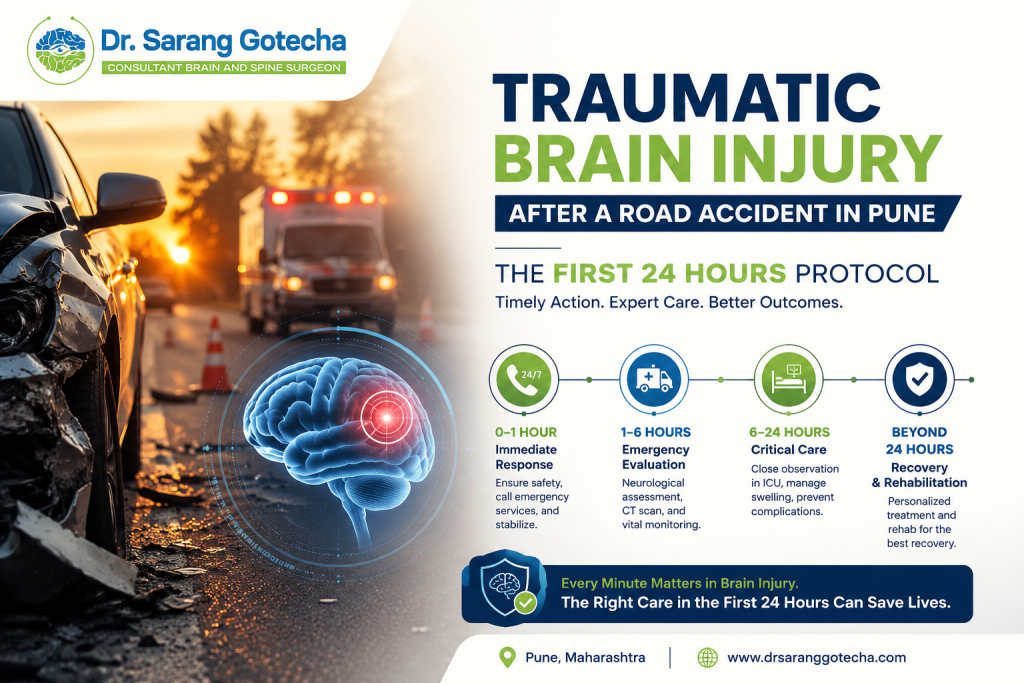
KEY TAKEAWAYS
- India has one of the highest rates of road accident fatalities globally — Pune and PCMC record over 400 road deaths annually, with head injury being the leading cause of death.
- The first 60 minutes after a traumatic brain injury — the golden hour — determines whether the patient survives and with what neurological outcome.
- Three immediately correctable secondary brain injuries kill TBI patients who survived the initial impact: hypoxia (low oxygen), hypotension (low blood pressure) and raised intracranial pressure.
- An expanding epidural haematoma can be fatal within 2 to 4 hours of a road accident — surgical evacuation within this window is life-saving.
- The GCS (Glasgow Coma Scale) is the bedside tool used to assess TBI severity — a score under 8 indicates severe TBI requiring immediate neurosurgical evaluation.
- All significant head injuries in Pune should be taken to a hospital with 24-hour CT scanning and neurosurgical ICU capability — not the nearest clinic.
- Dr. Sarang Gotecha manages TBI patients including emergency craniotomy for acute haematomas across Pune and PCMC.
Every year, thousands of families in Pune receive the call no one wants: a road accident, a head injury, a hospital. In the chaos of that moment, knowing what to do — and what not to do — can be the difference between a full recovery and permanent disability or death.
Traumatic brain injury (TBI) is not simply ‘getting hit on the head’. It is a complex cascade of primary injury (the impact itself) and secondary injury (the biological consequences that unfold in the hours after) that experienced neurosurgeons are trained to interrupt. This guide explains the golden hour protocol for TBI in Pune, what happens at the hospital and when surgery is needed.
QUICK FACTS
Annual Road Deaths in Pune: Over 400 per year (Industry estimate — traffic data)
Head Injury as TBI Cause: Leading cause of road accident death in India
GCS Score for Severe TBI: Under 8 — requires immediate neurosurgical evaluation
Epidural Haematoma Fatal Window: Can be fatal within 2 to 4 hours without surgery
Golden Hour: First 60 minutes from injury to definitive care
CT Brain — Time to Scan: Within 30 minutes of ED arrival for moderate-severe TBI
TBI Statistics in Pune and India 2025-2026
| Metric | Data Point | Source |
| Annual road accident deaths — India | ~1,50,000 per year | MoRTH India |
| Head injury as cause of road death | ~60% | Industry estimate |
| Annual TBI cases in Pune | ~3,000 to 5,000 (Industry estimate) | Industry estimate |
| Epidural haematoma surgical window | Under 2 to 4 hours | Published neurosurgical literature |
| Mortality with surgical treatment vs without | ~10 to 20% vs ~70% (EDH) | Published literature |
| GCS under 8 — mortality risk without treatment | ~50 to 70% | Published literature |
| PCMC road accident two-wheeler involvement | ~70% of serious cases (Industry estimate) | Industry estimate |
Understanding Traumatic Brain Injury: Primary vs Secondary Injury
TBI has two components that neurosurgeons distinguish carefully — because only the second is treatable.
Primary brain injury is the damage that occurs at the moment of impact: contusions (bruising of brain tissue), lacerations, diffuse axonal injury from rotational forces and skull fractures. This injury is fixed at the moment it occurs — no intervention reverses it. The neurosurgeon cannot undo the damage the road did.
Secondary brain injury is everything that happens after the impact: hypoxia (the brain is deprived of oxygen because the airway is compromised), hypotension (blood pressure drops from blood loss and the brain loses its blood supply), raised intracranial pressure (blood accumulates in the skull, compressing the brain), brain oedema (swelling) and metabolic disturbances. Every one of these secondary injury mechanisms is preventable or treatable — and that is what the first 24 hours of TBI management are about.
What to Do at the Scene: The Bystander’s Role in Pune
Step 1: Call for Emergency Transport Immediately
The moment a road accident involves a head injury — loss of consciousness, confusion, inability to remember the accident, visible head wound, unequal pupils, fitting — call 108 (National Ambulance Service) or 112 immediately. Don’t waste time finding a private vehicle. Trained paramedics can manage the airway, establish IV access and prevent secondary injury during transport in ways that a bystander in a private car cannot.
Step 2: Do Not Move the Patient Unless in Immediate Danger
A significant proportion of road accident TBI patients also have cervical spine injuries. Moving a patient with an unstable neck fracture incorrectly — lifting under the arms, dragging by the legs — can convert an incomplete spinal cord injury into a complete one. If the patient is not in immediate danger from fire, traffic or drowning, stabilise the head manually and wait for the ambulance. If you must move them, keep the head, neck and body aligned as a single unit.
Step 3: Airway, Breathing, Basic Assessment
While waiting for the ambulance: check if the patient is breathing — look for chest rise, listen for breath sounds. If they are not breathing and you are trained in basic life support, begin CPR. If they are breathing but unconscious, the recovery position (lateral, head extended to open the airway) reduces the risk of aspiration. Do not give water or food. Do not remove a helmet forcibly if one is being worn — the paramedics have equipment to do this safely.
The Golden Hour: What Happens at the Emergency Department
In Pune’s emergency departments with neurosurgical capability, the TBI protocol activates the moment a trauma patient with head injury arrives. The ABCDE assessment (Airway, Breathing, Circulation, Disability, Exposure) runs simultaneously with trauma history and neurological assessment.
The GCS (Glasgow Coma Scale) is scored immediately: eye opening (1-4), verbal response (1-5) and motor response (1-6). A total GCS of 13-15 is mild TBI. A GCS of 9-12 is moderate TBI. A GCS of 8 or below is severe TBI requiring immediate CT brain, anaesthesia involvement and neurosurgical consultation.
CT brain without contrast is performed within 30 minutes of ED arrival for moderate-to-severe TBI. CT spine is added if neck injury is possible. CT brain identifies the lesions that require emergency surgery: epidural haematoma, subdural haematoma, intracerebral haematoma, depressed skull fracture with underlying brain injury and diffuse cerebral oedema with midline shift.
Surgical Emergencies After TBI: When the Neurosurgeon Acts
| TBI Lesion | Appearance on CT | Surgical Threshold | Outcome Without Surgery |
| Epidural haematoma (EDH) | Lens-shaped (biconvex) bright collection | Volume over 30 ml or shift over 5 mm | Fatal in 2 to 4 hours |
| Acute subdural haematoma | Crescent-shaped bright collection | Thickness over 10 mm or shift over 5 mm | High mortality — 50 to 70% |
| Intracerebral haematoma | Round bright collection in brain | Volume over 30 ml with GCS decline | Progressive deterioration |
| Depressed skull fracture | Bone fragments pressed inward | Open fracture, cosmetic, dural breach | Infection, seizure risk |
| Diffuse axonal injury | Diffuse microhaemorrhages, white matter changes | Supportive — no surgical role | Outcome depends on severity |
| Raised ICP from oedema | Effaced cisterns, midline shift, sulcal loss | ICP monitor, decompressive craniectomy | Brain herniation, death |
ICP Monitoring and Medical Management in the Neurosurgical ICU
For TBI patients who do not require immediate surgery but have a GCS under 9 or CT showing cerebral oedema and raised ICP risk, management in a neurosurgical ICU is essential. Intracranial pressure monitoring (using an ICP bolt or external ventricular drain) guides treatment decisions in real time.
The ICP management bundle in Pune’s neurosurgical ICUs includes: head elevation to 30 degrees, osmotic therapy (mannitol or hypertonic saline) to draw fluid out of the brain, ventilation control to maintain optimal CO2 levels, blood pressure management to maintain cerebral perfusion pressure above 60 mmHg, temperature control and sedation protocols to reduce metabolic demand.
When all medical measures fail to control ICP — typically when sustained ICP above 25 mmHg persists despite maximal therapy — decompressive craniectomy (removing a large bone flap to allow the swollen brain to expand outward) is a life-saving option. The bone flap is stored and replaced 3 to 6 months later when brain swelling has resolved.
TBI Management in Pune and PCMC: Where to Go
Not every hospital in Pune or PCMC is equipped to manage moderate-to-severe TBI. The minimum requirements are: 24-hour CT scanner with immediate availability, a neurosurgical team available for emergency surgery, a neurosurgical ICU with ICP monitoring capability and blood bank access for emergency surgery.
For patients in the Baner, Wakad, Thergaon and wider PCMC zone, several hospitals along the Baner-Wakad corridor and in the PCMC municipal area now meet these requirements. Dr. Sarang Gotecha is available for emergency neurosurgical consultation and management of TBI patients including emergency craniotomy for acute haematomas.
Pre-saving his contact at drsaranggotecha is recommended for families of high-risk road users.
Frequently Asked Questions
Q: What should I do if a family member has a head injury after a road accident in Pune?
Call 108 or 112 immediately for ambulance transport. Do not move the patient unless in immediate danger — possible cervical spine injury means any incorrect movement can cause paralysis. If unconscious but breathing, place carefully in the recovery position. Go to the nearest hospital with 24-hour CT and neurosurgical capability, not the nearest clinic. Time from injury to CT to surgery determines outcome — every minute matters.
Q: What is the golden hour in traumatic brain injury?
The golden hour refers to the first 60 minutes after a traumatic brain injury when rapid assessment, CT imaging and surgical intervention can prevent secondary brain injury and death. Secondary brain injuries — hypoxia, hypotension, raised intracranial pressure — are the treatable killers. Arriving at a hospital with neurosurgical capability within 60 minutes of injury gives TBI patients the best possible chance of survival and recovery.
Q: What is the GCS and why does it matter in head injury?
The Glasgow Coma Scale (GCS) is a bedside scoring tool that measures three components: eye opening (1-4), verbal response (1-5) and motor response (1-6). A total score of 15 is normal; a score of 8 or below indicates severe TBI requiring immediate neurosurgical evaluation, CT brain and ICU admission. GCS is used at every stage of TBI management to monitor deterioration or improvement.
Q: When is emergency surgery needed after a head injury?
Emergency surgery is required when CT brain shows: an epidural haematoma over 30 ml or causing midline shift over 5 mm, an acute subdural haematoma over 10 mm thick or causing shift over 5 mm, an intracerebral haematoma causing neurological deterioration, an open depressed skull fracture or diffuse cerebral oedema unresponsive to medical ICP management. These are neurosurgical emergencies — surgery within 2 to 4 hours of diagnosis significantly reduces mortality.
Q: What is decompressive craniectomy and when is it used for TBI?
Decompressive craniectomy involves removing a large bone flap from the skull to allow the swollen brain to expand outward rather than compressing itself against the rigid skull. It is used for severe TBI with raised intracranial pressure that does not respond to maximal medical management. The removed bone flap is preserved and replaced (cranioplasty) 3 to 6 months later when brain swelling has subsided.
Q: Does Dr. Sarang Gotecha manage traumatic brain injury in Pune?
Yes. Dr. Sarang Gotecha manages traumatic brain injury including emergency craniotomy for acute epidural and subdural haematomas, ICP monitoring and neurosurgical ICU care across Pune and PCMC. He is available for emergency neurosurgical consultation through hospitals in the Baner-Wakad corridor. Contact information is available at drsaranggotecha.com.
The first 24 hours after a traumatic brain injury in Pune are the hours that determine outcome. Calling the ambulance immediately, reaching a hospital with CT and neurosurgical capability within the golden hour and receiving emergency surgery for surgically treatable haematomas are the three interventions with the greatest impact on survival and neurological recovery.
For TBI emergency management, neurosurgical consultation and complex head injury care across Pune and PCMC,
Dr. Sarang Gotecha is available at drsaranggotecha 24 hrs Contact us

Dr. Sarang Gotecha
Dr. Sarang Gotecha is a leading brain & spine surgeon in Pune, offering advanced care for complex neurological and spinal conditions. With strong academic credentials (MBBS, MS, MCh Neurosurgery) and years of surgical experience, he is committed to delivering precise, safe, and patient-focused treatments.
- Expert in brain tumor, spine & neuroendoscopic surgeries
- Specialized in minimally invasive & skull base surgeries
- Follows an ethical and patient-centric approach
- Available at clinics in Baner, Wakad, and Thergaon (Pune)