
KEY TAKEAWAYS
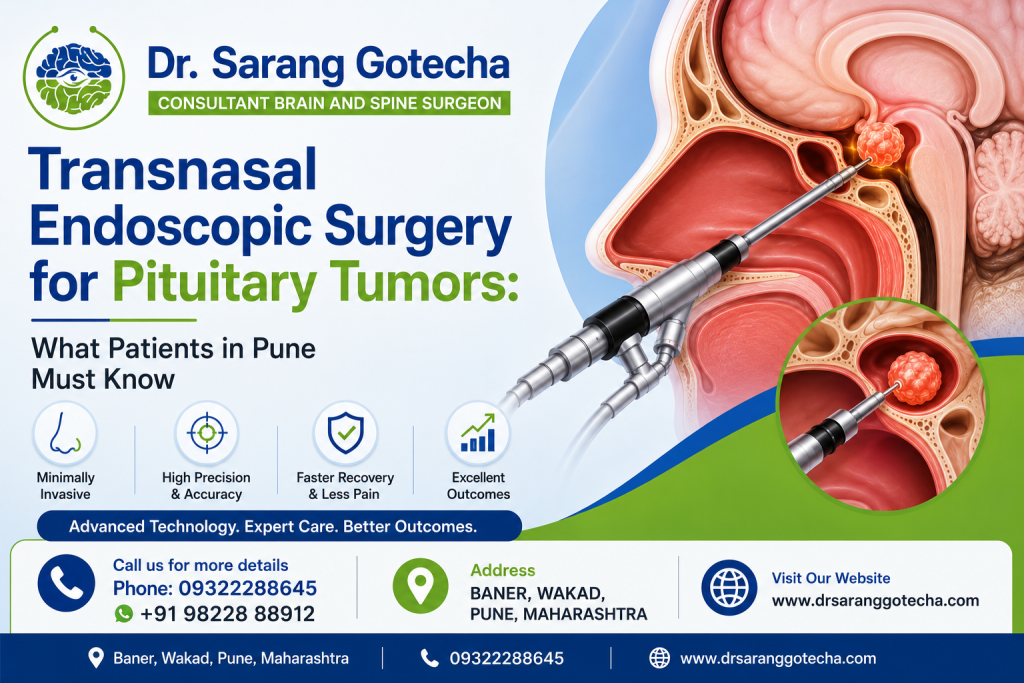
- Transnasal endoscopic surgery is now the gold-standard approach for most pituitary tumors — it uses the natural nasal passage as a surgical corridor, leaving no external scar.
- The pituitary gland sits in the sella turcica at the base of the skull, just behind the nasal passages — making the transnasal route the most direct access with the least brain manipulation.
- Pituitary macroadenomas (over 1 cm) can cause visual field loss by compressing the optic chiasm — surgical decompression often reverses this visual loss if performed before permanent damage.
- Transnasal endoscopic pituitary surgery has a complete resection rate of 75 to 90% for non-functioning adenomas and 60 to 80% for functioning (hormone-secreting) adenomas.
- Surgery for pituitary tumors in Pune costs INR 3,50,000 to INR 6,00,000 all-inclusive, depending on tumor size, complexity and hospital tier.
- Most patients are discharged within 3 to 5 days with no external wound, no skull incision and return to work within 2 to 3 weeks.
- Dr. Sarang Gotecha is experienced in transnasal endoscopic pituitary surgery for patients from Pune, PCMC, Baner and Wakad.
The pituitary gland is a pea-sized master gland at the base of the brain that controls thyroid function, cortisol production, growth hormone, reproductive hormones and water balance. When a benign tumor grows within it — a pituitary adenoma — the consequences range from hormonal dysfunction and infertility to visual loss and life-threatening hormone excess.
The good news is that pituitary tumors are among the most surgically accessible brain lesions. The transnasal endoscopic approach — operating through the nose without any external incision, skull opening or brain retraction — has transformed pituitary surgery into a procedure with a rapid recovery and an excellent outcome profile. This guide explains exactly how it works, what patients in Pune can expect and what the surgery costs.
QUICK FACTS
Pituitary Adenoma Prevalence: ~10% of all brain tumors; most common intracranial tumor in adults
Approach Used: Transnasal endoscopic (through the nose) — no external incision
Hospital Stay: 3 to 5 days
Return to Work: 2 to 3 weeks
Surgery Cost in Pune 2026: INR 3,50,000 to INR 6,00,000
Visual Improvement After Surgery: 70 to 80% of patients with pre-op visual field defects improve
Pituitary Tumor Statistics in India 2025-2026
| Metric | Data Point | Source |
| Pituitary adenomas as proportion of brain tumors | ~10 to 15% | Published literature |
| Annual pituitary surgeries in India | ~3,000 to 5,000 (Industry estimate) | Industry estimate |
| Proportion using endoscopic transnasal approach | Over 80% at experienced centres | Industry estimate |
| Complete resection rate — non-functioning macroadenoma | 75 to 90% | Published literature |
| Visual improvement rate after chiasmal decompression | 70 to 80% | Published literature |
| Recurrence rate at 10 years (non-functioning adenoma) | 10 to 20% after gross total resection | Published literature |
| Surgery cost in Pune (all-inclusive) | 3,50,000 to 6,00,000 INR | Industry estimate |
Types of Pituitary Tumors and Why They Matter
Non-Functioning Adenomas
These tumors don’t secrete hormones in excess — they cause symptoms purely by growing large enough to compress surrounding structures. When a macroadenoma (over 1 cm) extends upward into the suprasellar space, it compresses the optic chiasm — the crossroads of the visual pathways — causing the characteristic bitemporal visual field loss (tunnel vision with outer fields absent). Headache from sella expansion is also common. These tumors require surgery when they cause visual compromise or are growing.
Functioning Adenomas — Prolactinomas
Prolactin-secreting adenomas (prolactinomas) are the most common functioning adenomas and are often managed medically with dopamine agonists (cabergoline, bromocriptine). Surgery is indicated when medical management fails, causes intolerable side effects or in patients who wish to avoid lifelong medication. The transnasal approach normalises prolactin in 70 to 80% of surgical cases.
Acromegaly — Growth Hormone Secreting Adenomas
Excess growth hormone causes acromegaly — enlargement of hands, feet and facial features, joint pain, diabetes and cardiovascular disease. Surgical remission (normalisation of IGF-1 levels) is achieved in 50 to 80% of patients, with better rates for smaller tumors confined to the sella. Patients with persistent post-operative GH excess require adjuvant radiosurgery or medical therapy.
Cushing’s Disease — ACTH Secreting Adenomas
ACTH-secreting microadenomas cause Cushing’s disease — cortisol excess leading to central obesity, hypertension, diabetes, osteoporosis and severe immunosuppression. These are often small and difficult to localise on MRI. Surgical remission rates are 70 to 85% in experienced hands. Dr. Sarang Gotecha’s training at National Neuroscience Institute, Singapore — a high-volume pituitary surgery centre — is directly relevant here.
The Transnasal Endoscopic Approach: Step by Step
The transnasal endoscopic approach to the pituitary gland uses the natural nasal cavity as the surgical corridor. No incision on the face or scalp. No retraction of brain tissue. The surgical path goes through the nostril, through the posterior nasal cavity, through the sphenoid sinus and into the sella turcica — the bony hollow at the skull base where the pituitary gland sits.
The endoscope provides a wide-angle, high-definition view of the sella and surrounding structures. The neurosurgeon and ENT surgeon work together — the ENT surgeon manages the nasal and sphenoid sinus access while the neurosurgeon performs the intrasellar tumor removal with microscopic instruments. The tumor is removed in fragments through the same nostril-sized opening. Once resection is complete, the sellar floor is reconstructed with fat graft, fascia and sometimes a nasal septal flap to prevent CSF leak.
The entire procedure takes 2 to 4 hours under general anaesthesia. There is no external wound. The patient wakes up with nasal packing in place for 24 to 48 hours, which is the primary source of post-operative discomfort.
Pre-Operative Preparation for Pituitary Surgery
Pre-operative workup for transnasal pituitary surgery includes: MRI pituitary with dedicated sequences (including dynamic gadolinium), full pituitary hormone panel (GH, IGF-1, prolactin, ACTH, cortisol, FSH, LH, TSH, free T4), visual field testing (Goldman or Humphrey perimetry) and anaesthesia fitness assessment.
Patients with Cushing’s disease require careful endocrinological optimisation before surgery — elevated cortisol impairs healing and increases infection risk. Patients with acromegaly should have their GH excess managed as far as possible pre-operatively if surgery is not urgent. An endocrinologist should be involved in the peri-operative management of all functioning adenomas — neurosurgery and endocrinology working together produces the best outcomes.
Recovery After Transnasal Pituitary Surgery in Pune
| Recovery Milestone | Timeline |
| Nasal packing removal | 24 to 48 hours post-surgery |
| Hospital discharge | Day 3 to 5 |
| Nasal crusting and discharge resolution | 2 to 4 weeks |
| Return to desk / office work | 2 to 3 weeks |
| Return to physical exercise | 4 to 6 weeks |
| Driving | 2 to 3 weeks (once cleared by surgeon) |
| First post-operative MRI | 6 to 8 weeks post-surgery |
| Hormone assessment post-op | 6 weeks and 3 months post-surgery |
| Visual field reassessment | 6 weeks post-surgery |
The most important post-operative warning signs are: a clear watery nasal drip (possible CSF leak — call the surgical team immediately), fever with nasal symptoms (possible meningitis), sudden severe headache (possible haematoma in the sella) and new visual deterioration (urgent re-evaluation needed). These are uncommon — the overall complication rate for transnasal pituitary surgery is under 5% at experienced centres — but patients and families should know them.
Pituitary Surgery Cost in Pune and PCMC 2026
| Cost Component | Amount (INR) | Notes |
| Surgeon’s fee (neurosurgeon + ENT) | 1,00,000 to 2,00,000 | Two-surgeon approach for complex cases |
| Anaesthesia | 30,000 to 60,000 | Neuroanesthesia specialist |
| OT and endoscopy equipment | 50,000 to 1,00,000 | High-definition endoscopy system |
| Hospital ward stay (3 to 5 nights) | 30,000 to 75,000 | Private room rate |
| ICU stay (1 to 2 nights) | 15,000 to 50,000 | Per night rate |
| Sellar reconstruction materials | 20,000 to 50,000 | Fat graft, fascia, nasal septal flap |
| Post-op medications and hormones | 5,000 to 15,000 | Nasal rinses, antibiotics, steroids |
| Total all-inclusive estimate | 3,50,000 to 6,00,000 | Mid-tier Pune hospital |
Pituitary Surgery in Pune and PCMC: What to Expect
A 34-year-old woman from Wakad presented with 8 months of worsening peripheral vision loss and amenorrhea. MRI showed a 2.3 cm pituitary macroadenoma with suprasellar extension compressing the optic chiasm. Prolactin was mildly elevated (stalk compression effect), and FSH and LH were suppressed. Transnasal endoscopic surgery was performed in a banner-affiliated hospital. Gross total resection was confirmed on post-operative MRI at 6 weeks. Visual field perimetry at 6 weeks showed complete normalisation of peripheral vision. Menstrual cycles resumed at 3 months. She returned to her IT role at 2.5 weeks post-surgery with no external wound visible.
This outcome is representative of well-selected non-functioning macroadenoma patients. The transnasal endoscopic approach at an experienced centre in Pune delivers cosmetically excellent, functionally strong results with a short recovery. For pituitary tumor assessment and surgery,
Book a Consultation with Dr. Sarang Gotecha at drsaranggotecha
Frequently Asked Questions
Q: What is transnasal endoscopic surgery for pituitary tumors?
Transnasal endoscopic surgery uses the natural nasal passage as a surgical corridor to access the pituitary gland at the base of the skull, without any external incision or brain retraction. A high-definition endoscope is passed through one nostril, through the sphenoid sinus and into the sella turcica where the pituitary tumor is located. The tumor is removed under direct endoscopic vision and the sellar floor is reconstructed to prevent CSF leak.
Q: How long is recovery after pituitary surgery in Pune?
Most patients are discharged 3 to 5 days after transnasal endoscopic pituitary surgery. Return to desk work is typically 2 to 3 weeks. Nasal crusting and discharge resolve over 2 to 4 weeks. The first post-operative MRI is performed at 6 to 8 weeks. Hormone levels are reassessed at 6 weeks and 3 months post-surgery. There is no external wound — recovery is primarily from the nasal passage and sinus manipulation.
Q: What is the cost of pituitary tumor surgery in Pune in 2026?
Transnasal endoscopic pituitary surgery in Pune costs approximately INR 3,50,000 to INR 6,00,000 all-inclusive, covering the neurosurgeon and ENT surgeon fees, anaesthesia, endoscopy equipment, 3 to 5 day hospital stay, sellar reconstruction materials and post-operative medications. The cost depends on tumor size, complexity and hospital tier.
Q: Will my vision improve after pituitary tumor surgery?
70 to 80% of patients with pre-operative visual field defects from optic chiasm compression experience meaningful visual improvement after successful tumor decompression. Improvement typically begins within days to weeks of surgery as the chiasm recovers from compression. Complete recovery is more likely when surgery is performed before irreversible damage to the optic nerve fibres occurs — which is one of the strongest arguments for early surgical intervention.
Q: Can all pituitary tumors be treated with the transnasal approach?
The transnasal endoscopic approach is suitable for the majority of pituitary adenomas, including most macroadenomas with suprasellar extension. Tumors with significant lateral extension into the cavernous sinus, unusual anatomy or very large suprasellar components may require combined endoscopic and craniotomy approaches. Your neurosurgeon will determine the optimal approach based on your MRI anatomy.
Q: Is pituitary tumor surgery covered under health insurance in India?
Yes. Pituitary tumor surgery including transnasal endoscopic procedures is covered under most comprehensive private health insurance policies in India. Pre-authorisation from your TPA is required. Provide MRI pituitary reports, hormone panel results and the surgeon’s operative plan. Ayushman Bharat PM-JAY covers standard pituitary surgery at empanelled hospitals. CGHS beneficiaries can access CGHS-empanelled centres in Pune.
Transnasal endoscopic pituitary surgery has transformed pituitary tumor care. No external scar, no brain retraction, 3 to 5 day hospital stay and 2 to 3 week recovery represent a dramatic improvement over older surgical approaches. For patients in Pune, PCMC, Baner and Wakad with a pituitary tumor diagnosis, access to this expertise is now locally available.
Dr. Sarang Gotechahttps://drsaranggotecha.com/about offers transnasal endoscopic pituitary surgery with comprehensive pre-operative endocrinological planning and post-operative follow-up.
Book a Consultation At drsaranggotecha

Dr. Sarang Gotecha
Dr. Sarang Gotecha is a leading brain & spine surgeon in Pune, offering advanced care for complex neurological and spinal conditions. With strong academic credentials (MBBS, MS, MCh Neurosurgery) and years of surgical experience, he is committed to delivering precise, safe, and patient-focused treatments.
- Expert in brain tumor, spine & neuroendoscopic surgeries
- Specialized in minimally invasive & skull base surgeries
- Follows an ethical and patient-centric approach
- Available at clinics in Baner, Wakad, and Thergaon (Pune)