
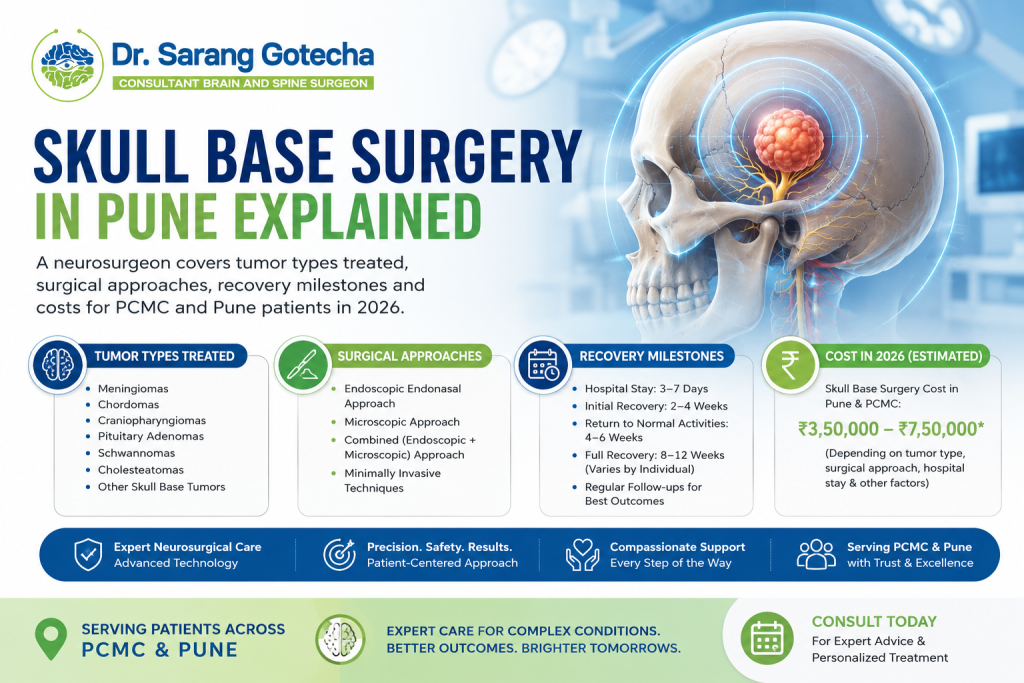
Key Takeways for the Skull Base surgery In Pune
- The skull base is the floor of the cranial cavity — a complex region of bone, nerves and blood vessels where tumors present some of neurosurgery’s most demanding surgical challenges.
- The most common skull base tumors treated surgically in Pune are meningiomas, acoustic neuromas (vestibular schwannomas), pituitary adenomas and chordomas.
- Skull base surgery uses specialised approaches — retrosigmoid, pterional, orbitozygomatic, transpetrosal — that minimise brain retraction and maximise access to deep structures.
- Gross total resection is achieved in over 90% of convexity meningiomas and 80 to 85% of acoustic neuromas at experienced skull base centres.
- Skull base surgery cost in Pune ranges from INR 5,00,000 to INR 12,00,000 depending on tumor type, location, approach and ICU stay.
- Recovery after skull base surgery takes 6 to 12 weeks for most patients, with full neurological recovery continuing for up to 12 months.
- Dr. Sarang Gotecha performs skull base surgery for patients across Pune, Baner, Wakad, Thergaon and PCMC with international fellowship training in complex neurosurgery.
The skull base is neurosurgery’s most technically demanding territory. It is a region of dense bone, critical neurovascular structures — the carotid arteries, basilar artery, cranial nerves, brainstem — compressed into a space the size of a fist. Tumors growing here are anatomically challenging not because they are necessarily malignant, but because of where they are.
This guide explains which skull base tumors are treated surgically in Pune, what surgical approaches are used, what patients can realistically expect during recovery and what the costs look like. For families navigating a skull base tumor diagnosis, this information provides the foundation for an informed conversation with a neurosurgeon.
QUICK FACTS
Most Common Skull Base Tumor: Meningioma (40 to 50% of skull base tumors)
Second Most Common: Acoustic neuroma (vestibular schwannoma)
Skull Base Surgery Cost in Pune: INR 5,00,000 to INR 12,00,000
Hospital Stay: 7 to 14 days
Return to Work: 8 to 12 weeks
Gross Total Resection Rate — Meningioma: Over 90% (convexity); lower for cavernous sinus involvement
Skull Base Tumor Statistics in India 2025-2026
| Tumor Type | Proportion of Skull Base Tumors | Surgical Cure Rate | Source |
| Meningioma | 40 to 50% | Over 90% (convexity) | Published literature |
| Acoustic neuroma | 20 to 25% | 80 to 90% GTR | Published literature |
| Pituitary adenoma | 10 to 15% | 75 to 90% GTR (transnasal) | Published literature |
| Chordoma | 3 to 5% | 40 to 60% GTR (difficult) | Published literature |
| Craniopharyngioma | 3 to 5% | Variable — surgery + radiation | Published literature |
| Glomus tumor | 2 to 4% | High with embolisation + surgery | Published literature |
| Skull base metastasis | 5 to 8% | Palliative — decompression focus | Industry estimate |
Common Skull Base Tumors Treated in Pune
Meningiomas — The Most Common Skull Base Tumor
Meningiomas arise from the meningeal coverings of the brain and are the most common skull base tumor. They grow slowly — over years to decades — and are typically benign (WHO Grade 1). Skull base meningiomas are classified by location: sphenoid wing, olfactory groove, tuberculum sellae, petroclival, tentorial and cavernous sinus. Location determines both the surgical approach and the likelihood of complete removal.
Convexity and parasagittal meningiomas are the most surgically accessible — gross total resection exceeds 90% and recurrence is rare. Petroclival and cavernous sinus meningiomas are among the most challenging skull base lesions, given their proximity to the basilar artery, brainstem and multiple cranial nerves. Planned subtotal resection followed by radiosurgery (Gamma Knife or CyberKnife) is increasingly preferred for tumors invading the cavernous sinus to reduce cranial nerve morbidity.
Acoustic Neuroma — Vestibular Schwannoma
Acoustic neuromas are benign tumors of the vestibular nerve in the internal auditory canal and cerebellopontine angle (CPA). They present with progressive unilateral hearing loss, tinnitus and sometimes vertigo. Large tumors cause brainstem compression, hydrocephalus and cerebellar signs. Treatment options include observation (small tumors), radiosurgery (Gamma Knife for tumors under 3 cm) and microsurgical resection (for large tumors, compressive symptoms or patient preference).
The three surgical approaches for acoustic neuroma — retrosigmoid, translabyrinthine and middle fossa — offer different trade-offs between hearing preservation, facial nerve preservation and completeness of resection. Facial nerve monitoring during surgery is mandatory — preserving the facial nerve’s integrity while removing the tumor is the primary surgical goal alongside decompressing the brainstem.
Chordoma — The Most Challenging Skull Base Tumor
Chordomas arise from remnants of the notochord (the embryonic spine precursor) at the clivus (the bone at the base of the skull in front of the brainstem). They are locally aggressive, erode through bone, encase major vessels and cranial nerves and frequently require combined neurosurgical and skull base approaches. Gross total resection is achievable in only 40 to 60% of cases given the anatomical constraints. Post-operative high-dose proton beam radiation is the standard adjuvant treatment for residual tumor.
Craniopharyngioma
Craniopharyngiomas are benign but locally destructive tumors arising from embryonic remnants near the pituitary stalk. They are most common in children and young adults and present with visual loss, pituitary hormone deficiencies and hypothalamic dysfunction. Surgery aims to decompress the visual pathways while minimising hypothalamic damage — a difficult balance that defines the long-term quality of life outcome.
Skull Base Surgical Approaches: Matching Approach to Tumor
| Approach | Best For | Key Advantage | Cranial Nerves at Risk |
| Retrosigmoid (posterior fossa) | Acoustic neuroma, CPA tumors | Hearing preservation possible | VII, VIII |
| Translabyrinthine | Large acoustic neuroma — no hearing | Best facial nerve exposure | VII — preserved with monitoring |
| Pterional craniotomy | Sphenoid wing meningioma, aneurysms | Broad frontal-temporal access | II, III, IV, V |
| Orbitozygomatic | Skull base meningioma, craniopharyngioma | Reduced brain retraction | II, III, IV, V, VII |
| Transpetrosal | Petroclival meningioma, chordoma | Access to clivus, basilar artery | V, VII, VIII |
| Transnasal endoscopic | Pituitary, clivus chordoma | No brain retraction — direct access | Pituitary stalk |
| Expanded endonasal | Large clivus/petroclival lesions | Maximally minimally invasive | Lower cranial nerves |
Pre-Operative Preparation for Skull Base Surgery
Skull base surgery requires the most comprehensive pre-operative workup in neurosurgery. In addition to standard brain MRI with gadolinium, CT angiography maps the relationship between the tumor and major vessels. For vascular tumors (glomus, hypervascular meningiomas), pre-operative embolisation by an interventional radiologist reduces intraoperative blood loss. Audiological assessment and formal visual field testing provide baseline measurements for post-operative comparison.
Multi-disciplinary planning involving neurosurgery, ENT skull base surgery and, for complex cases, vascular surgery and oncology determines the optimal approach. Anaesthetic planning for skull base surgery addresses: prone or park-bench positioning, lumbar drain for CSF relaxation, intraoperative neuromonitoring (IONM) setup and blood product availability for vascular tumors. All IONM leads — facial nerve EMG, BAER (brainstem auditory evoked response), SSEPs and MEPs — are placed before surgical positioning.
Post-Operative Recovery After Skull Base Surgery
| Recovery Milestone | Timeline | Notes |
| Neurosurgical ICU stay | 2 to 5 days | Cranial nerve monitoring, ICP management |
| Total hospital stay | 7 to 14 days | Longer for complex approaches |
| Wound healing | 2 to 3 weeks | No shampooing for 10 to 14 days |
| Return to desk work | 8 to 12 weeks | Depending on neurological status |
| Driving | 10 to 12 weeks | Surgeon clearance required |
| Hearing assessment post-op | 4 to 6 weeks | Audiogram — compare to baseline |
| Facial nerve recovery (if weakness) | 3 to 12 months | Progressive improvement typical |
| Post-op MRI | 6 to 8 weeks | Assess resection extent |
| Radiosurgery planning (if residual) | 6 to 8 weeks post-surgery | Gamma Knife or CyberKnife |
Skull base surgery carries specific risks determined by the structures adjacent to the tumor. Facial nerve weakness, hearing loss (for approaches sacrificing the labyrinth), lower cranial nerve palsy (dysphagia, hoarseness) and CSF leak are the most common procedure-specific complications. These risks are highest for large tumors in complex locations and lowest for small, accessible tumors resected by experienced skull base surgeons.
Skull Base Surgery Cost in Pune 2026
| Tumor and Approach | Cost Range (INR) | Hospital Stay | Key Cost Driver |
| Convexity meningioma (pterional) | 3,50,000 to 6,00,000 | 5 to 8 days | Standard craniotomy |
| Sphenoid wing meningioma | 5,00,000 to 8,00,000 | 7 to 10 days | Complex approach, IONM |
| Acoustic neuroma (retrosigmoid) | 5,00,000 to 8,00,000 | 7 to 10 days | Facial nerve monitoring, BAER |
| Petroclival meningioma | 7,00,000 to 12,00,000 | 10 to 14 days | Transpetrosal approach, embolisation |
| Chordoma (extended endonasal/combined) | 7,00,000 to 12,00,000+ | 10 to 14 days | Multi-stage, proton radiation adjuvant |
| Craniopharyngioma | 6,00,000 to 10,00,000 | 8 to 14 days | Endocrine management, hypothalamic risk |
Skull Base Surgery in Pune and PCMC: Dr. Sarang Gotecha
Dr. Sarang Gotecha’s WFNS fellowship from the National Neuroscience Institute, Singapore — one of Asia’s premier skull base centres — and his extensive neurosurgical experience make him one of the most qualified skull base surgeons accessible to patients in western Pune and PCMC. He performs meningioma surgery, acoustic neuroma resection, chordoma resection and craniopharyngioma surgery using modern skull base approaches with full IONM support.
For a skull base tumor consultation, MRI review and honest assessment of surgical options, recovery expectations and costs, book an appointment at drsaranggotecha.com. Serving patients from Pune, Baner, Wakad, Thergaon and PCMC.
Frequently Asked Questions
Q: What types of tumors require skull base surgery in Pune?
The most commonly treated skull base tumors in Pune include meningiomas (benign tumors of the brain coverings), acoustic neuromas or vestibular schwannomas (benign tumors of the hearing nerve), pituitary adenomas (treated via transnasal endoscopic approach), chordomas (locally aggressive clivus tumors) and craniopharyngiomas. Each tumor type has a specific surgical approach matched to its location and relationship to critical structures.
Q: How long is recovery after skull base surgery in Pune?
Hospital stay after skull base surgery is 7 to 14 days, with 2 to 5 days in the neurosurgical ICU. Return to desk work is typically 8 to 12 weeks. Driving is cleared at 10 to 12 weeks. Cranial nerve deficits — facial weakness, hearing changes — that occur post-operatively typically improve over 3 to 12 months as nerves regenerate. Follow-up MRI at 6 to 8 weeks assesses resection completeness.
Q: What is the cost of skull base surgery in Pune in 2026?
Skull base surgery cost in Pune ranges from INR 3,50,000 to INR 6,00,000 for accessible convexity meningiomas to INR 7,00,000 to INR 12,00,000 or more for complex petroclival meningiomas, large acoustic neuromas and chordomas. Costs include surgeon and assistant fees, anaesthesia, IONM, neuronavigation, ICU stay, hospital ward stay and implants where applicable.
Q: What is an acoustic neuroma and how is it treated?
An acoustic neuroma (vestibular schwannoma) is a benign tumor of the vestibular nerve in the internal auditory canal and cerebellopontine angle. It presents with progressive one-sided hearing loss, tinnitus and sometimes vertigo. Small tumors (under 1.5 cm) can be observed or treated with radiosurgery. Large tumors with brainstem compression require microsurgical resection via retrosigmoid or translabyrinthine approach with mandatory facial nerve monitoring.
Q: Is skull base surgery available without travelling to Mumbai?
Yes. Skull base surgery for most tumor types — meningioma, acoustic neuroma, pituitary tumors — is available at neurosurgical centres in Pune’s Baner-Wakad corridor. Dr. Sarang Gotecha performs skull base surgery with full intraoperative neuromonitoring for patients from Pune and PCMC. Highly complex cases such as large chordomas or revision skull base procedures may benefit from discussion with a tertiary skull base multidisciplinary team.
Q: Does Dr. Sarang Gotecha have specific training in skull base surgery?
Yes. Dr. Sarang Gotecha’s WFNS fellowship from the National Neuroscience Institute, Singapore included training in complex skull base and cerebrovascular neurosurgery alongside his general neurosurgical MCh qualification. He is experienced in pterional, retrosigmoid, orbitozygomatic and transnasal endoscopic skull base approaches for the full range of skull base tumors managed surgically in Pune. Book at drsaranggotecha.com.
Skull base surgery is one of neurosurgery’s most technically demanding disciplines — but it is also one where excellent outcomes are consistently achievable by experienced surgeons using modern approaches and monitoring. For patients in Pune and PCMC with meningioma, acoustic neuroma, pituitary adenoma or chordoma, expert skull base surgery is now available locally.

Dr. Sarang Gotecha
Dr. Sarang Gotecha is a leading brain & spine surgeon in Pune, offering advanced care for complex neurological and spinal conditions. With strong academic credentials (MBBS, MS, MCh Neurosurgery) and years of surgical experience, he is committed to delivering precise, safe, and patient-focused treatments.
- Expert in brain tumor, spine & neuroendoscopic surgeries
- Specialized in minimally invasive & skull base surgeries
- Follows an ethical and patient-centric approach
- Available at clinics in Baner, Wakad, and Thergaon (Pune)