
KEY TAKEAWAYS
- Cerebrovascular surgery addresses blood vessel abnormalities of the brain — aneurysms, arteriovenous malformations (AVMs), cavernous malformations and moyamoya disease requiring bypass.
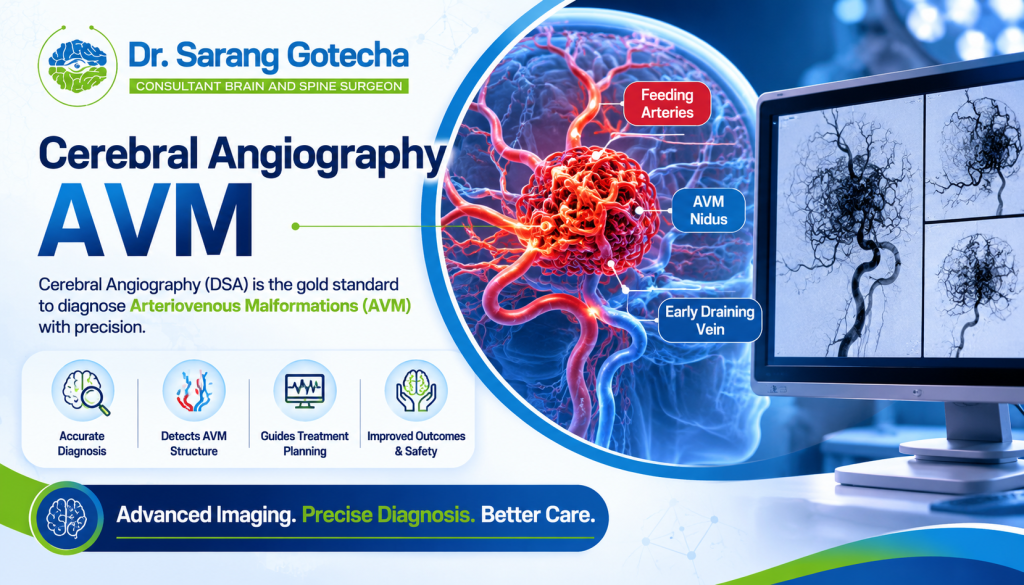
- Brain AVMs are tangles of abnormal arteries and veins that bypass the capillary bed — they carry a 2 to 4% annual rupture risk causing intracerebral haemorrhage.
- Unruptured aneurysms are managed with microsurgical clipping or endovascular coiling — the choice depends on aneurysm morphology, location and patient factors.
- Cerebrovascular surgery in Pune costs INR 3,50,000 to INR 10,00,000 depending on the specific condition and treatment approach.
- AVM resection in Pune has cure rates of 90 to 95% for Spetzler-Martin Grade 1 to 2 AVMs — with operative morbidity under 5% in experienced hands.
- Cerebral bypass surgery (EC-IC bypass) for moyamoya disease or complex aneurysms is one of the most technically demanding procedures in all of neurosurgery.
- Dr. Sarang Gotecha performs cerebrovascular surgery including aneurysm clipping, AVM resection and bypass procedures for patients across Pune and PCMC.
The brain is the most blood-dependent organ in the body, consuming 20% of total cardiac output through a network of arteries, capillaries and veins. When abnormalities develop in these vessels — an aneurysm bulging at an arterial wall, an AVM creating a dangerous short-circuit between arteries and veins, or a cavernous malformation slowly leaking blood — the consequences range from gradual neurological deterioration to catastrophic haemorrhage.
Cerebrovascular surgery is the neurosurgical subspecialty that addresses these conditions. This guide provides Pune patients and families with a clear overview of the main cerebrovascular conditions treated surgically, what the surgery involves, what the costs are and what outcomes are realistic.
QUICK FACTS
AVM Annual Rupture Risk: 2 to 4% per year (cumulative lifetime risk)
Aneurysm Clipping Cost Pune 2026: INR 4,00,000 to INR 8,00,000
AVM Resection Cost Pune 2026: INR 5,00,000 to INR 10,00,000
Cavernous Malformation Surgery Cost: INR 3,50,000 to INR 6,00,000
EC-IC Bypass Cost Pune: INR 5,00,000 to INR 9,00,000
AVM Cure Rate (Grade 1-2): 90 to 95% with complete resection
Cerebrovascular Condition Statistics in India 2025-2026
| Condition | Prevalence | Annual Bleed Risk | Surgical Cure Rate | Source |
| Cerebral aneurysm | 3 to 5% adults (unruptured) | 0.5 to 1% (small); higher for large | Over 98% occlusion (clipping) | Published literature |
| Brain AVM | ~0.1% population | 2 to 4% per year | 90 to 95% (Grade 1-2) | Published literature |
| Cavernous malformation | ~0.5% population | 0.5 to 3% per year | Over 95% (accessible) | Published literature |
| Moyamoya disease | Rare in India — increasing recognition | High stroke risk without treatment | Bypass significantly reduces stroke risk | Published literature |
| Dural AV fistula | Rare | Variable — cortical drainage high risk | 90%+ with surgery or embolisation | Published literature |
Brain Arteriovenous Malformations (AVMs)
A cerebral AVM is a tangle of abnormal blood vessels in which arteries connect directly to veins without the normal intervening capillary network. Arteries carry high-pressure blood; veins are not built to receive it. Over time, this abnormal high-pressure flow causes the AVM to enlarge, recruits more feeding vessels and progressively increases the risk of rupture.
AVMs are graded using the Spetzler-Martin scale (1 to 5) based on size, venous drainage pattern and proximity to eloquent brain. Grade 1 and 2 AVMs are small, accessible and offer excellent outcomes with surgery. Grade 4 and 5 AVMs carry significant operative risk from surgery alone — management involves a combination of radiosurgery, embolisation and sometimes staged resection.
AVM Treatment Options
Microsurgical resection is the only treatment that provides immediate cure — once the AVM nidus is completely removed, the rupture risk is eliminated. Endovascular embolisation reduces blood flow through the AVM before surgery but rarely cures it alone. Stereotactic radiosurgery (Gamma Knife) obliterates AVMs over 2 to 3 years, during which the rupture risk persists. Combined multimodal treatment (embolisation plus radiosurgery or embolisation plus surgery) is used for complex Grade 3 to 4 AVMs.
Cerebral Aneurysms: Clipping vs Coiling
As described in the February 2026 blog on headache and aneurysm, the two treatment options for cerebral aneurysms are microsurgical clipping and endovascular coiling. Clipping is performed through a craniotomy — a titanium clip is placed across the aneurysm neck to permanently exclude it from the circulation. It has the lower long-term recurrence rate (under 2% at 10 years). Coiling fills the aneurysm sac with platinum microcoils through a catheter-based approach — shorter recovery but higher recurrence (10 to 20% requiring repeat treatment at 10 years).
The ISAT trial (International Subarachnoid Aneurysm Trial) established that coiling has better short-term outcomes for patients with suitable anatomy after ruptured aneurysm. For unruptured aneurysms, wide-neck or fusiform morphology, and posterior circulation aneurysms accessible by surgery — clipping is frequently the preferred option. The decision is made by a cerebrovascular team after detailed angiographic analysis.
Cavernous Malformations
Cavernous malformations (cavernomas) are abnormal clusters of enlarged blood-filled spaces within the brain or spinal cord. Unlike AVMs, they have low blood flow — but they bleed repeatedly over time, with each bleed causing incremental neurological damage. The annual bleed rate is 0.5 to 3% per lesion. Surgery is indicated for symptomatic lesions — those that have bled and caused neurological deficits — particularly when accessible at the brain surface or within the spinal cord. Deep cavernomas near critical structures (brainstem, thalamus) are approached only when recurrent bleeding has made the neurological risk of further observation greater than the surgical risk.
Cerebral Bypass Surgery for Moyamoya and Complex Aneurysms
Extracranial-intracranial (EC-IC) bypass surgery reroutes blood supply to the brain by connecting an artery outside the skull (typically the superficial temporal artery) to an artery inside the skull (typically the middle cerebral artery). It is used for moyamoya disease (a progressive narrowing of the internal carotid arteries causing chronic ischaemia) and for complex aneurysms that cannot be clipped or coiled and require deliberate parent artery sacrifice with revascularisation.
EC-IC bypass is one of the most technically demanding procedures in neurosurgery. It requires suturing vessels 1 to 2 mm in diameter under microscopic magnification, with intraoperative Doppler confirmation of bypass patency. Intraoperative indocyanine green (ICG) angiography confirms flow through the bypass before closure. The procedure takes 4 to 7 hours and requires a neurosurgeon with specific microsurgical vascular training.
Cerebrovascular Surgery Cost in Pune 2026
| Procedure | Cost Range (INR) | Hospital Stay | Key Cost Driver |
| Aneurysm clipping (unruptured) | 4,00,000 to 7,00,000 | 5 to 8 days | Craniotomy, ICU, neuronavigation |
| Aneurysm clipping (ruptured SAH) | 5,00,000 to 9,00,000 | 10 to 21 days | Prolonged ICU, vasospasm management |
| AVM resection (Grade 1-2) | 5,00,000 to 8,00,000 | 7 to 10 days | IONM, embolisation if pre-op |
| AVM resection (Grade 3-4) | 7,00,000 to 12,00,000 | 10 to 14 days | Multi-stage, combined modality |
| Cavernoma resection (cortical) | 3,50,000 to 6,00,000 | 5 to 8 days | Standard craniotomy with IONM |
| EC-IC bypass surgery | 5,00,000 to 9,00,000 | 7 to 10 days | Microsurgical technique, ICG angio |
| Endovascular coiling | 3,00,000 to 6,00,000 | 3 to 5 days | Coil hardware, angio suite |
Cerebrovascular Surgery in Pune and PCMC
Dr. Sarang Gotecha’s WFNS fellowship from National Neuroscience Institute, Singapore included training in cerebrovascular surgery. He performs aneurysm clipping, AVM resection and cavernoma surgery for patients across Pune and PCMC. For complex conditions requiring multidisciplinary management — large AVMs needing combined embolisation and surgery, moyamoya requiring bypass — he works within a collaborative framework with endovascular and neurointervention specialists.
For patients in Baner, Wakad, Thergaon and PCMC with a cerebrovascular diagnosis, an expert consultation before committing to any treatment pathway is essential. Book at drsaranggotecha.com.
FAQ
A brain aneurysm is a balloon-like bulge in the wall of a single brain artery, caused by wall weakness. An AVM (arteriovenous malformation) is a tangle of abnormal blood vessels where arteries connect directly to veins without normal capillaries, creating a high-pressure short-circuit. Aneurysms rupture suddenly with catastrophic haemorrhage. AVMs bleed more slowly (intracerebral haemorrhage) with a 2 to 4% annual rupture risk. Both require cerebrovascular surgical expertise.
AVM resection cost in Pune in 2026 ranges from INR 5,00,000 to INR 8,00,000 for Grade 1 to 2 AVMs and INR 7,00,000 to INR 12,00,000 for complex Grade 3 to 4 AVMs requiring combined modality treatment. Costs include surgeon, anaesthesia, IONM, pre-operative embolisation if required, ICU stay and hospital ward stay. The complexity and grade of the AVM are the primary cost drivers.
Both are effective treatments with different risk-benefit profiles. Clipping (open surgery) has lower long-term recurrence (under 2% at 10 years) but is a more invasive procedure. Coiling (endovascular) has faster recovery and lower short-term risk but higher recurrence requiring repeat treatment (10 to 20% at 10 years). The best choice depends on aneurysm location, morphology, patient age and the cerebrovascular team’s recommendation after angiographic analysis.
EC-IC (extracranial-intracranial) bypass surgery connects an artery outside the skull to one inside the skull to improve brain blood supply. It is used for moyamoya disease (progressive internal carotid artery narrowing causing brain ischaemia) and for complex aneurysms requiring parent artery sacrifice. It is one of neurosurgery’s most technically demanding procedures and requires a neurosurgeon with specific microsurgical vascular training.
Cerebral aneurysms have a genetic component — first-degree relatives of aneurysm patients have 3 to 7 times the population risk. Patients with polycystic kidney disease and connective tissue disorders (Ehlers-Danlos syndrome, Marfan syndrome) also carry higher aneurysm risk. Moyamoya disease has genetic factors particularly in East Asian populations. If you have a first-degree relative with a brain aneurysm, screening MRI angiography is worth discussing with a neurosurgeon.
Yes. Dr. Sarang Gotecha performs cerebrovascular surgery including microsurgical aneurysm clipping, AVM resection and cavernoma surgery as part of his neurosurgical practice in Pune. His international training at National Neuroscience Institute, Singapore encompasses cerebrovascular techniques. Patients from Pune, Baner, Wakad, Thergaon and PCMC can book a cerebrovascular consultation at drsaranggotecha.com.
Cerebrovascular surgery in Pune in 2026 covers a broad spectrum: aneurysm clipping, AVM resection, cavernoma surgery and cerebral bypass. Each condition has a clear surgical indication, a defined procedure, realistic outcome data and knowable costs. For patients in Pune and PCMC with a cerebrovascular diagnosis, expert consultation before any treatment decision is the essential first step.

Dr. Sarang Gotecha
Dr. Sarang Gotecha is a leading brain & spine surgeon in Pune, offering advanced care for complex neurological and spinal conditions. With strong academic credentials (MBBS, MS, MCh Neurosurgery) and years of surgical experience, he is committed to delivering precise, safe, and patient-focused treatments.
- Expert in brain tumor, spine & neuroendoscopic surgeries
- Specialized in minimally invasive & skull base surgeries
- Follows an ethical and patient-centric approach
- Available at clinics in Baner, Wakad, and Thergaon (Pune)