
KEY TAKEAWAYS
- Cervical spondylosis is age-related degeneration of the cervical spine disc desiccation, osteophyte formation, facet arthritis and ligamentum flavum hypertrophy that narrows the cervical spinal canal and compresses the cord or nerve roots.
- Surgery is indicated when spondylosis causes cervical myelopathy (cord compression with neurological deficits) or refractory cervical radiculopathy not responding to conservative management.
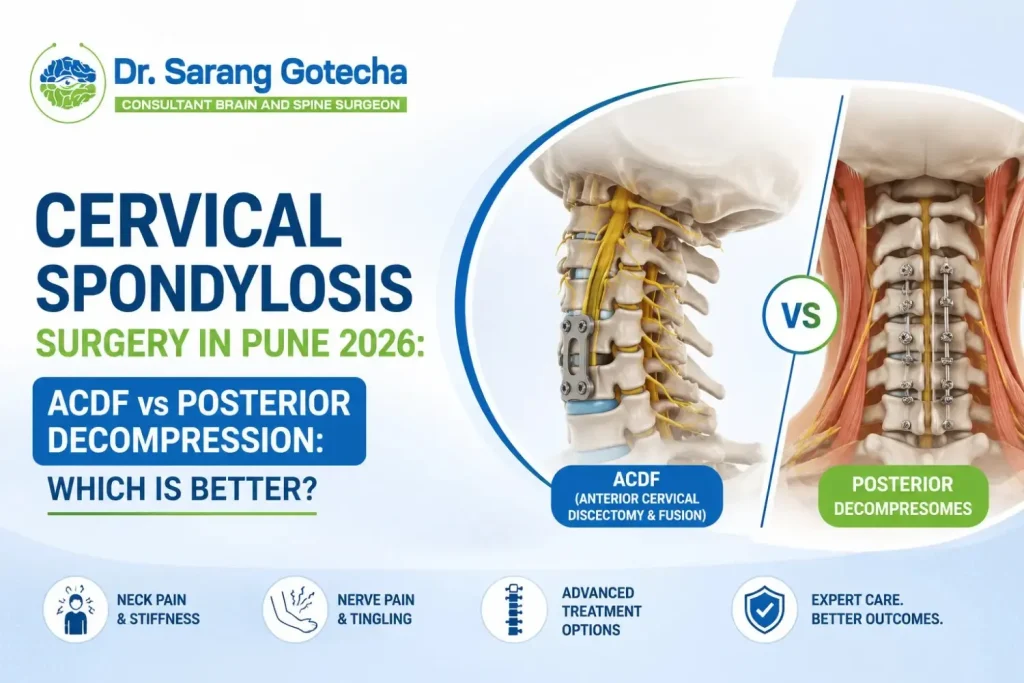
- ACDF (Anterior Cervical Discectomy and Fusion) approaches from the front of the neck best for 1 to 3 level anterior compression from disc-osteophyte complexes.
- Posterior decompression laminectomy or laminoplasty approaches from the back of the neck best for multi-level compression, congenitally narrow canals and when the cord is compressed from behind.
- ACDF cost in Pune 2026 ranges from INR 2,50,000 to INR 4,50,000 per level; posterior laminoplasty for 3 to 5 levels costs INR 3,00,000 to INR 5,50,000.
- Surgery for cervical myelopathy prevents progression in over 80% of patients and improves function in 60 to 70% outcomes are best when surgery is performed before irreversible cord signal change develops.
- Dr. Sarang Gotecha performs both ACDF and posterior cervical decompression for patients across Pune, Baner, Wakad, Thergaon and PCMC.
Cervical spondylosis is so common in adults over 50 that it is almost universal on MRI a radiological diagnosis that rarely causes clinical concern. But when cervical spondylosis progresses to the point of compressing the spinal cord, it becomes one of the most insidious and disabling conditions in neurosurgical practice.
The decision between ACDF and posterior decompression is one that confuses patients and sometimes even the clinicians who refer them for surgery. This guide provides a clear, anatomy-based framework for understanding which approach is appropriate for which patient and what each operation involves, costs and delivers.
QUICK FACTS
Most Common Surgical Indication: Cervical spondylotic myelopathy (cord compression)
ACDF Cost per Level Pune 2026: INR 2,50,000 to INR 4,50,000
Posterior Laminoplasty Cost Pune 2026: INR 3,00,000 to INR 5,50,000 (3 to 5 levels)
Myelopathy Arrest Rate: Over 80% with timely surgery
Hospital Stay (ACDF): 2 to 3 days
Hospital Stay (Posterior): 3 to 5 days
Cervical Spondylosis Surgery Statistics in Pune 2025-2026
| Metric | Data Point | Source |
| Prevalence of cervical spondylosis over 50 | Over 90% show radiological changes | Published literature |
| Cervical myelopathy surgical cases in Pune annually | ~800 to 1,200 (Industry estimate) | Industry estimate |
| Surgery arresting myelopathy progression | Over 80% | Published literature |
| Surgery improving myelopathy symptoms | 60 to 70% | Published literature |
| ACDF fusion rate at 1 year | Over 95% | Published literature |
| Laminoplasty motion preservation | Yes — no fusion required | Published literature |
| Surgery cost range in Pune 2026 | 2,50,000 to 5,50,000 INR | Industry estimate |
What Is Cervical Spondylosis and When Does It Need Surgery?
Cervical spondylosis is the umbrella term for age-related degenerative changes in the cervical spine. Starting in the fourth decade, cervical discs lose water content, collapse in height, and develop posterior osteophytes (bone spurs) that project into the spinal canal. The uncovertebral joints and facet joints hypertrophy. The ligamentum flavum buckles and thickens. Over decades, the combination of these changes progressively narrows the cervical spinal canal.
In most adults, these changes cause only neck pain and stiffness. Surgery is not required. In a proportion those with a congenitally narrow cervical canal, rapidly progressing degeneration or specific anatomical compression patterns the changes compress the cervical spinal cord (myelopathy) or nerve roots (radiculopathy) to a degree requiring surgical decompression.
Cervical Myelopathy: The Primary Surgical Indication
Cervical spondylotic myelopathy (CSM) develops when the compressed spinal cord can no longer conduct motor and sensory signals normally. Symptoms develop insidiously: clumsy hands (difficulty with fine motor tasks writing, buttoning, chopsticks), stiff or spastic gait (the classic Romberg sign of myelopathy unsteady on a narrow base), bilateral hand tingling, urinary urgency and, in advanced cases, lower limb weakness. Many patients attribute these changes to normal ageing for years before the diagnosis is made.
MRI showing cervical cord signal change (T2 hyperintensity) indicates established intramedullary cord damage. Surgery at this stage still prevents further progression in over 80% of patients, but functional recovery is less complete than surgery performed before cord signal change develops. Every year of delay in symptomatic CSM increases the risk of irreversible cord damage.
ACDF – Anterior Cervical Discectomy and Fusion
What ACDF Involves
ACDF approaches the cervical spine through a small incision (3 to 4 cm) on the front of the neck, working between the natural tissue planes to reach the disc space. The disc is completely removed along with the posterior osteophytes that are compressing the cord or nerve root. A titanium cage packed with bone graft is placed in the disc space to maintain height and promote fusion. An anterior cervical plate is fixed with screws above and below to stabilise the construct during fusion.
The procedure takes 60 to 90 minutes per level. Hospital stay is 2 to 3 days. There is no back-of-neck wound. A soft cervical collar is worn for 1 to 2 weeks for comfort. Return to desk work is 3 to 5 weeks. Fusion is confirmed on CT or X-ray at 3 to 6 months.
When ACDF Is the Right Choice
ACDF is the preferred approach when: compression is predominantly anterior (from disc-osteophyte complex projecting backward into the canal), 1 to 3 levels are involved, the patient has good cervical lordosis (the natural inward curve), and the goal is direct decompression of a specific nerve root or cord segment. It is the gold standard for single-level radiculopathy and 1 to 2 level myelopathy from anterior disc-osteophyte disease.
Limitations of ACDF
ACDF fuses the operated levels motion at those segments is permanently eliminated. Adjacent-level disease (breakdown of the disc above and below the fusion) occurs in 10 to 15% of patients over 10 years as the adjacent levels bear increased mechanical stress. For patients needing 4 or more level ACDF, the surgery becomes longer and more complex and the risk of pseudarthrosis (failure of fusion) increases. Multi-level ACDF also risks dysphagia (difficulty swallowing) from anterior retraction, particularly in the immediate post-operative period.
Posterior Cervical Decompression: Laminectomy and Laminoplasty
Laminoplasty : The Motion-Preserving Posterior Approach
Laminoplasty expands the cervical spinal canal from behind without removing the laminae permanently. The neurosurgeon cuts one side of each lamina completely and the other side partially (‘open door’ technique), then hinges the laminae open like a door to create a larger canal. Mini-plates or sutures hold the opened laminae in their expanded position. The spinal cord has more space immediately — without any fusion, without any bone graft and with preservation of cervical motion.
Laminoplasty is the preferred posterior approach for multi-level cervical spondylotic myelopathy (3 to 5 levels) where posterior compression from buckled ligamentum flavum and hypertrophied facets is the dominant mechanism. It preserves cervical motion patients can continue to turn their heads and avoids adjacent-level disease risk.
Laminectomy : The Older Posterior Approach
Traditional laminectomy removes the laminae entirely to decompress the cord. It is highly effective but has one significant limitation: without the supporting posterior structures, the cervical spine can develop kyphotic deformity (forward bending) over time ‘laminectomy kyphosis’ which can actually worsen cord compression by stretching it over the kyphotic angle. For this reason, laminoplasty has largely replaced laminectomy as the standard posterior approach for CSM in adults with preserved lordosis.
Laminectomy with fusion (posterior cervical fusion) combines posterior decompression with lateral mass screws and rods to stabilise the spine used when pre-existing kyphosis or instability is present. It is the most comprehensive posterior approach but also the most complex, with the longest hospital stay (4 to 6 days) and recovery.
ACDF vs Posterior Decompression: The Decision Framework
| Factor | ACDF (Anterior) | Laminoplasty (Posterior) | Laminectomy + Fusion (Posterior) |
| Number of levels | 1 to 3 levels | 3 to 5 levels | Any — with instability or kyphosis |
| Compression direction | Anterior (disc-osteophyte) | Posterior (ligament, facets) | Mixed or with instability |
| Cervical alignment | Normal lordosis | Normal lordosis required | Kyphosis — corrected with fusion |
| Motion preservation | No — fused | Yes — motion preserved | No — fused |
| Adjacent level disease | 10 to 15% at 10 years | Reduced risk | Applies to fused levels |
| Hospital stay | 2 to 3 days | 3 to 4 days | 4 to 6 days |
| Return to desk work | 3 to 5 weeks | 4 to 6 weeks | 6 to 8 weeks |
| Cost in Pune (INR) | 2,50,000 to 4,50,000 (1-2 level) | 3,00,000 to 5,50,000 | 3,50,000 to 6,00,000 |
| Best for | 1 to 3 level ant. compression, radiculopathy | Multi-level CSM, lordosis preserved | CSM with kyphosis or instability |
Pre-Operative Preparation and Post-Operative Care
Pre-operative workup for cervical spondylosis surgery includes: cervical MRI within 3 months (confirms compression level and cord signal), cervical X-rays in flexion and extension (assesses dynamic instability), CT cervical spine (for bony anatomy and osteophyte mapping), nerve conduction studies if peripheral neuropathy is in the differential, and anaesthesia fitness assessment.
After ACDF, the most common post-operative complaints are: throat soreness and mild dysphagia from anterior retraction (typically resolves within 1 to 2 weeks), neck stiffness from the soft collar and incisional discomfort. After laminoplasty, neck stiffness is more pronounced and may persist for 4 to 8 weeks as the posterior muscles recover. Cervical physiotherapy is initiated at 3 to 4 weeks post-surgery for both approaches.
| Recovery Milestone | ACDF (1 to 2 level) | Laminoplasty (3 to 5 level) |
| Hospital discharge | Day 2 to 3 | Day 3 to 4 |
| Soft collar (comfort) | 1 to 2 weeks | 2 to 4 weeks |
| Return to desk work | 3 to 5 weeks | 4 to 6 weeks |
| Driving | 4 to 6 weeks | 5 to 7 weeks |
| Fusion confirmed (ACDF) | 3 to 6 months (CT/X-ray) | Not applicable |
| Physiotherapy | Week 3 to 4 | Week 3 to 5 |
| Neurological improvement | Months 2 to 12 | Months 2 to 12 |
| Full activity | 3 to 4 months | 3 to 4 months |
Cervical Spondylosis Surgery in Pune and PCMC
Cervical spondylosis surgery both ACDF and posterior laminoplasty is available at hospitals in the Baner-Wakad corridor serving PCMC patients. Dr. Sarang Gotecha performs both anterior and posterior cervical approaches and makes the surgical decision based on imaging anatomy, number of levels, alignment and clinical presentation rather than a default preference for one approach.
A 58-year-old retired engineer from Aundh presented with a 2-year history of hand clumsiness, gait unsteadiness and bilateral hand tingling. MRI showed 4-level cervical cord compression (C3-C7) with cord signal change at C4-C5. Posterior laminoplasty (C3-C7) was performed. At 6 months, gait had normalised and hand function improved significantly he returned to driving and resumed his hobby of technical drawing. Cord signal change remained on MRI but did not progress.
For ACDF or laminoplasty consultation, imaging review and surgical planning, book your appointment with Dr. Sarang Gotecha.
Frequently Asked Questions
Q: What is the difference between ACDF and posterior decompression for cervical spondylosis?
A: ACDF approaches the cervical spine from the front of the neck, removes the disc and osteophytes directly and fuses the operated levels with a cage and plate. It is best for 1 to 3 level anterior compression. Posterior decompression laminoplasty or laminectomy approaches from behind the neck, expanding the canal by hinging the laminae open (laminoplasty) or removing them (laminectomy). It is best for multi-level compression and preserves motion (laminoplasty). The choice depends on the number of levels, compression direction and cervical alignment.
Q: How do I know if I need ACDF or posterior decompression in Pune?
A: The decision is based on three factors: number of levels requiring decompression (1 to 3 favour ACDF; 3 to 5 favour laminoplasty), direction of compression on MRI (anterior disc-osteophyte favours ACDF; posterior ligamentum flavum and facet hypertrophy favour laminoplasty) and cervical alignment (lordosis supports either approach; kyphosis may require ACDF or posterior fusion with correction). Your neurosurgeon should review your MRI and X-rays together before recommending one approach.
Q: What is the cost of cervical spondylosis surgery in Pune in 2026?
A: ACDF costs approximately INR 2,50,000 to INR 4,50,000 for single to two-level procedures in Pune, all-inclusive. Posterior laminoplasty for 3 to 5 levels costs INR 3,00,000 to INR 5,50,000. Posterior laminectomy with fusion costs INR 3,50,000 to INR 6,00,000. Costs include surgeon, anaesthesia, 2 to 5 days hospital stay, implants (cage, plate, mini-plates) and post-operative medications.
Q: Does cervical spondylosis surgery fix myelopathy?
A: Surgery for cervical myelopathy arrests progression in over 80% of patients and improves symptoms in 60 to 70%. The best outcomes occur when surgery is performed before irreversible cord signal change develops on MRI. Cord signal change (T2 hyperintensity) indicates established cord damage decompression prevents further deterioration but may not fully reverse existing deficits. This is why early surgical referral for progressive myelopathy is strongly recommended.
Q: Is laminoplasty better than ACDF for multi-level cervical spondylosis?
A: For multi-level cervical spondylotic myelopathy (3 to 5 levels) with preserved cervical lordosis and predominantly posterior compression, laminoplasty is generally preferred over multi-level ACDF. Laminoplasty preserves motion, avoids the risk of multi-level fusion failure and eliminates adjacent-level disease risk. Multi-level ACDF has higher pseudarthrosis rates, longer surgery and greater anterior retraction risk for 4+ levels. For 1 to 2 level predominantly anterior disease, ACDF remains the gold standard.
Q: Is cervical spondylosis surgery covered under health insurance in Pune?
A: Yes. ACDF, laminoplasty and laminectomy for cervical spondylosis are covered under most comprehensive private health insurance policies in India when myelopathy or refractory radiculopathy is documented. Pre-authorisation with MRI reports, clinical documentation of symptoms and the surgeon’s operative plan is required. Implant costs (cage, plate, laminoplasty mini-plates) are covered subject to your policy’s implant sub-limit.
Cervical spondylosis surgery in Pune in 2026 offers patients with myelopathy and radiculopathy a clear pathway to halting deterioration and recovering function. ACDF is right for anterior single to three-level disease. Laminoplasty is right for multi-level posterior-dominant compression with preserved lordosis. The anatomy on your MRI determines the approach not the surgeon’s default preference.
For cervical spondylosis surgical consultation, MRI review and approach selection in Pune and PCMC, book your appointment with Dr. Sarang Gotecha.
Medical Disclaimer
This article is for general informational purposes only and does not constitute medical advice. It is not a substitute for professional medical consultation, diagnosis or treatment. Always consult a qualified neurosurgeon for any medical concern. Individual outcomes, costs and recovery timelines vary. Dr. Sarang Gotecha and Edgelink Technology Pvt Ltd accept no liability for decisions made solely based on this content.

Dr. Sarang Gotecha
Dr. Sarang Gotecha is a leading brain & spine surgeon in Pune, offering advanced care for complex neurological and spinal conditions. With strong academic credentials (MBBS, MS, MCh Neurosurgery) and years of surgical experience, he is committed to delivering precise, safe, and patient-focused treatments.
- Expert in brain tumor, spine & neuroendoscopic surgeries
- Specialized in minimally invasive & skull base surgeries
- Follows an ethical and patient-centric approach
- Available at clinics in Baner, Wakad, and Thergaon (Pune)