
KEY TAKEAWAYS
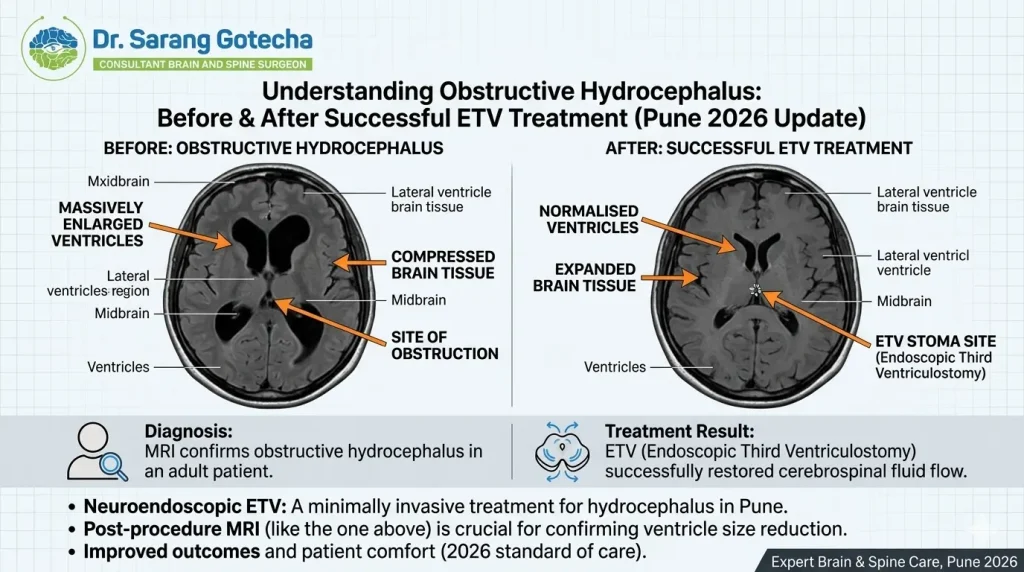
- Hydrocephalus is the abnormal accumulation of cerebrospinal fluid (CSF) in the brain’s ventricles, causing them to enlarge and compress the surrounding brain tissue.
- Two main treatments exist: ETV (Endoscopic Third Ventriculostomy) — a neuroendoscopic procedure that creates a natural CSF bypass — and VP shunt insertion, which drains CSF through a permanent silicone tube to the abdomen.
- ETV is preferred for obstructive hydrocephalus because it avoids permanent implant hardware and its lifetime complications of malfunction and infection.
- ETV success rate for obstructive hydrocephalus in adults is 60 to 80% — with failure most common in communicating hydrocephalus where shunt is more appropriate.
- ETV cost in Pune is INR 1,80,000 to INR 3,50,000; VP shunt insertion costs INR 1,50,000 to INR 3,00,000 plus shunt hardware costs.
- Normal pressure hydrocephalus (NPH) — the triad of gait disturbance, dementia and urinary incontinence in older adults — is treated with VP shunt with significant functional improvement in 60 to 80% of well-selected patients.
- Dr. Sarang Gotecha performs ETV and VP shunt procedures for adult hydrocephalus patients from Pune, Baner, Wakad, Thergaon and PCMC.
Hydrocephalus is not just a childhood condition. In adults, it develops from a range of causes — aqueduct stenosis, brain tumors obstructing CSF pathways, subarachnoid haemorrhage scarring the absorption surfaces, meningitis and the idiopathic form known as normal pressure hydrocephalus that commonly affects adults over 60. The symptoms are as varied as the causes: headache, gait disturbance, cognitive slowing, bladder urgency and in acute cases, rapid neurological deterioration.
The treatment decision — ETV versus VP shunt — is one of the most consequential choices in adult neurosurgery. Getting it right means decades of complication-free functioning. Getting it wrong means hardware failures, revision surgeries and progressive neurological decline. This guide gives Pune patients the information to understand the distinction and ask the right questions.
QUICK FACTS
ETV Success Rate (Obstructive Hydrocephalus): 60 to 80% in adults
ETV Cost Pune 2026: INR 1,80,000 to INR 3,50,000
VP Shunt Cost Pune 2026: INR 1,50,000 to INR 3,00,000 + shunt hardware
VP Shunt 10-Year Revision Rate: 25 to 40% need at least one revision
NPH Shunt Response Rate: 60 to 80% improve with correct patient selection
Hospital Stay (ETV or Shunt): 2 to 4 days
Hydrocephalus Statistics in India 2025-2026
| Metric | Data Point | Source |
| Annual adult hydrocephalus cases in India | ~30,000 to 50,000 (Industry estimate) | Industry estimate |
| Obstructive hydrocephalus proportion | ~40 to 50% | Published literature |
| Normal pressure hydrocephalus (NPH) proportion | ~20 to 30% of adult hydrocephalus | Published literature |
| Post-SAH communicating hydrocephalus | ~15 to 20% | Published literature |
| ETV success rate — aqueduct stenosis | 70 to 80% | Published literature |
| VP shunt 10-year revision rate | 25 to 40% | Published literature |
| NPH shunt improvement rate | 60 to 80% (well-selected patients) | Published literature |
Understanding Hydrocephalus: Types and Causes in Adults
Obstructive (Non-Communicating) Hydrocephalus
Obstruction within the CSF pathway — typically at the aqueduct of Sylvius connecting the third and fourth ventricles — prevents CSF from flowing from where it is produced (choroid plexus in the lateral ventricles) to where it is absorbed (subarachnoid space). The lateral and third ventricles enlarge while the fourth ventricle and subarachnoid space remain normal. Causes in adults include: aqueduct stenosis (idiopathic or inflammatory scarring), tectal plate tumors (pineal region tumors, tectal gliomas), posterior fossa tumors and intraventricular tumors (colloid cysts, ependymomas).
Obstructive hydrocephalus is the indication where ETV works best — it bypasses the obstruction by creating a new opening directly in the floor of the third ventricle, allowing CSF to bypass the blocked aqueduct and reach the subarachnoid space naturally.
Communicating Hydrocephalus
In communicating hydrocephalus, CSF flows freely through all ventricles but is not adequately absorbed at the subarachnoid granulations. The entire ventricular system enlarges. Causes include post-subarachnoid haemorrhage scarring of the arachnoid granulations, post-meningitis adhesions, leptomeningeal carcinomatosis and idiopathic causes. ETV is less effective here because the problem is not obstruction but impaired absorption. VP shunt is the primary treatment.
Normal Pressure Hydrocephalus (NPH)
NPH is an idiopathic communicating hydrocephalus of older adults characterised by the classic clinical triad: magnetic gait (a shuffling, wide-based, small-step gait — patients look as though their feet are stuck to the floor), progressive cognitive impairment and urinary urgency or incontinence. MRI shows enlarged ventricles with relatively preserved cortical sulci — the key imaging distinction from atrophic dementia where sulci are also enlarged.
The high-volume CSF tap test (removing 30 to 50 ml of CSF via lumbar puncture and assessing gait improvement over 24 hours) is the standard pre-surgical screening tool. Patients who improve after the tap test have a 60 to 80% chance of sustained benefit from VP shunt insertion. The gait component responds best — cognitive improvement occurs in 50 to 60% and urinary symptoms in 40 to 50%.
ETV — The Procedure and Its Advantages
ETV is performed through a single frontal burr hole under general anaesthesia. The neuroendoscope is passed through the burr hole, into the lateral ventricle, through the foramen of Monro and into the third ventricle. Using endoscopic scissors or a balloon catheter, the neurosurgeon creates a 3 to 5 mm fenestration in the floor of the third ventricle — just anterior to the basilar artery, which is visible through the translucent ventricular floor. CSF can now flow from the third ventricle directly into the subarachnoid space, bypassing the obstructed aqueduct.
The procedure takes 45 to 90 minutes. Hospital stay is 2 to 4 days. There is no permanent implant — no hardware that can malfunction, become infected or require revision over the patient’s lifetime. For obstructive hydrocephalus in adults, this is a compelling advantage over VP shunt, which requires lifelong hardware management.
Predictors of ETV Success
ETV works best when: the patient is an adult (better than paediatric outcomes), the cause is obstructive (not communicating), the obstruction is at the aqueduct or posterior fossa level, and the patient has not had prior shunt surgery. The ETV Success Score (ETVSS) provides a numerical probability of success based on age, aetiology and prior shunt surgery — values over 80% suggest ETV is the right first choice.
VP Shunt: When It Is the Right Choice
VP shunt remains the appropriate treatment when: ETV has failed or is predicted to have low success probability (communicating hydrocephalus, prior shunted patients), the patient has NPH (communicating — ETV ineffective), post-haemorrhagic or post-infectious hydrocephalus (damaged arachnoid granulations cannot be bypassed by ETV) or paediatric hydrocephalus with complex aetiology where ETV success rates are lower.
Modern programmable shunt valves allow the drainage pressure to be adjusted non-invasively using an external magnet — this reduces over-drainage (a major cause of complications) and allows CSF pressure optimisation without repeat surgery. Programmable valves cost more than fixed-pressure valves (INR 30,000 to INR 80,000 vs INR 8,000 to INR 20,000) but reduce revision surgery rates significantly.
ETV vs VP Shunt: The Decision Framework for Pune Patients
| Factor | ETV | VP Shunt |
| Best indication | Obstructive hydrocephalus | Communicating, NPH, post-SAH, post-infective |
| Permanent implant | None | Silicone catheter + valve system |
| Success rate (obstructive, adults) | 60 to 80% | 85 to 90% initially |
| 10-year revision rate | Lower — no hardware | 25 to 40% |
| Infection risk | Under 1% | 3 to 5% |
| Cost in Pune 2026 (INR) | 1,80,000 to 3,50,000 | 1,50,000 to 3,00,000 + shunt 8,000 to 80,000 |
| Hospital stay | 2 to 4 days | 2 to 4 days |
| Re-do if failed | VP shunt as backup | Shunt revision or ETV conversion |
| NPH treatment | Not effective | Primary treatment of choice |
Hydrocephalus Treatment in Pune and PCMC
A 67-year-old retired civil servant from Thergaon presented with an 18-month history of progressive shuffling gait, mild memory lapses and urinary urgency. His family had attributed the changes to ageing. MRI showed significantly enlarged ventricles with preserved cortical sulci — classic NPH pattern. High-volume tap test at a Pune hospital showed marked gait improvement at 4 hours post-tap. VP shunt with a programmable valve was inserted. At 3-month follow-up his gait had normalised, urinary urgency had largely resolved and his family reported meaningful cognitive improvement. This outcome is representative of well-selected NPH patients.
Dr. Sarang Gotecha performs ETV and VP shunt procedures for adult hydrocephalus from across Pune and PCMC. He uses the ETVSS to guide ETV versus shunt selection and programmable valves for all adult VP shunts.
We’re Here to Help You on Your Healing Journey
Have questions or need to book an appointment? Reach out to us — we’ll be happy to assist you.
Frequently Asked Questions
Q: What is the difference between ETV and VP shunt for hydrocephalus?
ETV (Endoscopic Third Ventriculostomy) creates a natural CSF bypass through the floor of the third ventricle using a neuroendoscope through a small burr hole — no permanent implant is needed. VP shunt inserts a permanent silicone tube from the brain ventricle to the abdomen to drain excess CSF. ETV is preferred for obstructive hydrocephalus; VP shunt is used for communicating hydrocephalus and NPH where ETV is ineffective.
Q: What is normal pressure hydrocephalus and can it be treated in Pune?
Normal pressure hydrocephalus (NPH) is a condition of older adults characterised by the triad of shuffling gait, cognitive decline and urinary urgency. Despite its name, ventricular pressure is intermittently elevated. It is treated with VP shunt insertion, which improves gait in 60 to 80% of well-selected patients. The tap test — removing 30 to 50 ml of CSF and observing for gait improvement — is the key pre-surgical screening tool. NPH treatment including VP shunt surgery is available in Pune and PCMC.
Q: What is the cost of hydrocephalus treatment in Pune in 2026?
ETV for obstructive hydrocephalus costs INR 1,80,000 to INR 3,50,000 all-inclusive in Pune. VP shunt insertion costs INR 1,50,000 to INR 3,00,000 plus shunt hardware (INR 8,000 to INR 80,000 depending on valve type). Programmable shunt valves cost more but reduce long-term revision surgery rates. Both procedures involve 2 to 4 days of hospital stay.
Q: What happens if ETV fails for hydrocephalus?
ETV failure — return of hydrocephalus symptoms after initially successful ventriculostomy — occurs in approximately 20 to 40% of patients over 5 years as the stoma (opening) may close. When ETV fails, VP shunt insertion is the standard backup treatment. The failure is managed as an elective procedure in most cases — only rapid deterioration with acute hydrocephalus requires emergency shunt insertion.
Q: Is hydrocephalus treatment covered under health insurance in India?
A: Yes. Both ETV and VP shunt insertion are covered under most comprehensive private health insurance policies in India. Pre-authorisation with brain MRI documentation and the surgeon’s operative plan is required before admission. Ayushman Bharat PM-JAY covers both procedures at empanelled hospitals. The shunt hardware cost (valve and catheter) is typically covered under the implant provision of the insurance policy — check your policy’s implant sub-limit.
Q: Does Dr. Sarang Gotecha treat adult hydrocephalus in Pune?
A: Yes. Dr. Sarang Gotecha performs ETV and VP shunt procedures for adult hydrocephalus including obstructive hydrocephalus, post-SAH communicating hydrocephalus and normal pressure hydrocephalus. He uses the ETV Success Score to guide procedure selection and programmable valves for VP shunt cases. Patients from Pune, Baner, Wakad, Thergaon and PCMC can book a consultation at drsaranggotecha.com.
Hydrocephalus in adults is a manageable condition when correctly diagnosed and treated with the appropriate procedure. ETV offers obstructive hydrocephalus patients a durable, hardware-free treatment. VP shunt with programmable valves effectively treats communicating hydrocephalus, NPH and post-haemorrhagic hydrocephalus. The right choice between them determines decades of quality life.
For hydrocephalus assessment, imaging review and ETV or VP shunt consultation in Pune and PCMC, book with Dr. Sarang Gotecha at drsaranggotecha.com.
See Our the more services provided by the Dr. Sarang Gotecha.with 100% results

Dr. Sarang Gotecha
Dr. Sarang Gotecha is a leading brain & spine surgeon in Pune, offering advanced care for complex neurological and spinal conditions. With strong academic credentials (MBBS, MS, MCh Neurosurgery) and years of surgical experience, he is committed to delivering precise, safe, and patient-focused treatments.
- Expert in brain tumor, spine & neuroendoscopic surgeries
- Specialized in minimally invasive & skull base surgeries
- Follows an ethical and patient-centric approach
- Available at clinics in Baner, Wakad, and Thergaon (Pune)